

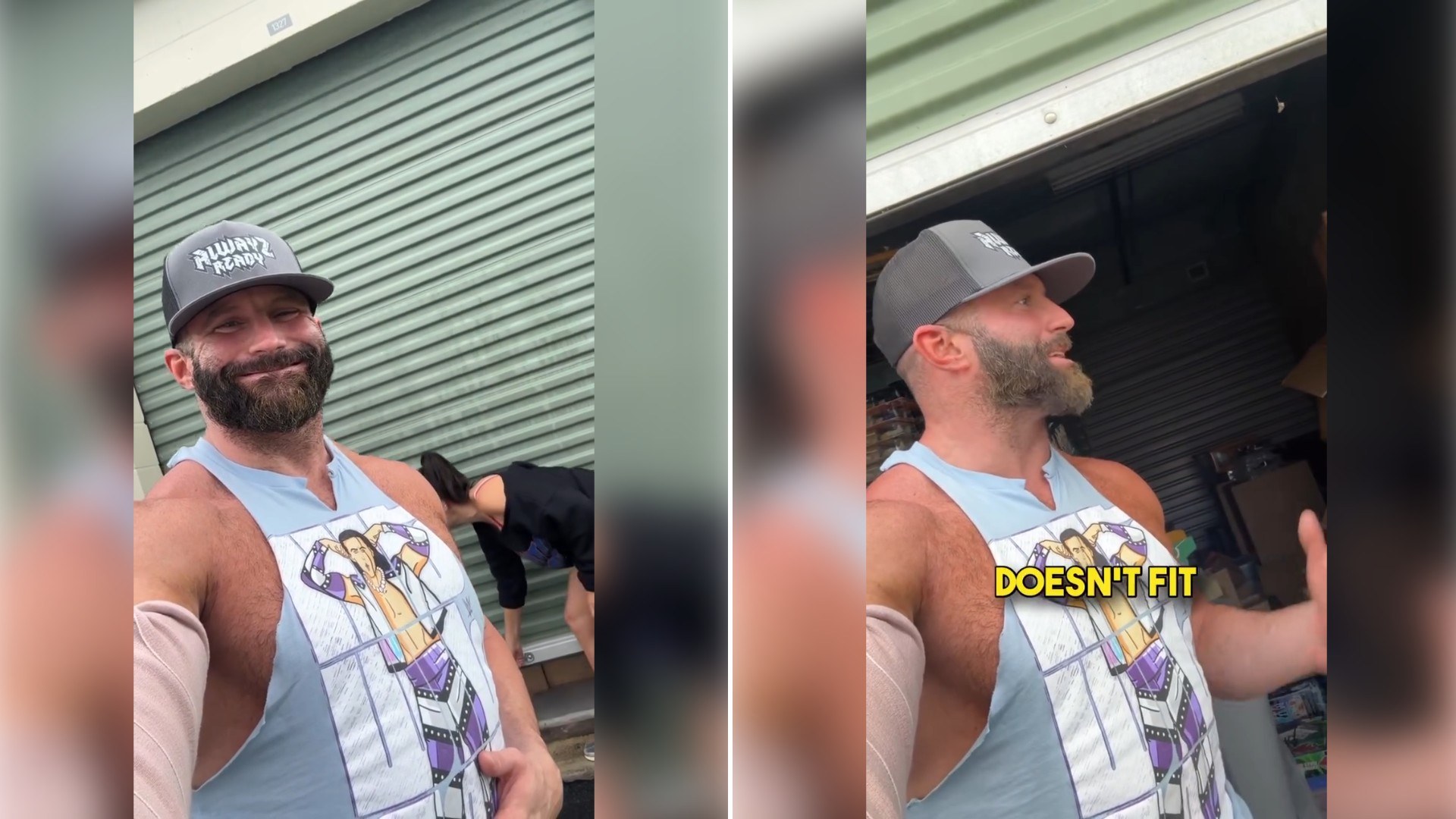
Every serious collector eventually has to answer to someone about how much space their hobby is taking up, and for @themattcardona, that someone is his wife, professional wrestler Chelsea Green. In a video filmed opening up a storage unit packed with years of accumulated wrestling memorabilia, the two go back and forth in a good-natured debate over whether the collection has crossed the line from dedicated hobby into genuine hoarding.
Rather than staging a tidy showcase, the video leans into the back-and-forth itself, item after item prompting a fresh round of the same friendly argument. It plays less like a memorabilia reveal and more like a familiar domestic dynamic many couples will recognize, one partner’s lifelong hobby colliding gently with the other’s sense of how much stuff one storage unit can reasonably hold.
Wrestling memorabilia collecting carries a specific intensity within the broader collectibles world, built up over years in the business by people who have often worked inside the industry themselves, accumulating everything from signed merchandise to props and personal items tied to a career rather than simply items purchased after the fact. A storage unit dedicated entirely to that kind of collection represents a level of accumulation that takes years, not a single shopping spree, to build.
The playful hoarding debate at the center of the video also taps into a familiar collector’s dilemma that has nothing to do with wrestling specifically: at what point does a meaningful, career-spanning collection start to feel like too much, and who gets to make that call, the collector or the partner sharing space with it.
What separates a collection built by someone who actually worked within an industry from one built purely as an outside fan is worth dwelling on here. A typical collector acquires memorabilia after the fact, hunting down signed items or vintage pieces through the secondary market, but someone with a career inside professional wrestling accumulates items as a natural byproduct of simply doing the job for years, gear worn in actual matches, merchandise produced for actual promotional runs, photographs and props that carry direct personal history rather than purchased significance. That distinction gives a storage unit like this one a different emotional weight than a typical fan collection, since letting go of any piece means letting go of a specific, lived memory rather than simply an acquired object.
The couple dynamic on display here also reflects something increasingly common in relationship content generally, where a partner’s hobby becomes a recurring, good-natured bit rather than a genuine source of conflict. Framing the tension as playful debate, rather than real frustration, signals a relationship comfortable enough to poke fun at its own friction points without either side actually feeling dismissed or unheard.
There is also a broader, more universal collector’s dilemma embedded in this video that extends well beyond wrestling memorabilia specifically. Nearly every serious collector eventually runs up against the same basic tension between wanting to keep everything that carries meaning and needing to live within finite physical space, and a storage unit is often the collector’s compromise of choice, a way of preserving a collection without letting it fully take over a shared living space at home.
That compromise, though, comes with its own quiet cost, since a storage unit essentially relocates a collection out of daily life and into a kind of holding pattern, seen occasionally rather than lived with constantly. Whether that trade-off counts as a reasonable solution or the first sign of a collection that has genuinely outgrown its owner’s ability to manage it is exactly the question this video leaves charmingly, deliberately unresolved.
For collectors and partners of collectors alike, the video’s easy humor offers a relatable way of handling that tension, treating a storage unit full of memorabilia as something to laugh through together rather than something to quietly resent.
It is also worth pointing out that this kind of publicly aired negotiation serves a function beyond entertainment. Plenty of collectors, wrestling-related or otherwise, quietly struggle with exactly this same tension at home without ever talking about it openly, either out of embarrassment or a sense that the disagreement is too minor or too personal to air. Watching a couple work through the same basic dynamic with humor rather than resentment offers a small, low-stakes model for how that conversation can go, even for viewers whose own collection has nothing to do with wrestling at all.
It is also worth pointing out how much visibility this kind of content gives to a side of professional wrestling most fans never get to see. Audiences are used to encountering wrestling memorabilia through auctions, conventions, or dedicated collector accounts, rarely through a casual, half-joking storage unit tour filmed by the person who actually lived the career behind it. That insider access, paired with the genuine spousal banter, gives the video a texture that a purely fan-driven memorabilia account could never quite replicate.
There is also something quietly instructive here for any couple navigating a hobby that has physically outgrown shared living space. Rather than treating the overflow as a problem to be solved immediately, both partners seem to have settled into an ongoing, low-stakes negotiation instead, revisiting the question periodically rather than forcing a single, final resolution. That kind of patient, recurring conversation is often a far more sustainable approach to a genuinely large collection than any one dramatic decluttering attempt could ever be.
Whatever the final verdict on hoarding versus dedication turns out to be, one thing is clear from the video alone: neither partner seems to want this particular argument to actually end anytime soon.

Leave a Reply