

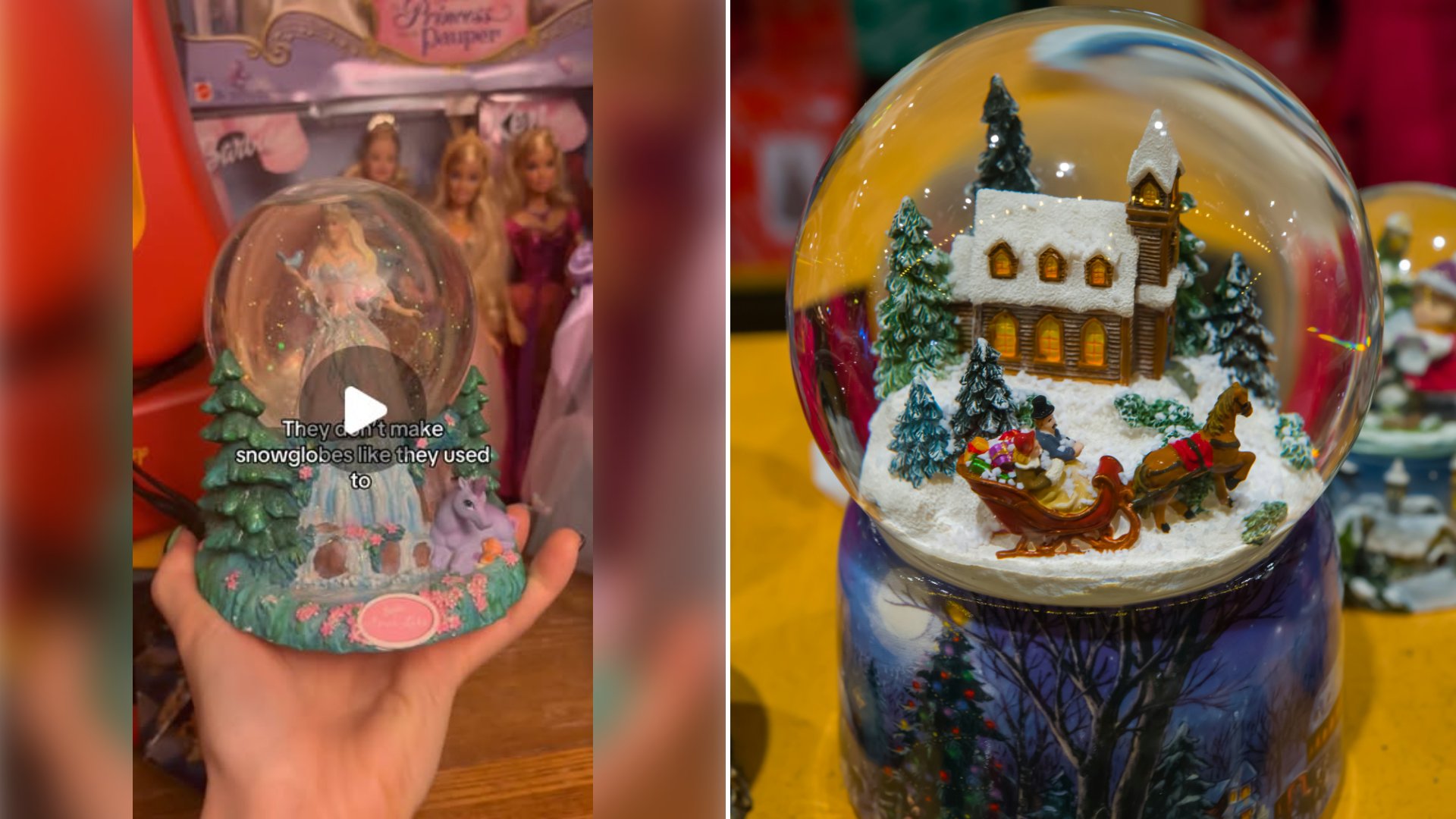
Collector @thecurious.collector works down an entire shelf of 2000s era Barbie themed snow globes, flipping each one over to set the glitter swirling around the scene sealed inside. Every globe gets its own moment, and by the time the shelf is done being shown off, it is hard to argue with the collector’s blunt assessment: companies simply are not making snow globes with this much glittery detail packed into them anymore.
Barbie snow globes were a reliable presence in toy aisles and gift shops throughout the 2000s, produced as both standalone collectibles and tie-in merchandise for the many Barbie direct-to-video movies and themed doll lines that came out that decade. Each one typically sealed a miniature diorama inside its base, built around whatever Barbie theme was popular at the time, from fairy tale and princess lines to seasonal holiday releases, with fine glitter suspended in the liquid to catch the light as it settled.
The claim that modern snow globes do not match this level of detail lines up with a broader, well-documented shift in how collectible merchandise gets made today. Manufacturing moved steadily toward simpler, lower-cost production methods across most mass-market toy and collectible categories over the past two decades, driven by rising material and labor costs that made the kind of intricate hand-assembled diorama work common in the 2000s increasingly expensive to justify at retail price points. Snow globes specifically saw their complexity scaled back as licensing deals shifted toward cheaper giveaway and promotional items rather than standalone collectible pieces built for display.
That production shift is exactly why 2000s Barbie snow globes have developed a genuine following among collectors now. Pieces tied to specific, limited-run Barbie movie releases or short-lived doll lines were never produced in the volumes that core doll releases were, since snow globes tended to be secondary merchandise rather than the main product. That smaller original production run, combined with the fact that snow globes are fragile and prone to leaking or clouding over time, means fewer intact, clear examples survive today than the original sales numbers might suggest, which is exactly the kind of scarcity that drives steady collector interest decades later.
Condition matters enormously with this category in a way it does not for most toys. A snow globe that has clouded, leaked, or lost glitter density is effectively a different object from a clear, fully intact example, since the entire appeal lives inside a sealed liquid chamber that cannot be repaired once it degrades. Collectors shopping for these pieces specifically check the clarity of the liquid and the density of the settled glitter before anything else, since a globe that looks dull or murky inside has lost the exact quality that made it desirable in the first place.
Watching an entire shelf of these get flipped and shaken one after another works as a reminder of just how much craft went into what were, at the time, treated as fairly disposable tie-in merchandise. Nobody was buying a Barbie snow globe in 2004 expecting it to become a sought-after collectible two decades later. That is usually how the best nostalgia collecting categories work. The good stuff was never marketed as an investment, it was just made with more care than anyone realized until the market for that era of craftsmanship had already moved on.
More from Vinyl and Velvet
- Barbie Collector Says She Quit Dolls at 16 for Being Too Cool, Then Dug Out Her Childhood Barbies When Covid Hit and Now Films a Room Packed Wall to Wall With Them
- Convention Attendee Brings His Childhood Pokemon Binder to a Dealer Booth Just to See If He Has Anything Good, and Walks Away Minutes Later With a Blind Cash Offer of 21,000 Dollars
- Game Boy Owner Says Mom Kept the Toys R Us Receipt From July 18, 1994, Showing a $49.99 Game Boy and a $19.99 Yoshi Game, and the Old Handheld Still Turns On Today

Leave a Reply