

If you went to school in the boomer years, you probably remember a few things that would raise eyebrows in a parent-teacher meeting today. The creator behind @memory_files rounded up ten of them in a list titled with a simple promise: things boomers did at school that would shock kids today. The line that wraps it up is perfect. None of this made headlines back then. It was simply an average Tuesday.
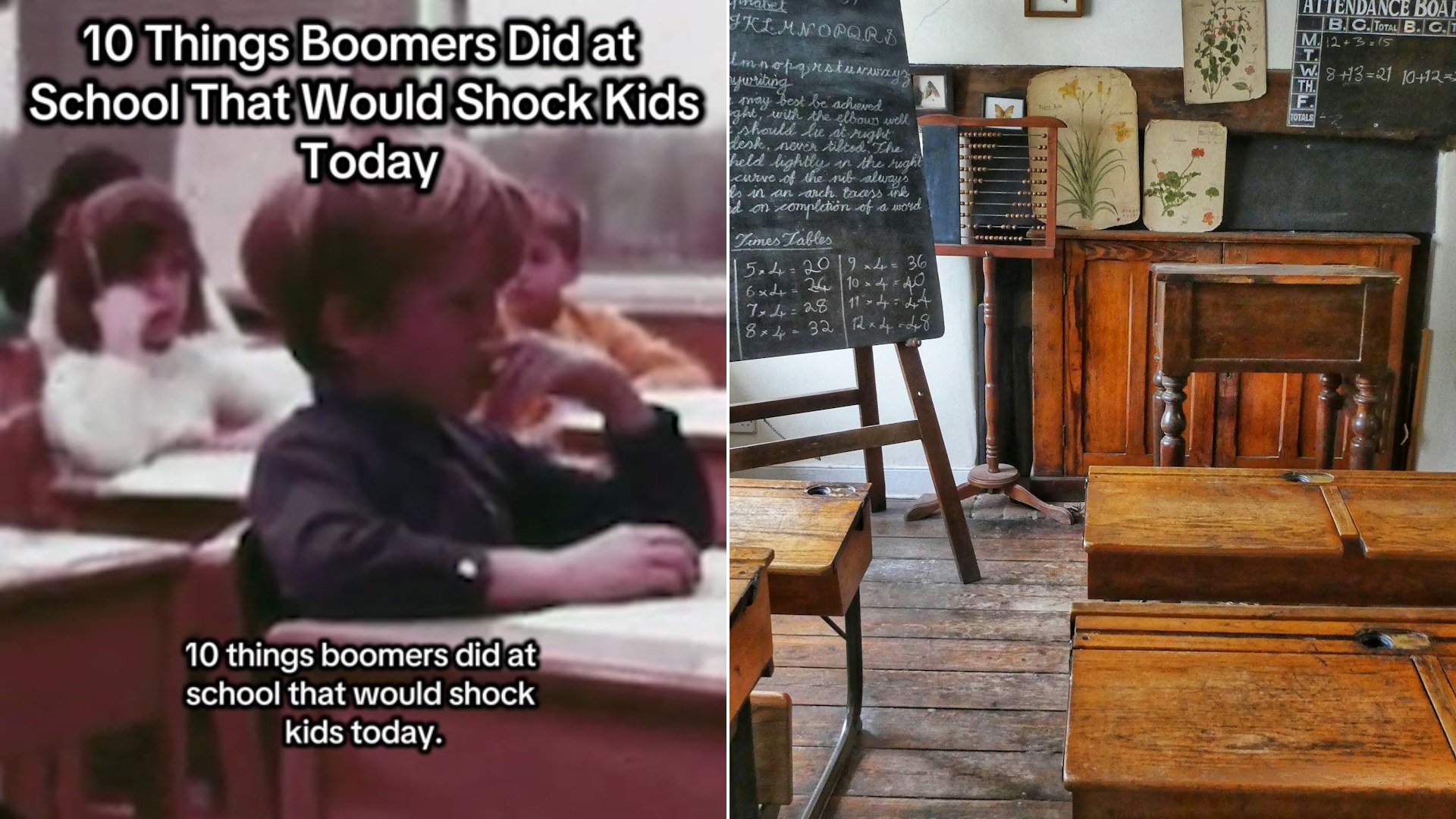
Let us walk through the ten, with some history behind the biggest surprises.
The List
1. Paddling for talking back. The creator says a student could get paddled by the principal and then walk right back to class as though nothing had happened.
2. Driving yourself to school. Teens drove themselves to school at 16 and parked in the student lot. The creator claims there were no restrictions on which spot you took, or even whether you had a license yet, which is the kind of detail that probably varied a lot from town to town.
3. Full contact dodgeball. The ball was aimed at your face, and a hit to the head counted the same as a hit anywhere else on the body.
4. Walking alone. Kids walked to school by themselves for well over a mile, crossing several busy intersections with no crossing guard in sight.
5. Wood shop with real tools. Students used real power tools, including an actual table saw, with barely more protection than a single set of safety lessons.
6. Cooking at 12. Home economics classes had students cooking on a real gas stove at 12 years old, with sharp knives and open flames included in the regular lesson plan.
7. The smoking lounge. Teachers kept a smoking lounge in the staff room, with ashtrays sitting out on the table between class periods.
8. Leaving campus for lunch. Students left campus unsupervised for lunch, even in middle school, and walked back in time for the bell.
9. Only fire and tornado drills. According to the creator, those were the only drills practiced, since nothing else was seriously considered a threat.
10. Writing lines. Detention meant writing the same sentence over and over on a chalkboard by hand, a hundred times straight.
The Paddle And The Law
The first item is the one that gets the biggest reaction. Paddling in schools was a recognized form of discipline for generations in the United States. According to the Wikipedia entry on school corporal punishment, the Supreme Court ruled in Ingraham v. Wright in 1977 that the Eighth Amendment’s ban on cruel and unusual punishment does not apply to students. In practice, that left the decision to states and local districts.
Times have changed. The same source reports that, as of 2024, 33 states and the District of Columbia ban corporal punishment in public schools, while the other 17 states allow it in both public and private schools. It persists mainly in some Southern states, and many schools that still allow it now send waivers home and will not paddle a child whose parent declines. In other words, what the creator describes as routine for boomers is now rare and increasingly controversial.
Drills, Then And Now
The creator says fire and tornado drills were the only ones practiced. Plenty of boomers will point out that this is not the whole story. Many schools in the 1950s and 1960s also held “duck and cover” exercises. The Wikipedia article on Duck and Cover describes a 1951 civil defense film made for children that taught them to get down low and shield themselves from flying window glass in case of a nuclear blast. Those drills became part of the civil defense routine that Americans were encouraged to practice. So if you remember crouching under your desk, your memory is not wrong, and it is a reminder that the list reflects one person’s version of the era.
Wood Shop And Home Ec
Shop class and home economics were staples of the school day. Many students learned practical skills there: how to read a ruler, use a hand plane, hem a pair of pants and cook a simple meal. Safety rules varied, and today’s classes generally use more protective gear, guards and instruction, but the heart of the idea is still valuable. Knowing how to cook and build a few things is a gift that lasts a lifetime.
If you did learn on a table saw or a gas stove, you may find that you still remember the safety rules your teacher drilled into you. Keep your fingers back, never reach over a blade, turn the pot handles inward. Those habits stick.
Independence On The Way To School
Items four and eight, walking alone for a mile and leaving campus for lunch, say a lot about how children were viewed. Kids were expected to handle small responsibilities at an early age. Parents often assumed a child would find the way, watch for traffic and return on time. Many people remember those walks fondly as the part of the day when they felt grown up. Others recall being nervous crossing a busy street. Both memories are real.
Today, many parents and schools take a more cautious approach, with drop-off lines, crossing guards and detailed pickup rules. The trade-offs are worth talking about with grandchildren, who may find it astonishing that a ten year old walked a mile alone.
What Still Holds Up
Not everything on the list is something to bring back. But a few threads are worth a second look.
- Hands-on classes. Cooking, sewing and woodworking give young people confidence and practical skills, and many schools are reviving them.
- Handwriting. Writing lines by hand is no one’s idea of fun, but practicing penmanship still has value.
- Walking when it is safe. A walk to school is good exercise and a chance to talk with friends.
- Treating kids as capable. Giving children real responsibility, in age-appropriate ways, helps them grow.
Share Your School Story
The creator closes by asking which of these happened at your school and for your age in the comments. It is a great prompt for the dinner table too. Which of the ten did you live through? Which ones would your grandchildren never believe? Writing a few down is an easy way to preserve a piece of history that no textbook covers: what an ordinary school day felt like when you were young.
If you have an old report card, a yearbook or a class photo, pull them out while you tell the story. The pictures make the details real, and the stories will make your family laugh.

Leave a Reply