

By the 1960s, a single oil-on-velvet portrait by an itinerant American sign painter named Edgar Leeteg was fetching $20,000 in Honolulu galleries — real money for a medium most fine-art museums refused to hang, according to a history compiled by Collectors Weekly.
Leeteg died in 1953 after a motorcycle accident, but the black velvet painting he helped popularize went on to become one of the most mocked, most mass-produced, and most unexpectedly resilient categories in American folk art. Nearly seven decades later, a small circle of serious collectors is paying serious money for the ones that were actually good.
A Sign Painter Finds His Canvas
Leeteg was a Depression-era commercial sign painter who moved to Tahiti in the 1930s and, according to Wikipedia’s sourced biography, reached for velveteen when canvas ran short. He kept his palette to seven colors plus white and worked the oil paint with a nearly dry brush so it wouldn’t clump or crack the velvet’s nap. Over roughly twenty years he produced around 1,700 paintings — close to three a month — mostly sensuous island scenes of Tahitian women that museums dismissed as tacky regardless of the technical skill involved, per Collectors Weekly’s reporting.
Word got out anyway. Collector Wayne Decker began commissioning ten Leeteg paintings a year, paying with aloha shirts and $200 in the early going before eventually amassing more than 200 canvases, Collectors Weekly reports. Bob Brooks, who ran the 7 Seas tiki nightclub in Hollywood, bought up whatever Leeteg had left and helped seed the tropical-velvet look into mainland tiki bars, including San Francisco’s Tonga Room. Returning Pacific Theater servicemen carried the style home in their duffel bags, and by the time Leeteg died at 49, “American Gauguin” was already a marketing line his Honolulu dealer used in earnest.
The Tijuana Assembly Line
The medium’s second act was less romantic and far larger in volume. Around 1950, Tijuana painter Juan Manuel Reyna began producing velvet religious imagery, and within two decades the trade had swallowed entire neighborhoods along Avenida Revolucion, per Collectors Weekly’s account of the border shops. Cesar Labastida was turning out forty paintings a week — matadors, Native American chiefs, Jesus — at $60 apiece starting in 1954. A local painter nicknamed “Chuy” Gutierrez photographed a craggy-faced neighbor and turned him into the mustachioed “bandido” image later copied thousands of times over, sometimes with an added eyepatch or cigar for variety.
Elvis arrived on velvet in the 1950s too, according to a Tijuana painter’s family history recounted in the same piece, and by the following decade “Velvis” production had scaled into something closer to manufacturing. In 1964, American entrepreneur Doyle Harden bought seven velvet paintings on a Juarez vacation, resold them at a profit back home, and by 1972 had built a maquiladora with partner Leon Korol running round-the-clock shifts that turned out several thousand paintings a day. The assembly method was literal: one worker painted the hair, the next the collar, the last Elvis’s profile — and the picture was done.
From Punchline to Provenance
That volume is exactly what killed the mid-market. Big-box retail, anti-street-vendor ordinances, and a hard cultural turn against disco-era kitsch collapsed most of the Tijuana trade by the mid-1980s, leaving Harden’s operation as one of the few survivors, per Collectors Weekly. What remained was a flood of cheap, interchangeable Elvises and toreadors that Americans spent the next two decades treating as a punchline.
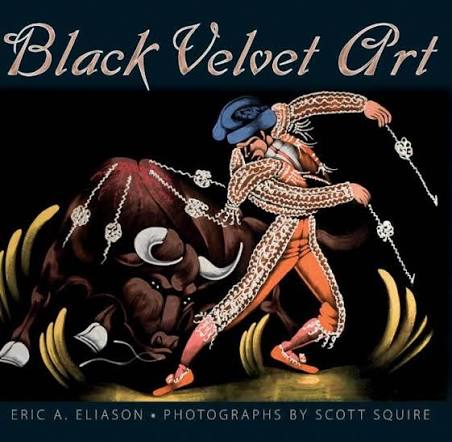
The reappraisal started with people who never stopped taking it seriously. Collectors Caren Anderson and Carl Baldwin co-wrote Black Velvet Masterpieces in 2007 and opened the Velveteria museum, which reopened in Los Angeles’s Chinatown in December 2013 after an earlier Portland location closed, according to Wikipedia’s entry on the museum. The pair built a collection of roughly 3,000 paintings, rotating a few hundred through the gallery at a time. Folklorist Eric A. Eliason gave the category its first serious academic treatment with 2011’s Black Velvet Art, arguing the paintings function as a kind of “anti-art” that lets viewers signal good taste precisely by acknowledging how bad the medium supposedly is.
None of that scholarship changed what a Tijuana tourist Elvis is worth at a garage sale — still pocket change. But it did draw a sharper line between the disposable stuff and the real thing. A verified Leeteg, painted by the man’s own hand rather than knocked off by an anonymous maquiladora crew, still trades in a different universe entirely, closer to the $20,000-in-1960s-dollars territory that made him famous in the first place. Contemporary Tijuana and Nogales painters like Enrique Felix and Nacho Amaro keep the hand-painted tradition alive, and Calgary collector Rick Smith now throws a charity dinner called Rick’s Amazing Velvet Experience, charging several hundred dollars a plate to view his 300-piece hoard, per Collectors Weekly.
The market’s verdict, seven decades on, is oddly conventional: craftsmanship holds value, and everything else was always just a souvenir.

Leave a Reply