

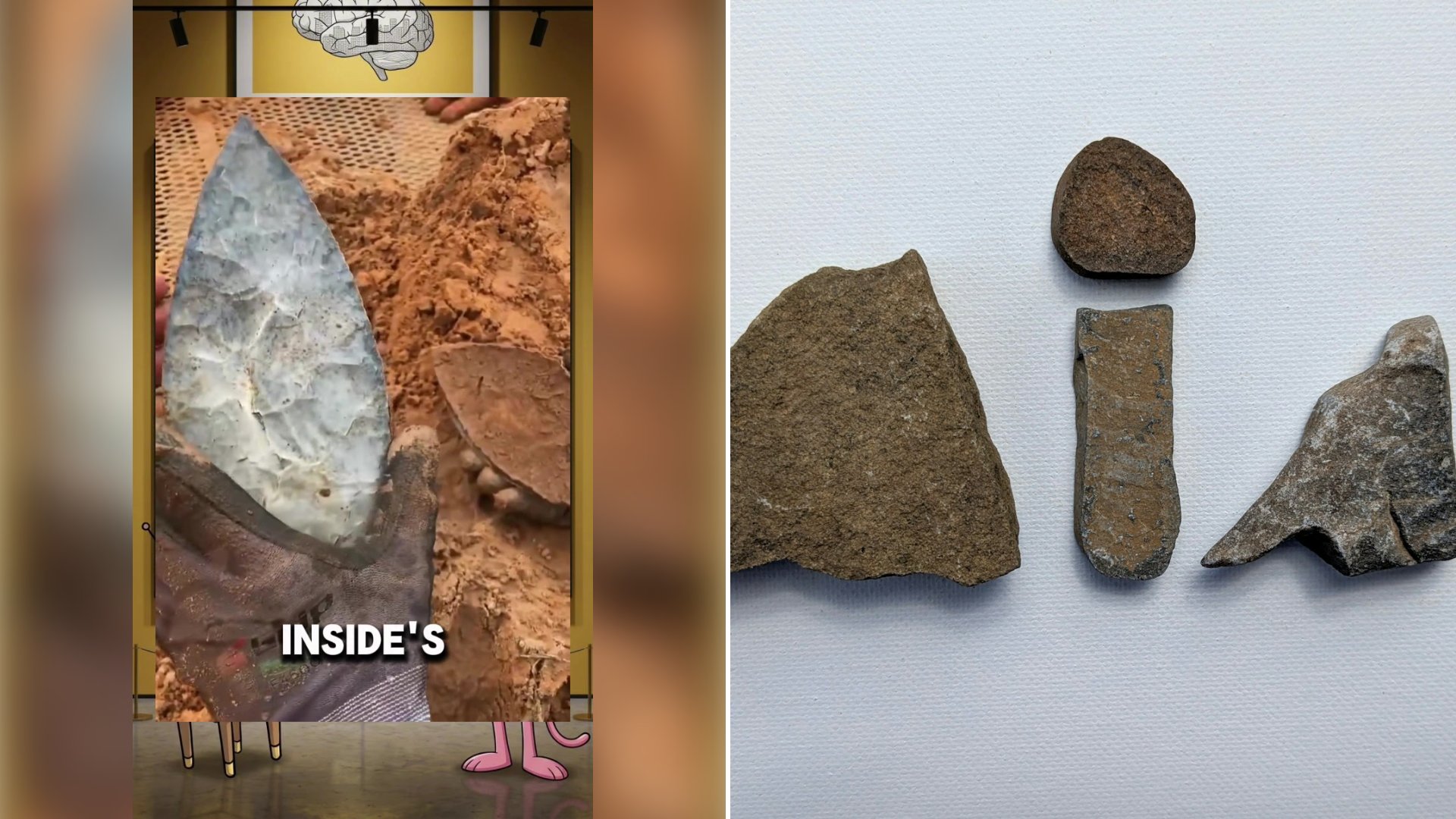
“Striking oil is cool,” the caption reads, “but finding two massive, perfectly preserved bifaces stacked together like a sandwich? Once in a lifetime.” In Texas, apparently, both are on the table.
The video documents a 3,000 to 4,000-year-old artifact cache uncovered in Texas, centered on two large stone bifaces found stacked directly on top of one another in the dirt. The camera lingers on one of the pieces mid-excavation: a broad, leaf-shaped blade roughly the length of a forearm, still half-buried in sandy soil, its pale, smoothly worked surface catching the light as a gloved hand brushes dirt away from its edges. A second, rougher biface sits beside it in the same patch of ground.
A biface is exactly what it sounds like: a stone tool worked on both faces, chipped and shaped through a process called flintknapping until it holds a clean, symmetrical edge. Making one is slow, deliberate work, striking off flakes in careful sequence until the raw stone takes on the final tool’s shape, and the larger and more symmetrical the finished piece, the more skill and material investment it represents. “For people who have never knapped, this level of skill is super rare,” one commenter wrote underneath the clip, a sentiment echoed throughout the comment section by people who clearly recognized what they were looking at.
Finding one biface this size and this well preserved would already be notable. Finding two, stacked together as though someone deliberately set them down that way three to four thousand years ago and never came back for them, is the detail that turns this from a good surface find into the kind of cache collectors describe as once-in-a-lifetime. Caches like this, groups of tools deposited together rather than scattered individually across a site, are often interpreted by archaeologists as intentional storage: someone burying usable, high-value tools with the plan to retrieve them later, a plan that for whatever reason never happened.
Texas has a long record of producing finds from this general time window, a period when the region’s indigenous populations were shifting away from the earliest Paleoindian hunting traditions and into more regionally specialized toolmaking, producing larger, more varied biface forms suited to local game and local stone sources. A cache this size and this intact gives researchers and collectors alike a rare, undisturbed look at exactly how finished that toolmaking tradition had become, since the pieces were preserved together rather than picked apart by centuries of erosion, plowing, or earlier collectors passing over the same ground.
@dailythinkingok
More from Vinyl and Velvet
- Collector Brings His Diet Coke Silver Bar in an Ice Cube Capsule to a Coin Shop, and the Dealer Offers Double Melt, $120 With Silver Sitting at About $60 an Ounce
- Safe Technician Empties a Hidden Safe He Says a Family Found Two Months After Losing Their Sister and Pulls Out Coin Collection Books, a Pouch of Rolled Coins and a Revolver Booklet
- Volunteer Gravestone Cleaner Asked Viewers Who Joseph Lampkin Was, Then Cleaned His 1871 Headstone and Revealed the Railroad Dump Car Accident That Killed Him at 17

Leave a Reply