

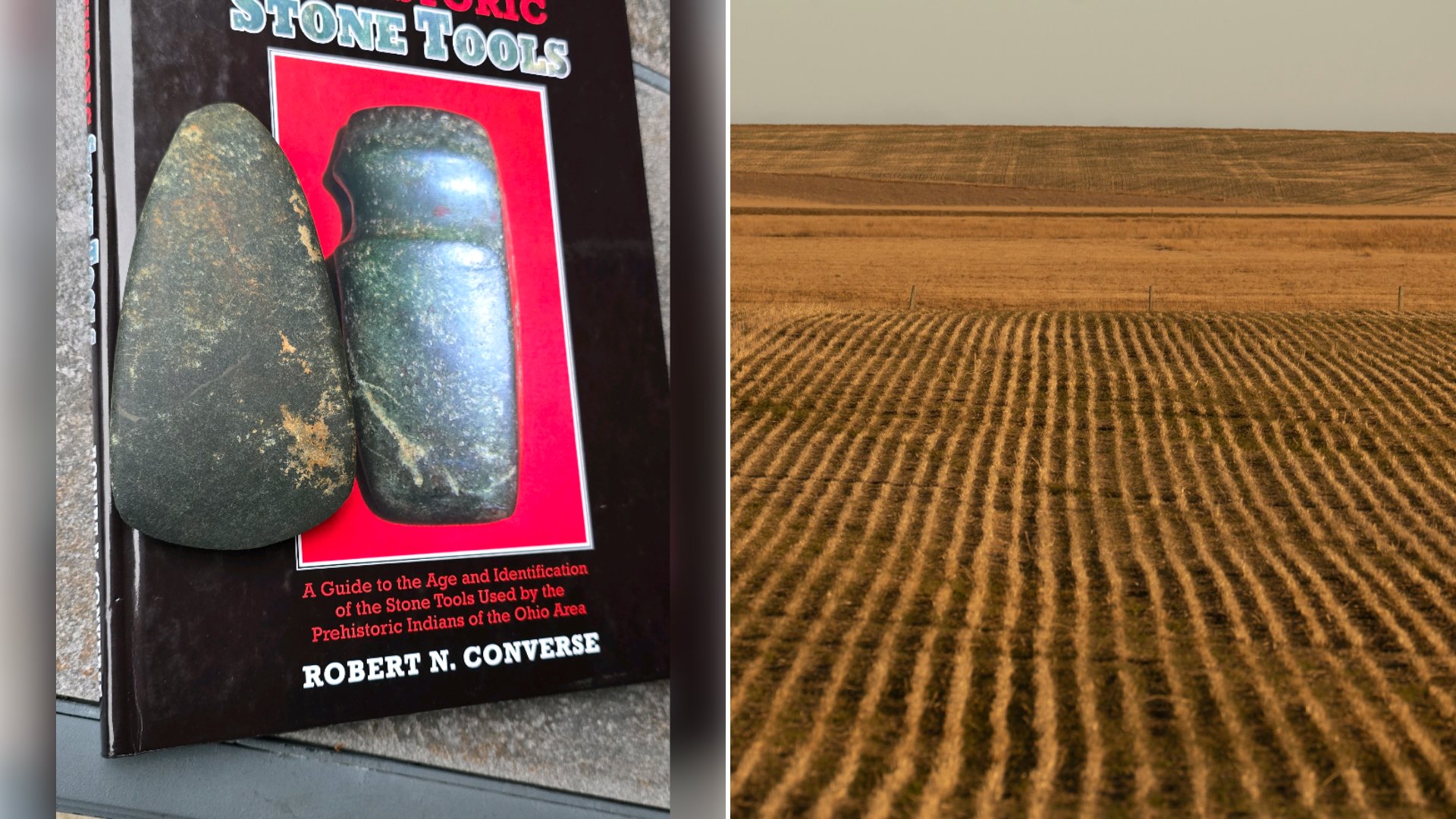
Most arrowhead hunters go years without a find that stops them in their tracks. This one brought a grown man to tears before he could even finish a sentence.
The video is a single continuous handheld shot, filmed outdoors in a sun-dappled Ohio field. A bearded man in a baseball cap is visibly shaking and catching his breath, holding up a smooth, dark greenish-black stone tool he had just pulled from the ground. “I don’t even know how to explain how I’m feeling right now,” he says, voice breaking. “Look at what I just found. Oh, my god. That’s fucking perfect.” On-screen text identifies the piece plainly: a “Museum grade Adena Adze,” dated to 800 B.C., found in Batavia, Ohio, and attributed to the Adena Mound Builders.
The Adena were one of the earliest mound-building cultures of the Ohio River Valley, flourishing roughly from 800 B.C. to the first century A.D. across what is now Ohio, Kentucky, Indiana, and West Virginia. They’re best known archaeologically for the earthworks and burial mounds they left behind, but Adena sites have also produced finely worked stone tools, including adzes and celts, ground and polished rather than simply flaked, meant for woodworking tasks like hollowing logs and shaping timber. A stone adze typically has a single beveled edge set at an angle to its handle, distinct from an axe’s straight-on blade, which made it effective for carving and smoothing wood surfaces.
What makes a complete, well-preserved example like this one significant to collectors and archaeologists alike isn’t just its age, it’s its survival. Ground stone tools took far longer to manufacture than flaked points, representing a real investment of time and skill from the person who made them, and a piece that has stayed intact and legible for roughly 2,800 years, through farming, erosion, and nearly three millennia of ground disturbance, is genuinely uncommon. Most surface finds of this age turn up broken, worn past recognition, or buried too deep to ever surface at all. This one came up smooth, tapered, and whole, found by someone who clearly understood exactly what he was holding the moment it cleared the dirt.
That recognition is really what the video captures. There’s no dramatic reveal structure, no appraiser, no price tag. Just a man alone in a field, overcome by the realization that he’s holding an object another human being shaped by hand eight centuries before the Roman Empire existed, and that it survived every single year between then and now just so he could be the one to find it.
@1tennvolfan
More from Vinyl and Velvet
- Collector Brings His Diet Coke Silver Bar in an Ice Cube Capsule to a Coin Shop, and the Dealer Offers Double Melt, $120 With Silver Sitting at About $60 an Ounce
- Volunteer Gravestone Cleaner Asked Viewers Who Joseph Lampkin Was, Then Cleaned His 1871 Headstone and Revealed the Railroad Dump Car Accident That Killed Him at 17
- Jeweler Reads the Engraving Inside an 18 Karat Wedding Band a Snorkeler Says She Found in the Adriatic Off a Puglia Beach Club, and Vows to Return It to Whoever Knows the Full 2017 Date

Leave a Reply