

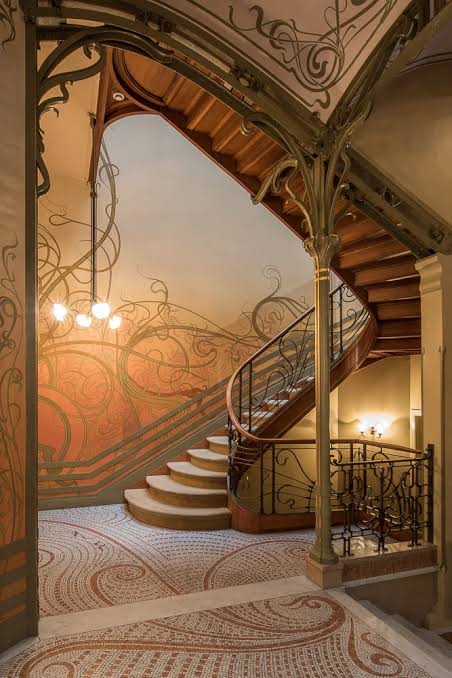
Fifteen to twenty-three. Those are the back-to-back numbers behind this year’s biggest swing in a closely watched design survey: the share of interior designers favoring Art Nouveau for their 2026 projects, up eight full percentage points from the year before, according to the 1stDibs 2026 interior design trends report, drawn from an annual poll of professional decorators across 17 countries. Nothing else in the survey’s roster of returning historic styles jumped that fast in a single year. For a movement that essentially vanished from mainstream production more than a century ago, that’s a striking number to be posting again in 2026.
A Movement Born to Fight the Machine
Art Nouveau emerged in Brussels in the 1890s, according to its documented history, and spread almost immediately to Paris and across Europe as architects and designers pushed back against the rigid, mass-produced look of the industrial age. Victor Horta, Hector Guimard and Charles Rennie Mackintosh built the movement’s defining structures, while Alphonse Mucha, René Lalique and Louis Comfort Tiffany carried its signature whiplash curves and botanical forms into posters, jewelry and stained glass. The style leaned deliberately on iron, glass and ceramic, materials that could be shaped into the sinuous, asymmetrical lines the movement is still recognized for today.
A Style Too Expensive to Survive Its Own Success
Art Nouveau’s collapse had almost nothing to do with taste turning against it and everything to do with economics. The look depended on expert, highly paid craftsmen at exactly the moment mass production was becoming the industry standard, and by 1905 it had already largely disappeared from France. World War I finished the job; by the 1920s, the geometric discipline of Art Deco and early modernism had replaced it almost everywhere. Unlike styles that faded gradually as tastes shifted, Art Nouveau was priced out of relevance while it was still fashionable — which is part of why the pieces that survive from its brief run now carry real weight with collectors.
What Designers Are Actually Chasing
The 1stDibs report grounds the trend in specifics rather than vague sentiment. Designer Pam Shamshiri, of Studio Shamshiri, is cited featuring a Throne chair by Carlo Bugatti, whom the report calls a master of experimental Art Nouveau furniture in the middle of its own renaissance. The report’s own editorial voice goes further, addressing designers directly: “A note for designers who lean into everything from Josef Hoffmann to Jugendstil: Your good eye is gaining recognition from your fellow designers, so you may want to grab that piece you’ve had your eye on for 2026.” That’s a notably specific nudge for a trend report to make — less “this look is back” and more “the market for these actual objects is about to get more competitive.”
Part of a Package Deal With History
Art Nouveau isn’t rising alone. The same 1stDibs survey tracks Bauhaus and Brutalism climbing back into favor in the same cycle, all three described as part of a broader swing toward historic revivalism after a stretch dominated by softer, more neutral contemporary looks. But Art Nouveau’s specific jump outpaces both of them in the data, and its visual language — organic curves, ornament, stained glass, botanical motifs — sits at the opposite end of the spectrum from Bauhaus’s stripped-down geometry and Brutalism’s raw concrete. Designers aren’t picking one historic revival lane this year. They’re pulling from the full range of what design history has to offer at once.
Why Curves Read as Rebellion Now
There’s a specific reason ornament feels fresh again after years of pared-down neutral interiors. The 2010s and early 2020s were dominated by a fairly narrow palette of design choices — matte white walls, boxy sofas, brass hardware repeated across a million listing photos, the kind of interior that photographs consistently well for a real estate listing but rarely feels like anyone’s actual personality. A Carlo Bugatti chair or a Tiffany-style glass fixture does the opposite of that on purpose. It refuses to be neutral. For designers whose clients are increasingly asking for rooms that don’t look like every other room on a home tour, a movement built entirely around asymmetry and organic excess is an obvious place to go looking.
Ornament Never Actually Went Extinct
Art Nouveau spent a century treated as a museum-piece style, something admired in a Paris Metro entrance photo rather than specified for a living room. An eight-point jump in a single survey cycle doesn’t undo that reputation overnight, but it does suggest designers are done treating ornament and mass production as opposites — the exact tension that killed the movement the first time around.

Leave a Reply