

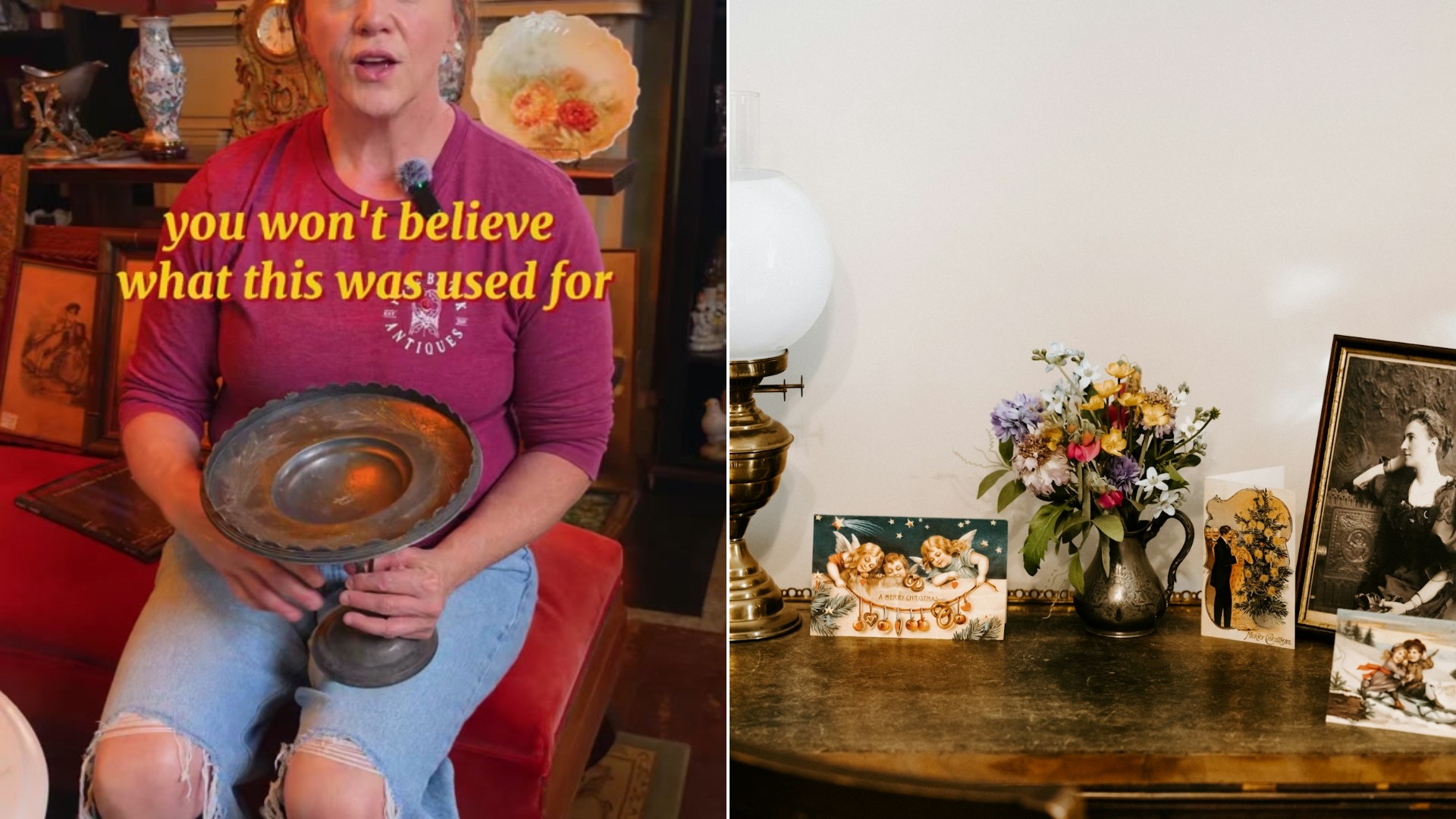
Pick up a beautiful etched antique, tilt it in your hand, and you might swear the thing is warped. That is exactly the trap in a short reveal from the dealer at @rose.block.antiqu, who shows off an 1896 Victorian piece with a monogram, a lovely etching and a lean to it. “You would not believe what this was actually used for,” she says.
The answer is a small piece of Victorian manners. The container had one job, and it had nothing to do with tea, jewelry or sewing. It was made to receive your calling card at the front door.
@rose.block.antiqu
It Is Dated 1896 And Carries A Monogram With Beautiful Etching
The dealer points out the date first: 1896. Then she shows the monogram and the etching, and she clearly loves it. “Oh, and I love that,” she says. “That’s just beautiful.”
A monogram on a piece like this would have marked the household that owned it. In a Victorian home, even the container by the door was meant to look like it belonged to the family.
“The Only Thing This Was Used For Was To Receive Your Calling Card”
Here is the twist. She says the only thing this was used for was to receive your calling card. In the Victorian era, it would have been at the front of the door.
When a visitor arrived, they would drop their calling card into the container. The butler would then receive that card and take it to the owner, or to whoever the visitor wanted to see.
It Is Not Warped, It Is Tilted On Purpose
The detail that makes people look twice is the lean. She says it is tilted, not warped. “It’s actually tilted for the ease of putting the calling card in.”
That is the kind of design thinking that is easy to miss. A slight angle makes it simple to slip a small card into the opening without fumbling, and the piece was built that way from the start.
“It’s amazing what the Victorian era, some of the easements that they made that we don’t even think about today,” she says.
What A Calling Card Was For
In the nineteenth century, calling cards were small printed cards carrying a person’s name, and they were an important part of polite society. Before you visited someone, or after you had been to their house, you sent or left a card to announce yourself.
A card left with a servant let the household decide whether to receive you. That is why a dedicated receiver by the door made sense. It kept the cards in one place, and the person who answered the door could carry them to the right room.
Cards were often kept simple, with a name in clean lettering, and families took care over how they looked. Having a handsome receiver by the door was a quiet sign that the household observed the proper forms. Guests who dropped a card in were taking part in a ritual everyone understood.
Today we send a text or knock and wait. In the Victorian era, you handed over a piece of card and waited to be invited in.
A Simple Way To Spot Odd Antiques
This little reveal is also a lesson in how to look at antiques. When a piece looks odd, do not assume it is damaged. Ask what it was made to do. A slight tilt, an unusual opening or a strange size can be the clue to its purpose.
Look for marks too. A date, like the 1896 here, and a monogram can help you place a piece in time and in a household. And talk to the dealer. The best antique sellers love explaining what an object was for, and a good story is part of what you are buying.
It is also a good reminder that antiques are not only about age and value. They are about how people lived. A piece made in 1896 to catch a card at a front door tells you more about daily life than a whole shelf of fancy china, and that is a big part of why dealers and collectors keep hunting for them.
Why Victorian Details Still Charm Collectors
Pieces from that era were designed with a sense of ceremony. Even an everyday item at the front door was etched and monogrammed, and shaped so that a visitor’s card would slide in easily. That attention to small details is what many collectors love about Victorian antiques.
The dealer ends her video with a joke that fits the moment. “Why don’t you call on Rose Block Antiques?” she says. “We would accept your calling card any day of the week.”
If you find something odd at a shop or an estate sale, take a moment to turn it over and ask what it was for. You may be holding a piece of etiquette that has been out of use for well over a century.
So the next time a piece in a shop looks crooked, give it a second look. It may not be damaged at all. It may simply have been designed for a purpose we no longer remember, with an angle chosen on purpose by someone who knew exactly how it would be used.
More Stories You May Like
- LA Museum With 30,000 Relics Including Eve Plumb’s Brady Bunch Bedroom Door Is Begging For $75,000 Before A $70,000 Balloon Payment Comes Due In December
- Script Signed By All Four Beatles Sat Unread In A Suitcase For Decades, With Eric Morecambe Calling Ringo Bingo And An Estimate Of £4,500 To £6,500
- 1980 Police Baseball Cards Handed Out To Kids One Or Two At A Time Now Make A Complete 25 Card Set With Young Cal Ripken Jr. Estimated At $100,000 And Up

Leave a Reply