

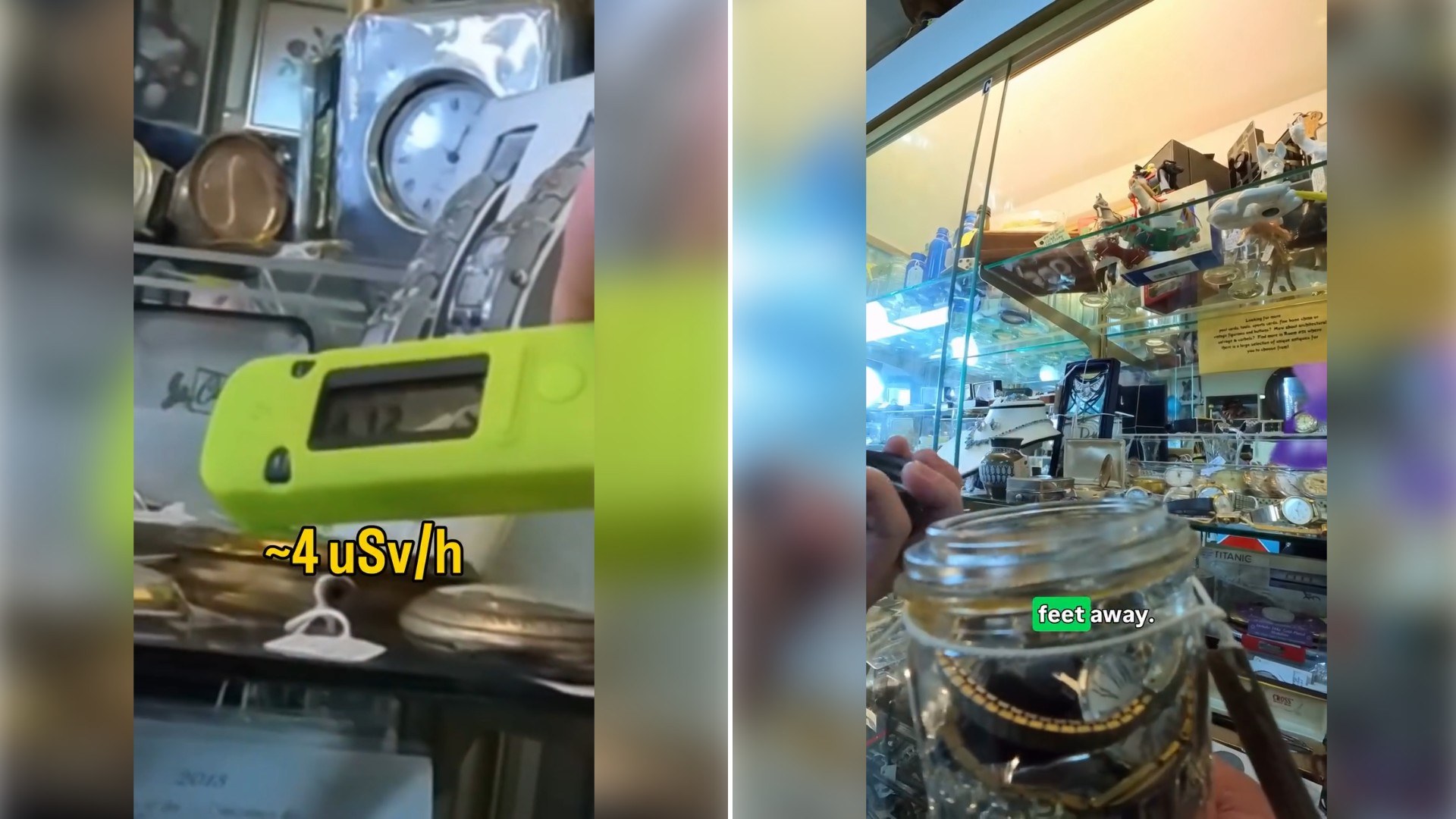
Most antiquing content is about appearance and history, but @radioactive.loonie has built an entire recurring series, Radioactive Antiquing, around a much stranger question: what in this shop is actually giving off radiation. Walking through a vintage store with a handheld radiation detector in hand, the creator tests item after item, and old watches, long known for using radium-based luminous paint on their dials and hands, are a recurring highlight.
The format has a built-in suspense to it that most antiquing videos lack, since every item gets the same simple test and most will register nothing at all, right up until one, often a decades-old watch, sets the counter off with an unexpected beep. That moment of genuine surprise, followed by the creator’s reaction, is the entire appeal of the series.
Radium-painted watch dials were common through much of the early to mid-twentieth century, prized at the time for their ability to glow in the dark long before safer luminous materials became standard. That history means a meaningful number of genuinely vintage watches still in circulation today do carry trace radioactivity, generally understood by collectors and experts to be low-level and not a serious hazard in brief handling, though it is exactly the kind of detail that makes items like these fascinating rather than simply decorative.
That slightly eerie scientific layer sets this kind of content apart from typical antiquing content, turning a routine browse through old merchandise into something closer to a hands-on history and chemistry lesson. It also speaks to a broader trend in collector content: audiences are drawn not just to an object’s look or rarity but increasingly to the hidden, verifiable facts behind it.
Part of what makes a recurring series like this one so effective is the sheer repeatability of the format. Every new shop, every new shelf of merchandise, offers a fresh batch of items to test, which means the creator never runs out of material the way a more narrowly themed antiquing account eventually might. The Geiger counter itself functions almost like a game show buzzer, turning an ordinary browsing session into a structured sequence of small, suspenseful reveals rather than a passive walkthrough.
The history behind radium paint is worth sitting with a bit longer, since it says something about how differently the twentieth century understood radioactivity compared to today. In the decades before the health risks of radium exposure were fully understood, the element was marketed almost as a wonder material, found not just in watch dials but in some cosmetics, tonics, and even novelty items, prized specifically for its glow. Watches were among the most enduring and widespread applications, largely because a luminous dial served an obvious, practical purpose for anyone needing to read the time in the dark, whether a soldier, a factory worker, or simply someone without a bedside lamp.
That practical origin is part of why so many radium watches have survived into the present in collectible condition. They were mass-produced, widely used, and often well cared for precisely because they were functional tools rather than purely decorative objects, which means vintage shops and estate sales continue to turn up genuine examples with some regularity, exactly the kind of steady supply that keeps a series like this one stocked with new material.
There is also a quieter safety education happening underneath the entertainment value here. Most casual shoppers have no reason to think about radioactivity when browsing a vintage shop, and a series like this one introduces the concept in a low-stakes, genuinely engaging way rather than through a dry warning label or a museum placard. Viewers walk away with a real, if informal, understanding of which categories of antique object might carry trace radioactivity, knowledge that is genuinely useful for anyone who collects vintage watches or similar items regularly.
It is worth noting, too, how the detector itself becomes a kind of co-star in this format, its beep doing narrative work that words alone could not. A spoken explanation of an item’s history can only carry so much dramatic weight, but an unexpected, involuntary beep from a handheld device reads as objective, almost scientific proof, lending the whole series a credibility that a purely verbal antiquing account would have to work much harder to earn.
This kind of content also fits into a broader appetite among collectors for verifiable, hands-on proof rather than secondhand claims. A seller can tell a shopper that a watch is a genuine vintage piece from a particular decade, but a Geiger counter registering activity on exactly the items history says should carry it offers a different, more tangible kind of confirmation, one that does not depend on taking anyone’s word for it. That sense of independently checkable evidence is part of why a format built around a simple handheld device has resonated well beyond viewers who collect watches specifically.
There is a reasonable comparison to be drawn between this series and other collector content built around specialized testing tools, whether that is a blacklight used to spot certain dyes and repairs, a jeweler’s loupe used to authenticate metals and stones, or a magnet used to separate genuine silver from plated imitations. Each of those tools turns a subjective judgment call into something closer to an objective test, and the Geiger counter simply extends that same instinct into a category, radioactivity, that most shoppers would never think to check for on their own.
For fellow antiquers curious about trying something similar, the series is a good reminder that vintage shops hold more than meets the eye, and sometimes the most interesting fact about an old object isn’t how it looks, but what it is quietly still doing decades after it was made.

Leave a Reply