

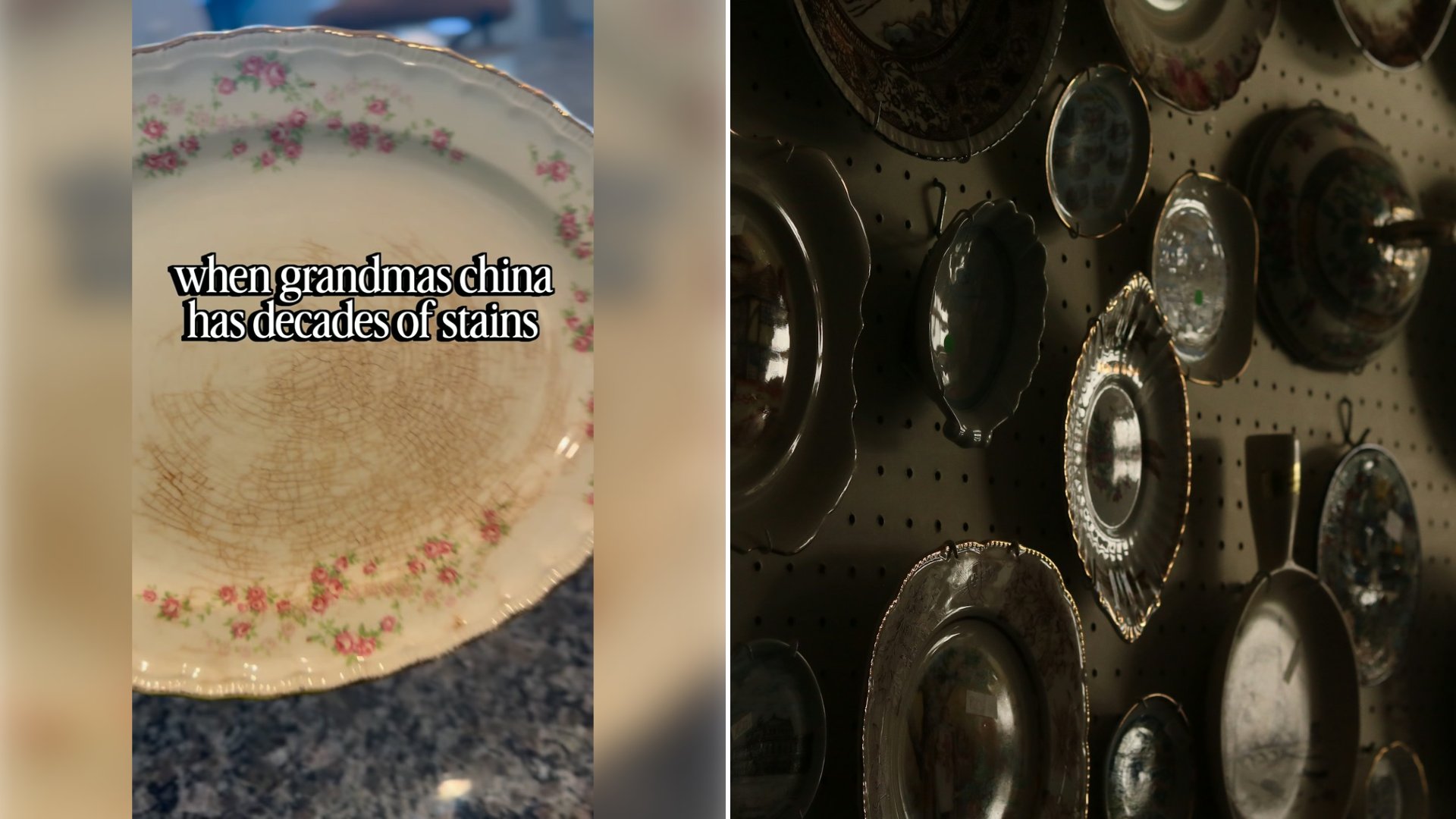
“When grandmas china has decades of stains” is the text across the opening shot of the reel from @tiersofjoy.tx, a post tagged with a Houston, Texas location. A cream colored plate with a pink rose border and a gold edge fills the frame, and the center of it is stained a mottled brown.
The caption explains the setup: “Sometimes the transformation starts with a good bath!” The caption goes on to say a customer sent in these Pope Gosser plates, and after hydrogen peroxide and “a few hours in the oven they came out perfect!” The plates belong to that customer, so the creator is working on someone else’s china.
The clip is under 17 seconds long and moves through the method in a few on screen steps. The opening text stays over the stained plate for about four seconds, with the brown mottling covering most of the center. A gold rimmed bowl is then held up to the camera, its inside yellowed, with a stack of plates in a glass baking dish behind it. Next the text “hydrogen peroxide for 24 hours” appears over the plates, with beads of liquid on the surface of one, followed by “oven at 200 F” over a wall oven whose touchscreen reads 200. Then comes “place in oven for an hour or two,” with a plate held up in front of the open oven and a look inside it. A bowl returns at 13 seconds with its gold rim bright and its inside clean, a brown bottle on the kitchen counter beside it. The last shots, under the text “like magic!”, show a plate with the same pink rose pattern on white and no brown left in the center.
One detail does not match: the caption says “a few hours in the oven,” while the on screen text says “an hour or two.” The result shown is the creator’s own, in a single before and after, and the final frames show the plates clean, with the rose pattern and gold edge intact.
The National Park Service’s museum program has published guidance on Preservation of Low Fired Ceramic Objects, Conserve O Gram 8/3, which is about earthenware type bodies, and the video does not say what kind of body these plates have. It still covers points that bear on this method. It warns that colored or oily liquids can stain beneath the glaze and that breaks in the glaze can come from “rapid heating or cooling,” which then lets liquids soak into the body. It says gilding is fired at or below 600 degrees Celsius, is weakly adhered and is fragile, and that ceramics should never be fired a second time to replace lost gilding. By comparison, 200 degrees Fahrenheit is about 93 degrees Celsius, far below the firing temperature for gilding, though the guidance’s worry is sudden change and not the number alone.
For a thrifter who finds a stained set, those points suggest where to be careful. Look the plates over in strong light for hairline cracks or a crackled glaze before any soak, since breaks in the glaze are where liquid gets in. Handle gold trim as little as possible and keep it away from scouring. If heat is part of the plan, bring plates up and down in temperature slowly instead of moving them straight from a counter into a hot oven or back out again. And if a set has real value, whether sentimental or financial, the same leaflet says stain removal should be left to a conservator.
More from Vinyl and Velvet
- Shopper Pays $20 at a Church Rummage Sale for Seven Hand Painted Plates Stamped 1988 on the Back, the Year She Was Born, Then Finds Single Plates Listed Near $200 Each
- Grandma’s Kitschy Ceramic Cookie Jar Might Be Worth Four Figures, and Collectors Are Paying Real Money to Prove It
- 6 Things in the China Cabinet Gen Z Does Not Want to Inherit

Leave a Reply