

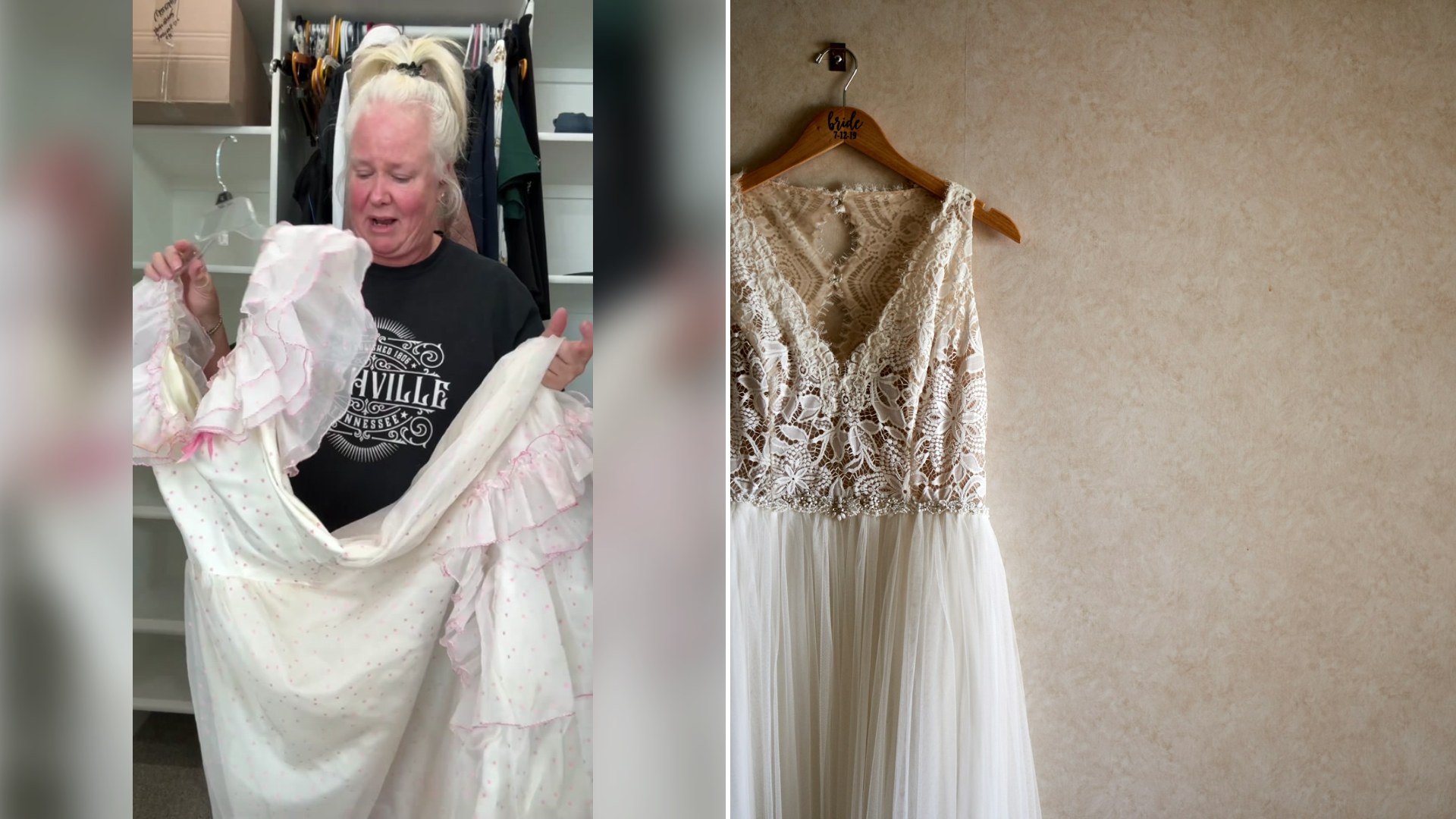
Some closets are time capsules, and few items inside them carry as much charge as a prom dress. Creator @angiebatis recently posted a video that stopped scrollers cold: forty years after her 1986 prom night, she still has the dress hanging in her closet, still has the photographs, and — remarkably — still has the same partner she wore it for. The question she poses to the internet is deceptively simple: is it finally time to let it go?
There is something uniquely disarming about a decades-old prom dress surfacing in someone’s closet in 2026. Prom is, for most people, a single-night event, a few hours of nervous excitement wrapped in taffeta or satin and immediately overtaken by whatever comes next in a young life. That a dress from 1986 survived relocations, decades of changing fashion, and the general churn of adult life to still be hanging in a closet says something about how certain objects quietly earn the right to stay.
What makes this particular story resonate so strongly, though, isn’t just the dress’s survival — it’s the fact that the relationship survived too. Prom dates are proverbially fleeting; the entire mythology of prom night is built on fleeting young romance, corsages, and photographs taken on a front lawn that will later feel almost embarrassingly earnest. For @angiebatis to still be with the person she wore that dress for turns an ordinary sentimental object into something closer to a relic of an origin story, a piece of material evidence for a love that actually lasted.
This is exactly the kind of story that thrives in vintage and nostalgia corners of the internet, because it collapses the distance between “personal memento” and “cultural artifact.” A prom dress from the mid-1980s is, on one level, just fabric and sequins. On another level, it is a near-perfect snapshot of an era: the big sleeves, the dramatic necklines, the specific shade of blush or jewel tone that dominated formalwear before trends shifted again in the 1990s. Anyone who lived through that decade, or who has spent time scrolling through yearbook photo archives, recognizes the silhouette instantly.
The “should I get rid of it” question is also one of the great recurring dramas of sentimental object ownership, and it shows up constantly in thrifting and decluttering communities. People wrestle publicly with whether to keep a wedding dress, a childhood toy, or a letter jacket, often posting the dilemma online specifically because an audience of strangers can offer the permission — or the pushback — that feels harder to generate internally. There is a reason entire YouTube and TikTok genres exist around decluttering: objects carry emotional weight disproportionate to their physical size, and deciding their fate can feel like deciding the fate of the memory itself.
What’s notable is how the comments section on a post like this tends to split into two camps almost immediately. One side argues for preservation: frame it, box it in acid-free tissue, pass it down, because garments like this are irreplaceable and the sentimental value only compounds with time. The other side argues for release: the memory lives in the relationship itself, not in the polyester lining, and letting the dress go to a thrift store or a costume archive could give it a second life rather than a slow decline in a closet. Both positions are really about the same underlying belief — that this dress matters — they just disagree about what honoring that meaning looks like.
There’s also a practical textile argument worth considering. Garments from the 1980s were often constructed with synthetic blends, taffeta, and early spandex components that don’t always age gracefully compared to natural fibers. A prom dress stored in a plastic garment bag for forty years can develop yellowing, fiber breakdown, or odor issues that no amount of sentimental value can reverse. Vintage clothing collectors and conservators generally recommend acid-free boxes, breathable cotton garment bags, and climate-controlled storage away from direct light — advice that applies just as much to a 1986 prom dress as it does to a museum-quality couture piece.
It’s also worth zooming out to appreciate why this story found an audience well beyond people who remember 1986 firsthand. Younger viewers, raised on thrifted prom dresses and a renewed appreciation for vintage formalwear, often express outright envy at the idea of owning an “original” 1980s prom dress rather than a modern reproduction. Vintage prom and wedding attire has become genuinely collectible in its own right, showing up on resale platforms and in costume archives, prized precisely because it wasn’t mass-produced with the same fast-fashion uniformity that defines so much of contemporary formalwear.
There’s also a generational layer worth noting: many commenters pointed out that their own mothers or grandmothers kept prom or wedding garments in cedar chests for similar reasons, treating the item less like clothing and more like a family document. In that sense, a prom dress can function the same way an old love letter or a ticket stub does — a small, portable piece of proof that a particular night, and a particular feeling, really happened the way memory insists it did.
Ultimately, stories like this endure because they ask a question almost everyone has quietly asked themselves about something in their own closet, attic, or storage bin. Few of us have the exact combination of circumstances — the same dress, the same partner, four full decades later — but all of us understand the pull of an object that has outlived its original purpose yet still refuses to feel disposable. Whether @angiebatis keeps the dress, frames it, or finally lets it go, the video is a reminder that the things we save are rarely about the things themselves; they’re about who we were when we first put them on, and who we’ve become since.

Leave a Reply