

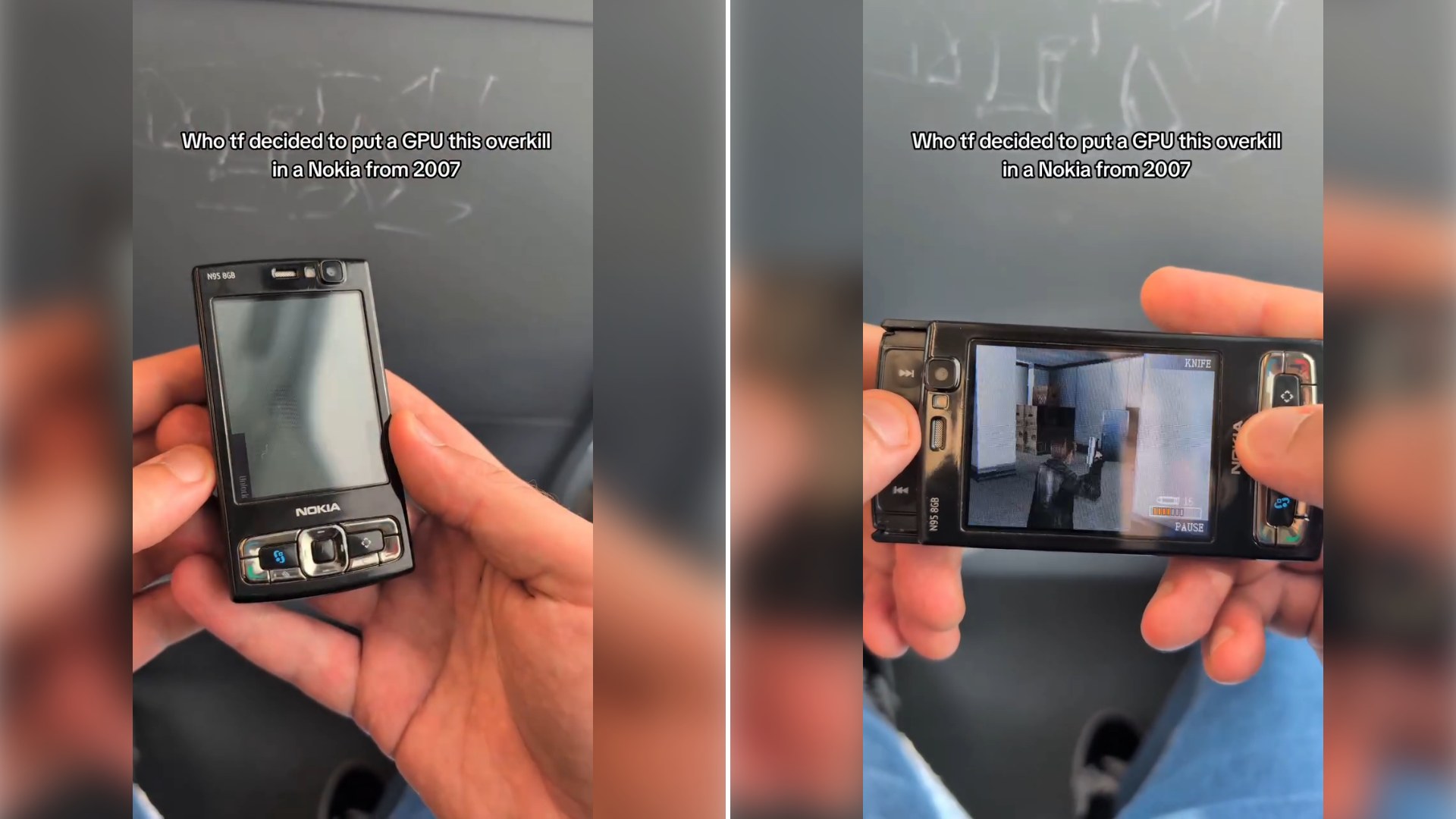
Long before smartphones became synonymous with powerful gaming, there was the Nokia N95, and @emazamboni sets out to prove just how far ahead of its time it really was. Firing up a full 3D game on the old handset, she shows off just how advanced the phone’s hardware genuinely was for its era, all set to a bouncy, upbeat soundtrack that makes the whole demonstration feel like a tiny time capsule.
Released in 2007, the Nokia N95 is widely remembered by mobile tech enthusiasts as one of the most genuinely ambitious phones of the pre-iPhone era, packing a five-megapixel camera, GPS navigation, Wi-Fi, and a dual-sliding design into a single device at a time when most competitors were still treating phones as primarily communication tools. Demonstrating it running an actual 3D mobile game is a direct, tangible way of showing modern audiences just how much capability was genuinely packed into that small, now-ancient-feeling slab of plastic and metal.
Vintage mobile phone collecting has become one of the most active and fast-growing corners of the broader retro tech hobby over the last several years. Unlike vintage computers or game consoles, which have had decades to build established collector markets, interest in early smartphones and feature phones is a genuinely newer phenomenon, driven largely by millennials who carried these exact devices through their teens and twenties and are only now recognizing them as legitimate historical artifacts rather than obsolete junk drawer clutter.
Demonstration videos like this one serve an important function within that collecting community beyond simple nostalgia. Showing a device actually functioning, running real software, rather than simply displaying it as a static object, proves something that photographs alone cannot: that these old phones were not primitive toys but genuinely sophisticated engineering achievements that, in some specific respects, pushed boundaries competitors would not catch up to for years.
The specific choice to showcase gaming capability also taps into an often-overlooked chapter of mobile history. Before app stores standardized how games reached phones, early 3D mobile titles were genuinely impressive technical feats, squeezed into devices with a tiny fraction of the processing power and memory that any modern smartphone carries. Watching one run smoothly on period-accurate hardware offers a vivid, visceral sense of just how much engineering ingenuity went into making it work at all.
There is also a broader design appreciation at play in content like this. The N95’s dual-sliding mechanism, revealing a numeric keypad on one side and media controls on the other, represented a genuinely distinctive physical design approach that modern touchscreen-dominated phones have almost entirely abandoned. For collectors, that mechanical ingenuity is often just as compelling as the software running on the device.
Videos like this ultimately do real work in reshaping how casual viewers think about early 2000s technology, moving it from a punchline about how primitive things used to be toward genuine respect for how much real innovation these devices actually represented in their moment, fully deserving of the same collector enthusiasm usually reserved for vintage cameras or classic game consoles.

Leave a Reply