

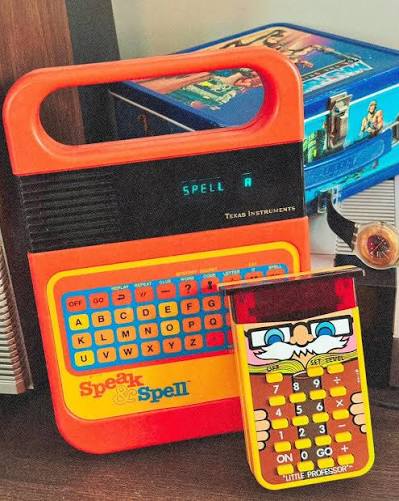
The chip inside a 1978 Texas Instruments toy was small enough to fit in a child’s hand, cost the company millions to develop, and did something no consumer product on Earth had done before: it made a machine talk using math instead of a recording. That toy was Speak & Spell, and the chip inside it, the TMS5100, is the direct ancestor of the speech compression still running quietly inside your phone every time you make a call.
Before Speak & Spell, “talking” toys and gadgets worked the way a music box does — they played back a physical recording, usually a tiny magnetic tape or a record-like disc hidden inside the casing. That approach was bulky, mechanical, and prone to wearing out. A team of engineers at TI’s Dallas research lab — Richard Wiggins, Paul Breedlove, Larry Brantingham, and Gene Frantz — set out to do something fundamentally different: generate a human voice from pure digital code, with no moving parts and no physical recording anywhere inside the device. Wiggins first demonstrated the concept in December 1976, and the team had a finished, sellable product by April 1978.
The breakthrough was a method called linear predictive coding, a mathematical shortcut for describing how the human vocal tract shapes sound. Instead of storing an actual recording of a word, the TMS5100 chip stored a compact set of numbers describing how to reconstruct that word’s waveform on the fly, then synthesized the voice in real time through a tiny speaker. It was, according to the IEEE’s own historical record, the first single-chip digital signal processor ever built for generating speech — a piece of engineering significant enough that the organization dedicated an official IEEE Milestone to it in October 2009, installed at TI’s own Dallas campus, honoring what the citation calls the technology that “led to the explosive growth of the DSP industry” across phones, medical devices, and industrial equipment.
The toy shipped with a small library of ROM-based word cartridges that could be slotted into the housing, letting kids expand its vocabulary beyond the built-in word list, and its plastic membrane keyboard let a child type a word letter by letter and get instant, electronically generated audio feedback — a genuinely new kind of interaction for 1978, closer to a rudimentary personal computer than to a typical wind-up toy. Internally, the same TMS5100 family of chips that gave Speak & Spell its voice also found its way, in modified form, into other TI products through the early 1980s, effectively seeding an entire generation of engineers with hands-on experience in an area of computing that barely existed as a commercial discipline a few years earlier.
That last part is the detail that tends to get lost under the toy’s goofy robotic voice and its “That is correct” chime. Linear predictive coding didn’t stay inside a $50 spelling toy. It became the mathematical foundation for the speech codecs that compress your voice into a signal small enough to travel over a cellular network without eating up the entire spectrum, and variations of the same underlying math still show up in voice assistants and audio compression schemes decades later. A toy built to help second-graders spell “cat” ended up seeding the compression science behind billions of phone calls.
The object itself now sits in a museum case rather than a toy chest. London’s Victoria & Albert Museum holds a second-generation Speak & Spell in its permanent collection, catalogued under accession number B.20-2022 and currently on display in the Young V&A’s Design Gallery, its case listing the original chiclet-keyboard first edition and the later membrane-keyboard version side by side as design milestones rather than nostalgia pieces. The museum’s own record doesn’t file it alongside other 1970s toys — it treats the object as a genuine milestone in personal computing, on the strength of the “digital signal processing of audio” packed inside a shell most people assumed was just electronic plastic. The Computer History Museum makes a similar case in its own permanent exhibit, grouping Speak & Spell with the microprocessor-driven consumer products that redefined what a household object could do.
It’s worth sitting with how odd that origin really is. The device that first proved a machine could generate a convincing human voice out of nothing but numbers wasn’t built in a defense lab or a university supercomputer wing. It was built so a kid stuck at the kitchen table could hear a robotic voice say “spell CAT” one more time, and somewhere in that repetition, the entire architecture of modern digital speech got its start.

Leave a Reply