

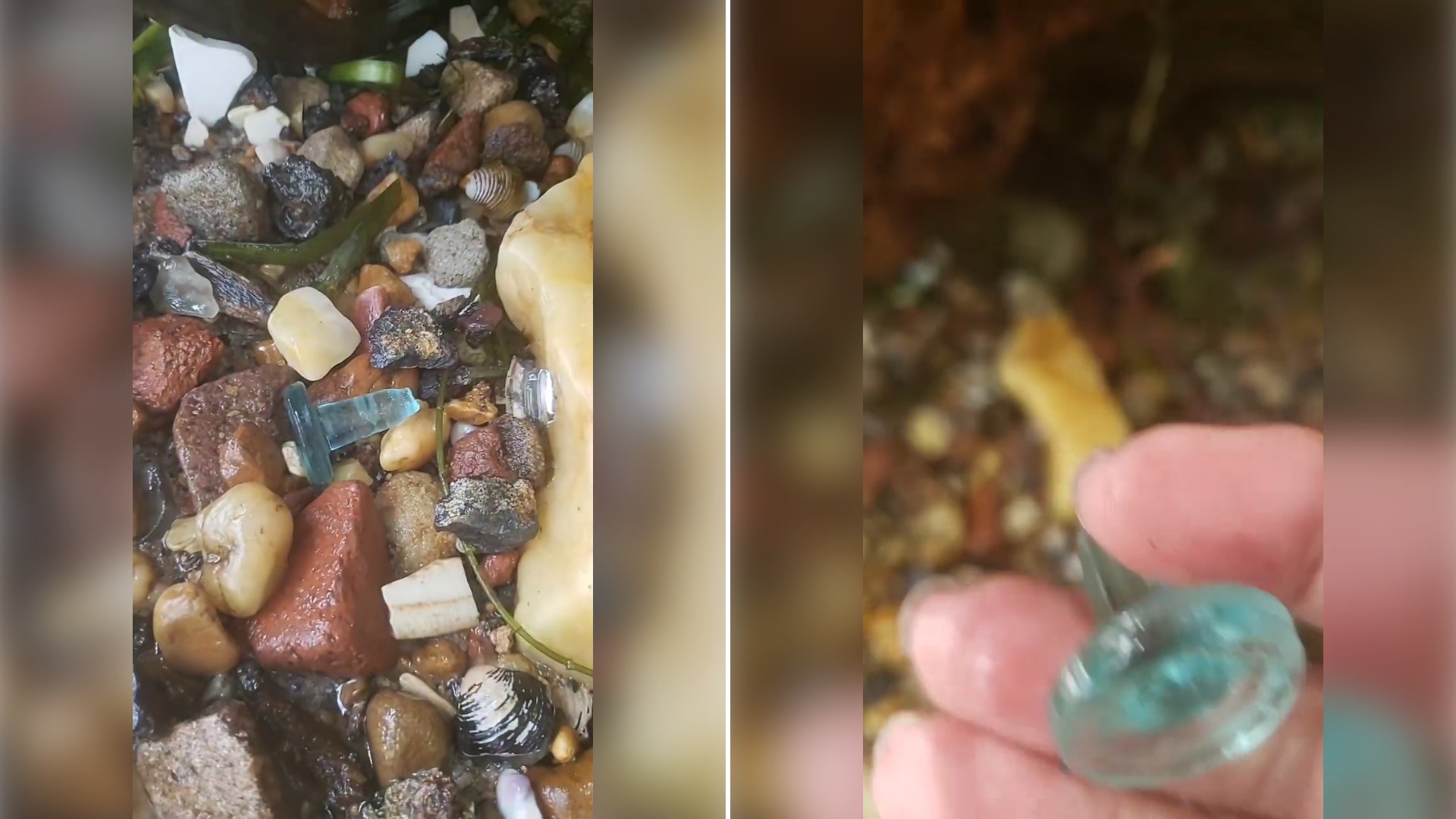
There is a particular kind of dedication required to go hunting for buried treasure in the middle of a storm, and @jennyjenx2 has it in spades. In this clip, she braves dangerous waves and an approaching nor’easter to search a rocky riverbed anyway, eventually turning up a weathered antique glass bottle stopper, another addition to an ongoing hobby built entirely around hunting for old, broken, and discarded objects that most people would walk right past.
Mudlarking, the practice of searching riverbanks, shorelines, and tidal flats for historical debris, has been quietly growing into one of the more compelling corners of the broader collecting world over the last several years. Unlike thrifting, where the hunt happens indoors under fluorescent lighting and among neatly hung racks, mudlarking takes place entirely at the mercy of weather, tides, and erosion, which is precisely what makes a find like this one feel earned rather than simply lucky.
Glass stoppers like the one recovered here were once a completely ordinary part of daily life, sealing everything from medicine bottles to household cleaning products before screw caps and plastic took over sometime in the early twentieth century. Their survival underground or underwater for a century or more, often chipped, frosted, or worn smooth by sediment, is part of what gives them their appeal. They are not rare in the sense of being valuable at auction, but they are rare in the sense that finding one requires genuine effort, patience, and a willingness to get your hands dirty in conditions most people would avoid entirely.
The decision to go out despite an incoming storm says something specific about the psychology of serious hobbyist hunters. Storms and rough surf actually tend to be productive conditions for mudlarkers, since churned-up sediment and shifting riverbeds can expose objects that have been buried undisturbed for decades. The risk calculation that leads someone to brave dangerous waves for the possibility of a find is the same impulse that drives estate sale regulars to show up before dawn or thrift store hunters to check the same location multiple times a week, just with considerably higher physical stakes.
There is also something quietly meditative about this specific style of content. Unlike the dopamine rush of thrift store reveals or pack-opening videos, mudlarking unfolds slowly, with long stretches of searching that may turn up nothing at all before a single object finally surfaces. That patience is part of the appeal for both the creator and the audience watching along, offering a kind of antidote to the instant gratification that dominates so much of short-form video content.
Social media has played an outsized role in bringing mudlarking into the mainstream collecting conversation. A hobby that used to be practiced quietly by a small, dedicated community, often along the River Thames in London, now has an enthusiastic following well beyond its traditional geography, with creators demonstrating that interesting historical debris can be found in rivers, lakes, and coastlines nearly anywhere.
Part of what makes these finds so compelling to watch is the direct, unmediated connection to the past they represent. A glass stopper does not come with a label explaining its exact origin or the hands it passed through, which leaves just enough mystery to make it endlessly interesting to speculate about. Was it tossed from a passing boat, lost during a flood, or simply discarded decades ago when its usefulness ran out? That ambiguity is a feature, not a bug, for anyone drawn to this kind of hunting.
For anyone inspired to try mudlarking themselves after watching a clip like this, it is worth noting that it comes with real risks worth respecting, from unpredictable currents to sharp buried debris, and that permissions vary significantly by location. But for those willing to put in the effort and exercise real caution, the reward is a direct, physical link to history that no museum display case can quite replicate.

Leave a Reply