

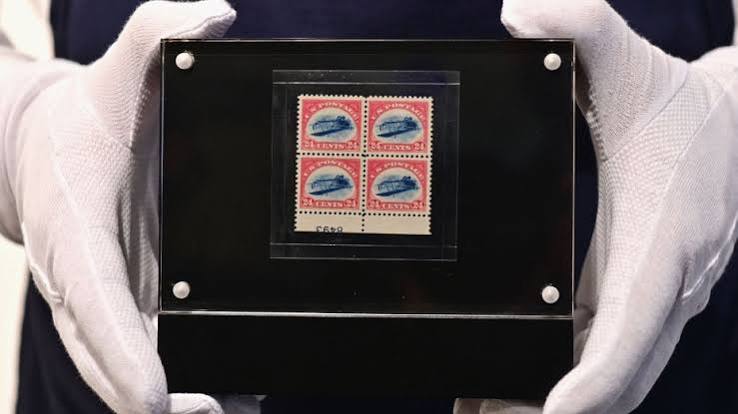
A single postage stamp sold for $2 million at a New York auction in November 2023. Not a sheet, not a block, one stamp, a 24-cent airmail issue from 1918 with a biplane printed upside down by mistake, according to NPR’s coverage of the sale. The buyer, real estate developer Charlie Hack, paid roughly $20,000 for every square millimeter of paper. Somewhere in the country right now, in a shoebox of old family letters nobody’s opened in decades, there’s a real, if extremely long, chance that a stamp worth a fraction of that is sitting inside an envelope waiting to be noticed.
An Upside-Down Airplane, Sold by Accident
The stamp at the center of the $2 million sale is known as the Inverted Jenny, and its origin story is a genuine printing accident rather than a design choice. Per the U.S. Postal Service’s own account of the error, the 1918 stamp required two separate passes through the press, one for the red frame and one for the blue image of a Curtiss “Jenny” biplane at its center, and printing a two-color stamp that way “was given to human error, as stamp collectors at the time well knew.” One sheet of 100 stamps went through with the plane printed upside down, and on May 14, 1918, a Washington, D.C. postal clerk sold the entire sheet to a customer named William T. Robey before anyone at the Post Office caught the mistake, a purchase now documented in the Smithsonian National Postal Museum’s own exhibition records.
Collectors have spent more than a century chasing down that original sheet of 100, and per NPR’s reporting on the record 2023 sale, nearly all of them have been accounted for over the decades since, with one known example stolen in the 1950s and never recovered. The specific stamp Hack purchased, catalogued as “Position 49” from its spot on the original sheet, had stayed inside the same family for multiple generations, kept out of light and never mounted in an album, which is precisely the kind of untouched condition that pushes a stamp’s value into seven figures.
The Inverted Jenny Isn’t Even the Rarest
As dramatic as the Jenny’s story is, it doesn’t top the list of the world’s most valuable stamps. According to a rundown of the field’s biggest sales, the 1856 British Guiana One-Cent Magenta, the only known surviving copy of that particular stamp, sold for $9.48 million in 2014 after spending decades out of public view. The 1847 Mauritius “Post Office” stamp, of which only 27 copies survive out of an original run of 1,000, has been valued as high as $9.6 million; famously, the last known example turned up when a schoolboy stumbled across it by accident in 1902. Even a block of four Inverted Jennys, rather than a single stamp, has sold for close to $4.9 million.
Why an Old Letter Is Worth a Second Look
What makes stamp errors different from most other attic treasures is how ordinary they look sitting in a drawer. A misprinted stamp isn’t flagged with a warning label; it’s just an envelope somebody’s grandparent mailed decades ago, indistinguishable at a glance from a thousand others, unless you actually stop and check the plate number, the color registration, or whether the image lines up the way it’s supposed to. Most attics don’t contain a $2 million stamp. But the reason these stories keep resurfacing, a sheet accidentally sold over a post office counter, a stamp rediscovered by a kid poking through old family papers, is that postal errors have a documented history of surviving in exactly the mundane, overlooked places nobody thought to search first.
Genuine finds are still rare enough that no one should expect to strike it lucky, and most old stamps really are worth face value or less. But the math behind these sales is real, verified by actual auction records rather than internet legend, and it means that a box of correspondence gathering dust in a closet is, at minimum, worth five minutes of careful attention before it gets thrown out. The upside-down plane that made history didn’t announce itself either. It just went into the mail like anything else, and it took a sharp-eyed customer at a post office counter to notice before it disappeared into circulation forever.

Leave a Reply