

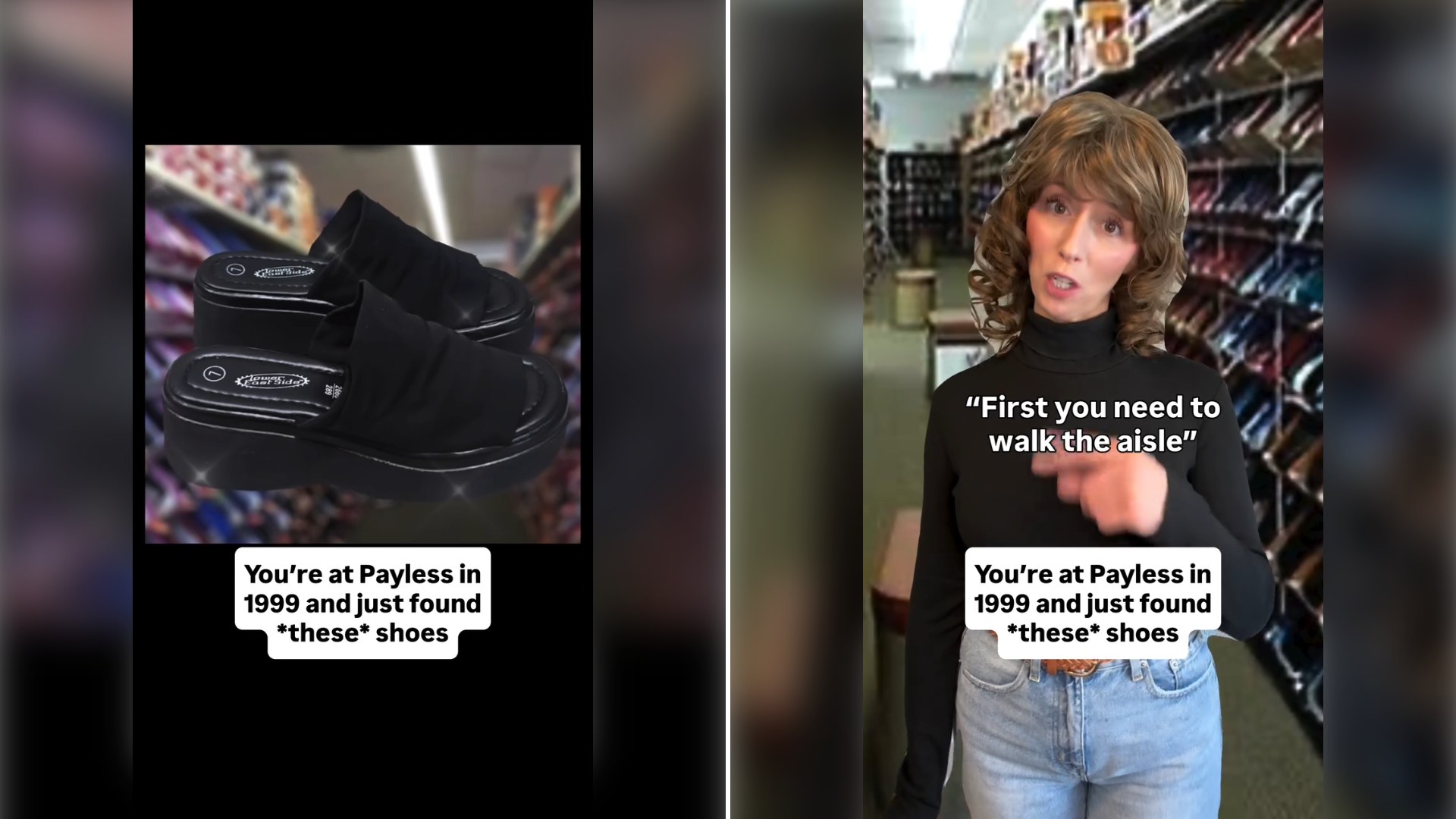
Few retail memories hit quite as specifically as a childhood trip to Payless, and @becky_strasburger brings that exact memory back to life in this video. In a clever two-character sketch, she plays both herself as a kid and her own mother, revisiting a very specific childhood routine: hunting for the best knockoff shoes on the Payless ShoeSource aisle back in 1999.
Payless ShoeSource occupied a genuinely unique cultural position in American retail throughout the 1990s and 2000s, serving as the go-to budget shoe destination for an enormous swath of families, which gave it an almost universal shared-memory status among people who grew up during that era regardless of where in the country they lived. The chain’s eventual closure in 2019, and its subsequent limited relaunch, only intensified the specific nostalgia many millennials and older Gen Z shoppers now feel toward the brand and the very particular shopping experience it represented.
The dual-role comedic sketch format, where a single creator plays both their childhood self and a parent, has become a particularly effective vehicle for this specific kind of nostalgic content, allowing a creator to dramatize a genuinely universal family dynamic, the negotiation between a child’s brand preferences and a parent’s budget constraints, entirely through solo performance. That format requires genuine comedic timing and character differentiation to land successfully, which makes a well-executed version especially satisfying to watch.
Knockoff or generic-brand shoes specifically carried a very particular social weight for kids growing up in the late 1990s, when brand-name sneakers functioned as genuine social currency at school, and a trip to a budget retailer like Payless often meant navigating real tension between a child’s desire to fit in and a family’s practical financial constraints. Recreating that specific negotiation captures something emotionally true well beyond simple shoe shopping nostalgia.
This kind of hyper-specific retail nostalgia has become an increasingly popular content category, as creators discover that naming an exact store, year, and shopping scenario tends to generate far more genuine engagement than vaguer, more generic references to childhood or the decade as a whole. The specificity itself, Payless ShoeSource, 1999, exactly, is what triggers such a vivid, immediate recognition for viewers who shared that same experience.
There is also something quietly meaningful about recreating a parent’s perspective within this kind of sketch, offering a small moment of retrospective empathy for the budgeting and compromise parents regularly navigated that may not have been fully apparent to a child at the time. Playing both roles allows the creator to honor both sides of that specific childhood memory simultaneously.
Content like this ultimately demonstrates the enduring power of hyper-specific retail nostalgia to connect with a wide, shared audience, proving that even a now-defunct discount shoe chain can carry genuine emotional weight decades later, simply by being named exactly and recreated with real comedic honesty.

Leave a Reply