

“In 1977, a Sony-built video recorder in the Sears catalog cost more than a used car. Families bought it anyway. Within 10 years, that machine was blinking 12:00 in most living rooms in America.”
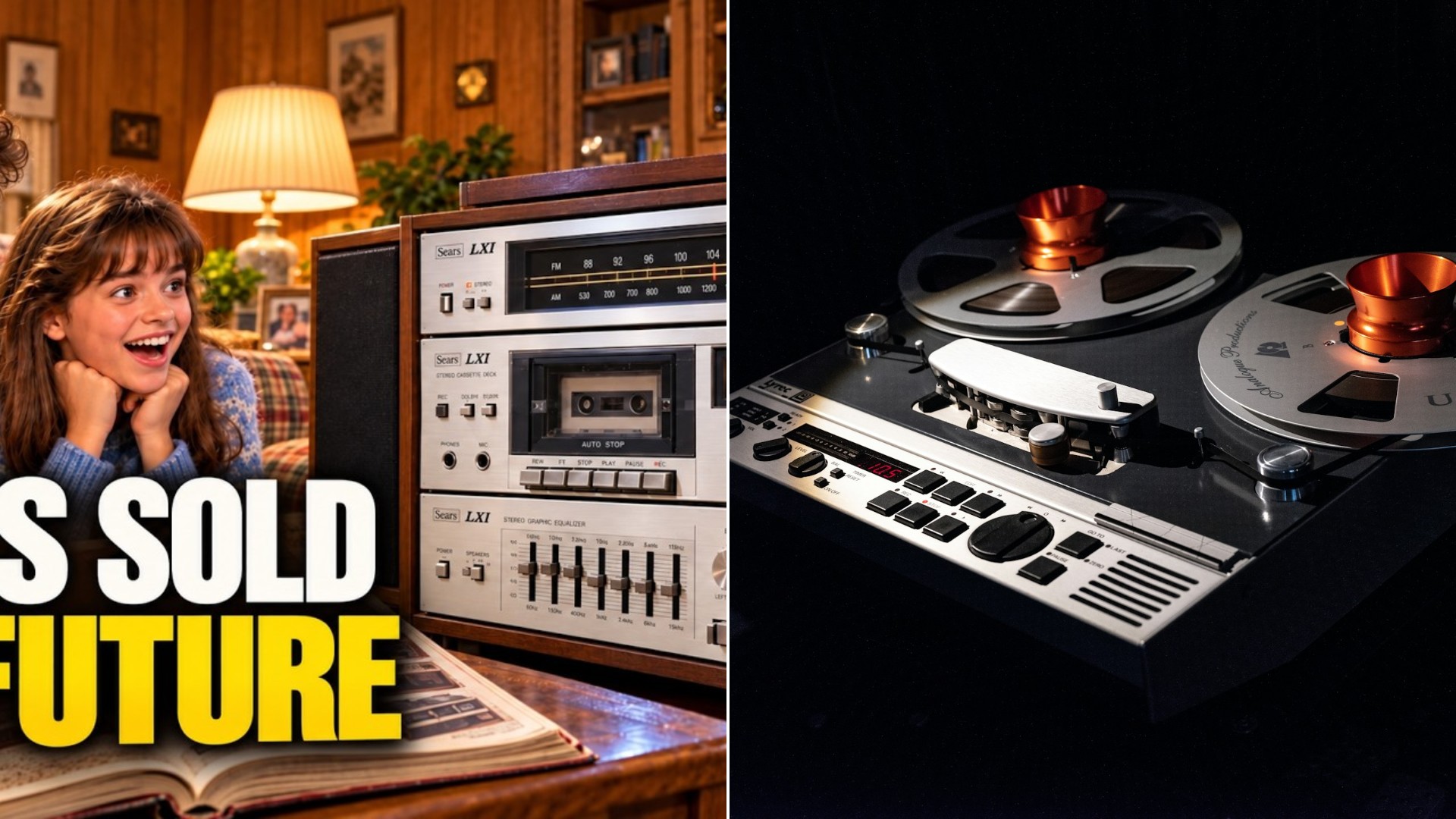
That is how The Technology America Left Behind opens a countdown of 25 machines from the Sears Wish Book, the catalog pages kids circled in ballpoint pen. The list runs from the eight-track tape player to the family VCR.
Two teasers hang over the whole list. One machine cost a giant company over half a billion dollars and vanished in five years. Another started a war fought on TV by a famous writer.
The Eight-Track Player Was Already Dying, But Sears Kept Selling It
At number 25, the eight-track. By 1980 it was on its way out, yet the catalog still showed home decks with chrome faceplates and wood grain sides next to the newer cassette machines.
It was born in the mid-1960s when Bill Lear, the man behind the Learjet, teamed up with Ford and RCA. By 1966 Ford offered factory players in new models.
The tape was a continuous loop, so it never needed rewinding. But albums had to be split into four programs, so your favorite song would fade out halfway, the machine would go “kachunk,” and the song would fade back in on the next track.
Record stores stopped stocking them in the early 1980s. The Columbia House mail order club kept shipping eight-tracks to loyal members until 1988.
The Typewriter Sold By The Thousands, And Liquid Paper Came From A Kitchen Blender
Number 24, the electric typewriter. Sears sold them by the thousands, many built by Smith Corona with the Sears name on the case. A good portable electric cost somewhere between $150 and $300 in the early 1980s.
For a kid heading to high school or college, it was not optional. Term papers and job applications had to be typed, and your mother might have typed her church newsletter on it at the kitchen table.
Mistakes were the enemy, which brings up a famous bit of history. Liquid Paper was invented by a Dallas secretary named Bette Nesmith Graham, who mixed white paint in her kitchen blender in the 1950s to cover typing mistakes. Her son Michael Nesmith later became one of the Monkees.
In 1979 she sold the company to Gillette for $47.5 million.
A Soft Click In The Dark And A Bill Murray Movie
Number 23 sat on every nightstand in America, the flip number clock radio. A row of white number cards flipped over every minute with a soft click, and by the 1980s Sears sold its own versions for around $25 to $40.
In 1993, Bill Murray woke up to a Panasonic flip clock radio playing “I Got You, Babe” over and over in Groundhog Day. The clock became one of the most famous props in movie history.
It lost out to red LED digital clocks, which were brighter and cheaper, but silent. “There was something about hearing that soft little click in the dark that made a bedroom feel like home.”
The Calculator Watch Was Banned From Tests, Which Only Made It Cooler
Number 22, the calculator watch. Casio released early models around 1980, and the jewelry section of the Sears catalog sold them for $30 to $50.
The buttons were so tiny you pressed them with a pencil tip. Teachers caught on fast, and calculator watches got banned from tests across the country. Marty McFly wore one in Back to the Future, and every boy wanted one.
The host jokes the smartwatch on your arm today is the grandson of that Casio and still cannot match its battery life. Some of the originals ran for years on a single coin cell.
Breaker One Nine: America’s Wild CB Radio Craze
Number 21, the CB radio. The craze caught fire in 1975 when the song “Convoy” by C.W. McCall hit number one, and in 1977 Burt Reynolds tore across the South in Smokey and the Bandit.
Sears sold CB radios under the Road Talker name, and a decent mobile unit ran $80 to $150. In 1977 the FCC expanded CB from 23 to 40 channels because the airwaves were jammed. Channel 19 was for truckers and channel 9 for emergencies.
Everyone had a handle, like Big Daddy or Hound Dog. People traded warnings about speed traps, called Smokey Reports. The FCC license requirement was dropped in 1983, because millions of people were ignoring it.
The Police Scanner Was The Original Social Network
At number 20, the police scanner. Many ordinary families kept one on top of the refrigerator, cycling through frequencies with a row of racing red lights. Regency and Bearcat dominated, and Sears sold scanners for $100 to $250.
Early models needed a crystal for each frequency, and later models were programmable, which felt like the space age. In small towns, the scanner told you whose barn was burning when the fire whistle blew.
Number One: The Family VCR That Blinked 12:00 Forever
At the top of the list, the family VCR. Sears sold its own Betamax as the Beta Vision, for well over $1,000. A year later JVC’s VHS arrived, and for a few years every neighborhood had a Betamax house and a VHS house.
In 1984 the movie studios took Sony to the Supreme Court. In a 5 to 4 decision, the court ruled that taping a show to watch later was legal, and that changed everything. Blockbuster opened its first store in 1985.
The last VCR was made in 2016. For nearly 30 years, the host says, it was the heart of the American living room. “It turned television from something that happened to you into something you chose.”
Dig Through The Attic And See What You Find
The host ends with a challenge. Search your basement, attic or your parents’ hall closet for one of these machines, whether it is an answering machine, a flip clock, a box of mixtapes or camcorder tapes nobody has watched in 30 years.
- Test any old electronics before plugging them in and keep original boxes.
- Check whether old tapes and manuals are still with the machine, since complete sets matter to collectors.
- Save the Wish Book too, if you still have it with the toys circled in pen.
More Stories You May Like
- That Rare Label On An Online Listing Does Not Make It Valuable So Check Sold Listings Before You Pay The Asking Price
- Young Woman Quietly Carried Her Southern Belle Grandmother’s Vintage Dresses Out Of The Basement For A Ninetieth Birthday Surprise Grandma Has Wanted For Years
- Dinner Plates That Cost $1,213 For A Set Of 12 In 1982 Now Draw A High Bid Of $110 For 66 Pieces Of The Same Lenox Pattern

Leave a Reply