

“I’m Dr. Lori. I’m in Seattle, Washington at the largest Goodwill store in the world. I’m going to show you what to buy. I’m going to show you what to walk by.”
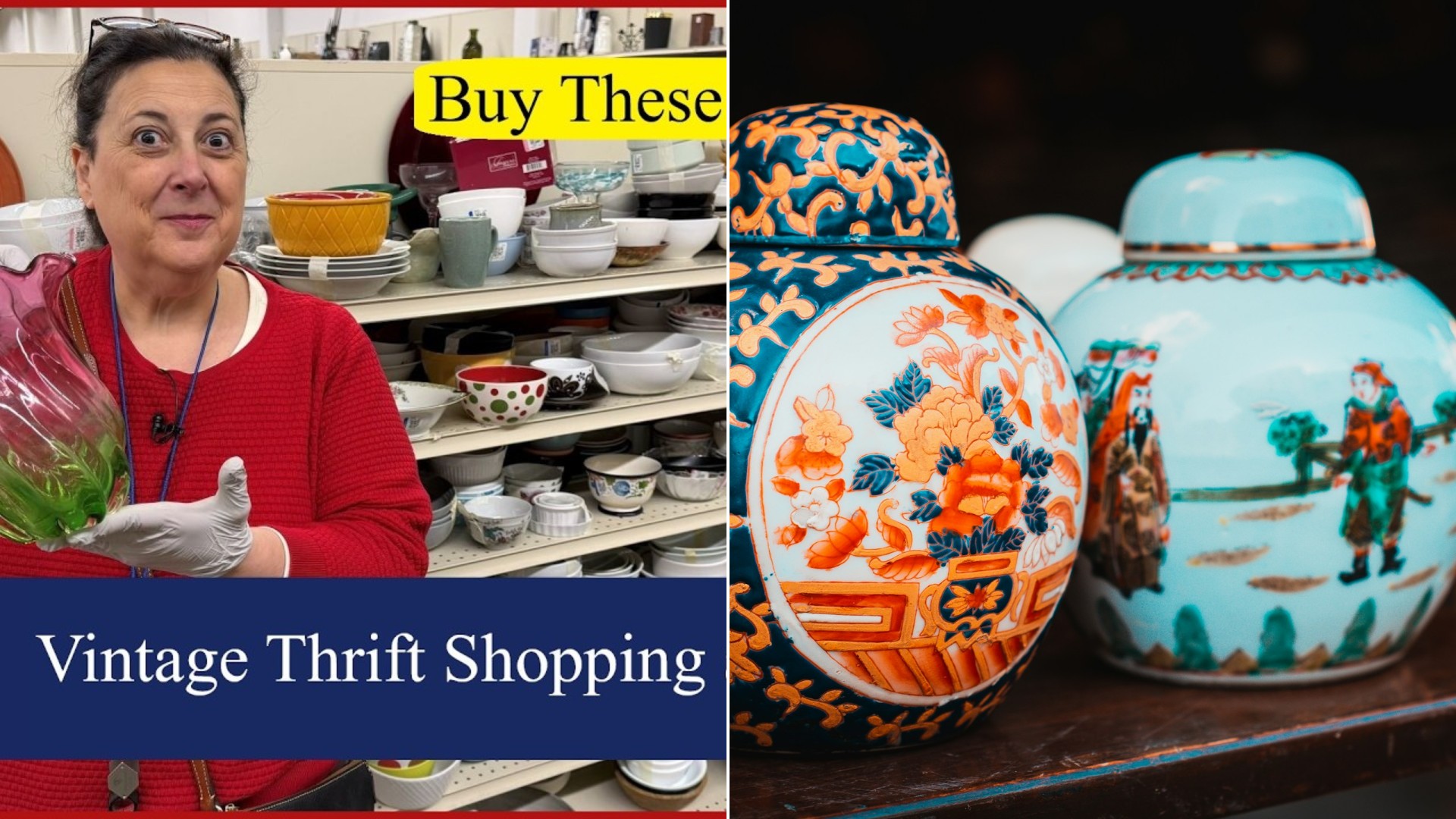
That is how antiques expert Dr. Lori opens a walk through the biggest Goodwill on the planet, price tag in one hand and resale value in the other. Her verdicts come fast, and a few of them are surprisingly generous.
The $12.99 Porcelain Piece She Says Is Worth $50
Her first big find is a piece of Noritake. She points to the “M in the middle,” which stands for Morimura Brothers, the manufacturer.
The price is $12.99. “This piece is worth $50,” she says. “I’d buy this.”
That sets the pattern for the rest of the video. She reads the maker’s mark, names the era, checks the price and gives her verdict in one breath.
Glass Bargains Priced At $2.99 To $9.99
A blueberry Pyrex pie plate is $2.99 and, she says, worth $15. She likes the uppercase Pyrex letters as a sign of age.
A cased glass vase, white inside and eggplant outside, is $5.99 but worth only $10, so she passes. Her reason is the thick bottom, since “you want that to be very thin at the bottom. That’s an indicator of quality.”
A three-tone American glass vase from the 1960s is $9.99, and she says willing buyers pay $60. Her tip is to look for a rough scraped spot on the base, which tells you how thick the glass is.
Fleck glass bowls are $7.99 for two and worth $15 each. A set of three blue glass plates at $5.99 earns her loudest approval. “I’d buy these and I would run. They’re $20 a plate.”
“Stop Complaining,” She Tells Shoppers Who Say Staff Reprice Behind Her
Midway through, Dr. Lori turns to critics. Some viewers claim that when she names a value, Goodwill workers rush over and raise the price.
“No one’s following me,” she says. “There’s nobody around here. They’re doing their job. I’m taping. It’s not happening. Stop complaining.”
She points out that the building is packed, and that she can hear the banging of workers filling the shelves. She says she will leave her treasures behind for the next shopper.
The Cheat Sheet On China And Ceramics
A Victorian transfer-ware plate from Imperial China is $14.99, and she values each at $30. She says the colored bands, in yellow, red, green or blue, were popular from the 1940s to the 1960s.
A Royal Doulton saucer at $5.99 is not a buy. It dates to the 1980s and is worth about $3, even though bone china is a good sign of quality because it is made with cow bone ash.
A set of Wallace China from Los Angeles is $7.99, and she says the 1950s pieces are collected and worth $5 each. A set of four HB Selb porcelain pieces made in Germany is $12.99 and should be priced at $25.
A Syracuse China collector plate is a mere $1.99 and worth $10. A Rosenthal set of three plates is $3.99 and worth $20.
Furniture And Clothes Worth A Second Look
She digs out three chairs to find a wicker rocker from the turn of the 20th century. It is $9.99, worth $150 as is, and $300 in good condition.
A 1960s office chair with its original vinyl and rubber pads is $9.99 and worth $40. A reupholstered chair at $19.99 is worth $50, but a solid hardwood version would be $150. Her trick is to knock on the wood. If it sounds hollow, it is not solid.
Clothes get the same treatment. A Calvin Klein piece is worth $35, and she says to check the zipper, since metal ones zip easier and rubbing a pencil’s graphite on them helps. A Marc Jacobs wool sweater at $14.97 should bring $35, and a Jones New York shirt at $9.99 is a bargain at a $20 retail value.
What To Pass On
Not everything gets a yes. A mass-produced print on canvas at $5.99 is worth $5, and she spots it by the straight line along the edge. A pressed glass fruit and nut dish is $2.99 and worth $3, so she walks by.
A blue and white piece with a late 20th century mark at $7.99 is worth about $3, and a Japan plate from the 1960s at $2.99 is worth $5. A J.Crew piece at $7.99 is worth $5 on the resale market.
Your Own Thrift Store Checklist
You can use her approach on your next trip. Start with the bottom of every piece, because marks tell you the maker and the age.
- Look for maker names such as Noritake, Rosenthal, Wallace and Syracuse.
- Knock on wood furniture to check that it is solid.
- Run your thumb over glass bases to feel how rough or thin they are.
- Use a magnifier to look for the dot pattern that marks a print rather than an original painting.
- Remember the numbers: she says an original of the print she checked could be worth about $50, while the print is worth $10.
Her last line is a favorite of thrifters everywhere. “I left all the treasures here for you. There’s more to come.”
More Stories You May Like
- Thrifting Duo At A Goodwill In Troy New York Spots A Signature Pattern They Have Never Seen And Jadeite And Then Asks If It Is Worth It
- One Estate Sale Dealer Says Family Silver Now Leaves Most American Homes Weighed On A Little Kitchen Scale Because It Has Two Prices That Barely Match
- Vintage Board Games Missing Pieces Are Worth A Fraction Of Complete Ones So Check Every Piece Before You Buy

Leave a Reply