

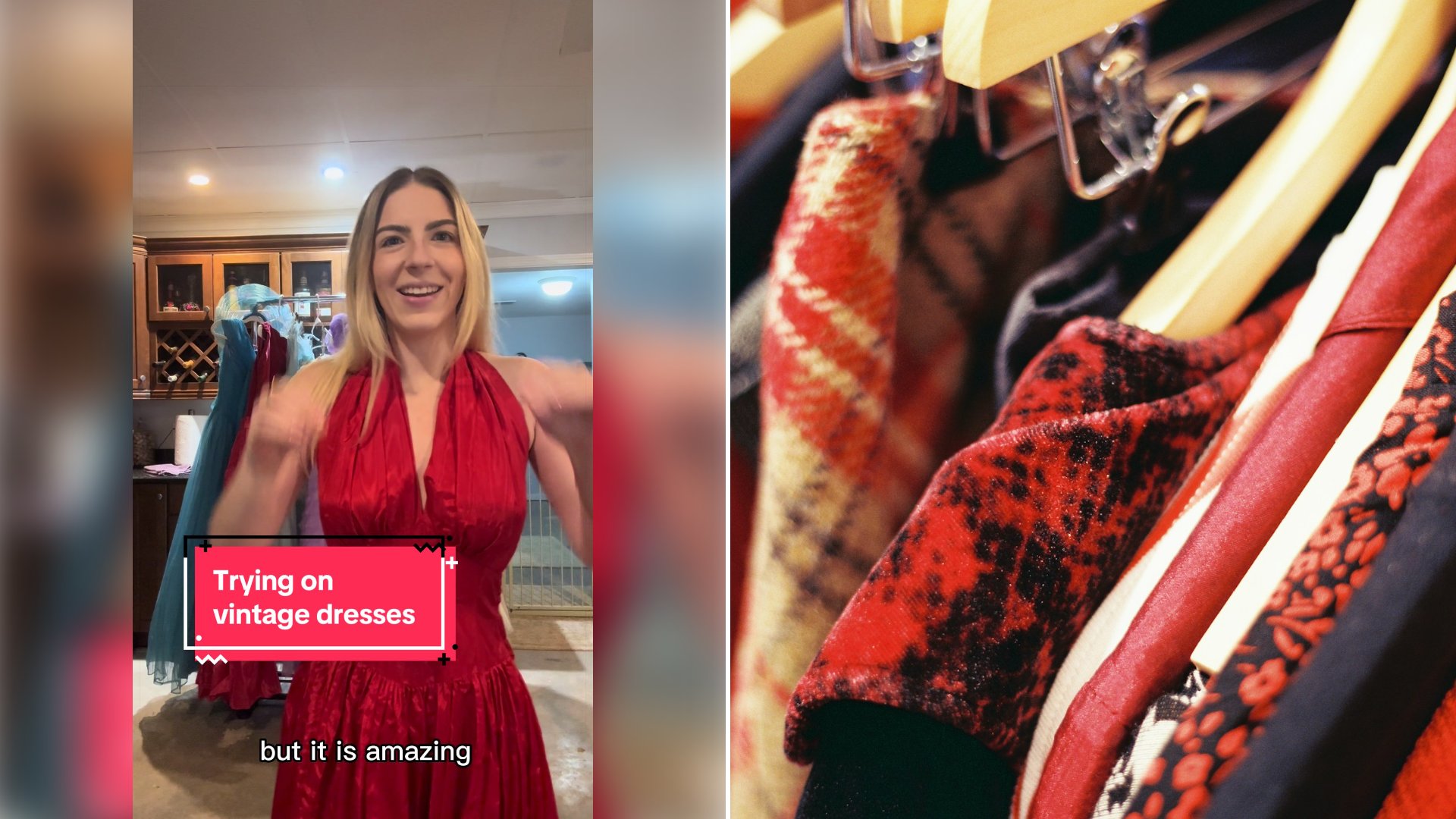
Every family has a basement, an attic or a back closet where the good stuff ends up. For the creator who posts as @rachel.e.altman, the good stuff was her grandmother’s collection of vintage dresses, and she shared on social media that she had quietly taken them out of the house on purpose. The reason is a surprise she hopes will mean a lot to her grandmother when she turns ninety.
@rachel.e.altman
What follows is a long try on session, dress by dress, with a lot of detail about fit, fabric and construction. It is part one of a series, and it is a fun look at what vintage Southern fashion can look like up close.
A Grandmother Who Was A Southern Belle
She says she is about to try on a bunch of her grandmother’s vintage dresses, and that she is pretty sure most of them date to the 1950s. Her grandmother, she explains, is from Central Georgia, and Southern belle is basically what she was. Some of the dresses carry tags from brands, while others she believes were handmade, possibly by her grandmother or by her grandmother’s mother.
She notes a few differences between herself and the woman who first wore the dresses. She says she has a little more in the hips than her grandmother did, and that her grandmother was taller. She puts herself at five foot one and thinks her grandmother was around five foot five when she was younger. She says the first dress she tries is just a little long.
Why The Dresses Left The Basement
She says she literally snuck the dresses out of her grandmother’s basement. The family had gone over for Mother’s Day, and that was her chance. She says she knew the dresses were there because she had tried them on years and years ago.
There is a reason she cannot simply ask. Her grandmother’s ninetieth birthday is in September, and she says her grandmother has wanted for years to have pictures taken of her granddaughter in these dresses at an antebellum house. The plan is to surprise her. She decided to get a head start a couple of months early, and she has a deadline. She says everything has to be finished by the end of July, because she leaves for school in August and will be out of state.
The Four Dresses In Part One
She says the first dress fits pretty well and is just a little long.
The second, she thinks, might have been handmade. It comes with a matching little top that she describes as really tiny. She says she is a size two but fuller on top, so the fit there is not perfect.
The third is one of her favorites. She says it is maybe from the 1950s or edging into the sixties, and it is super big, with crinoline underneath.
The fourth, she says, was definitely handmade, and she can tell by the stitching on the inside. It is made entirely of tulle, has boning and bows running down the back, and is the only one of the group with a zipper. She says she remembers this one from when she was a kid. The purple dresses and a white one are saved for part two.
What Makes A Dress Look Handmade
Her inside seam clue is a good one, and it is worth knowing if you ever find old dresses in a family trunk or at an estate sale. Here are some general ways people tell a handmade garment from a store bought one.
Start by turning the dress inside out. Factory made garments of the mid twentieth century usually have tidy, uniform seam finishes, often pinked or overcast at the edges, and they tend to have a woven label sewn into the neckline or waistband. Home sewn or dressmaker pieces may have hand finished hems, slightly uneven stitching, seam allowances bound with bias tape, or hooks and eyes sewn by hand. None of that makes a dress less valuable. Often it makes it more special, because it means someone built it for one particular person.
Look at the zipper, too. Metal zippers were common for decades, and the style of the zipper pull and teeth can help narrow down an era, though a zipper can also be replaced during a repair, so it is not proof on its own. Side zippers were common in the 1950s and 1960s. A dress with only one zipper and a lot of boning, like the tulle dress she describes, suggests careful, structured construction.
Trying On Vintage Dresses Safely
If you ever get to try on a family heirloom, a few precautions help the dress last. Wash and dry your hands first, and take off jewelry, belts and anything with a clasp that could snag tulle or lace. Step into a dress rather than pulling it over your head when you can, and ask a helper to work the zipper so the seam is not strained. Old fabrics, especially silk, rayon and anything with a lot of crinoline or netting, can become brittle over time. If you hear a seam creak, stop and take the dress off rather than forcing it.
Fit is another thing to plan for. Vintage sizing does not match modern sizing, and women in the 1950s were often fitted over foundation garments such as girdles and structured slips that shaped the waist. A dress that looks small on the hanger may fit better with the right undergarments, but it may also simply not work for a different body, and that is fine. Pins and clamps can help a photographer fit a dress for a shoot without altering the original stitching.
Planning A Photo Shoot In Vintage Clothing
The idea of photographing a granddaughter in her grandmother’s dresses at an old house is a lovely one, and the planning is worth doing carefully. Pick a date with soft, even light, such as early morning or the hour before sunset, and plan for the heat if you are in the South in summer. Tulle and crinoline can be warm to wear, so build in breaks and shade. Bring a steamer, safety pins, a lint roller and a small sewing kit. Keep food and drinks away from the dresses, and think about a flat clean surface for changing.
If the location is a historic house, contact the owners or the organization that runs it well ahead of time. Many such places have rules about photography, permits, fees and the hours when they are open to private shoots. It is also worth reading up on the history of the property so the photos tell a respectful story. Some historic sites have complicated pasts, and thoughtful planning keeps the focus on the family and the clothing.
Finally, think about storage afterward. Once the pictures are done, the dresses will be safest in breathable garment bags or acid free boxes, away from damp basements, which are a common source of mildew. A basement may be a fine hiding place for a surprise, but it is rarely the best long term home for delicate fabric.
A Family Project With A Deadline
What makes this story charming is the combination of a small family secret, a big birthday and a ticking clock. A granddaughter slips the dresses out over Mother’s Day weekend, tries them on one at a time, and aims to finish before she leaves for school in August. The finished photographs, whenever they happen, are meant for a woman who has hoped to see them for years. For now, part one is a good reminder that the clothes in an older relative’s basement are often more than clothes.

Leave a Reply