

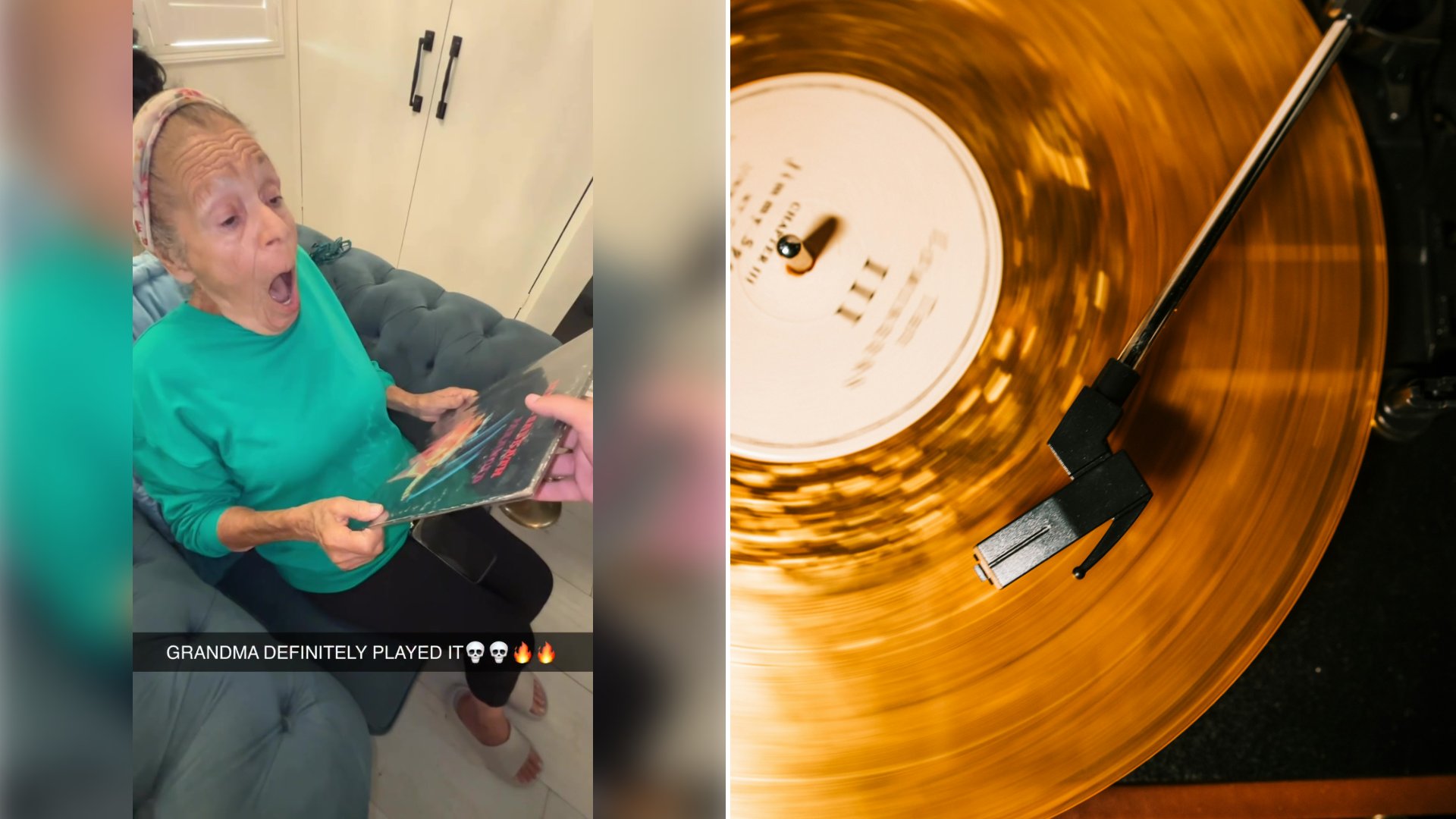
A grandson films himself handing his grandmother a record sleeve she hasn’t held in decades, the kind of setup that usually ends in a quiet, misty-eyed smile and a slow trip down memory lane. This time it goes somewhere else entirely. The second the needle drops into the groove, she’s up on her feet, moving like the decades in between never happened, singing every word and pulling off a performance that catches the whole room off guard.
The clip, posted by @bigtastystudios, plays out like a two-act surprise. Act one is the handoff: a little hesitation, a flicker of recognition on her face as she reads the label, then the slow realization of exactly which pressing her grandson tracked down. Act two is the record actually spinning, and it’s the part that turns a sweet family moment into something people keep rewatching. She doesn’t just hum along or tap a foot. She’s dancing, singing full-voiced, and clearly right back in whatever room or year she first heard that song.
@bigtastystudios
Moments like this aren’t just sentimental, they’re backed by actual psychology. Researchers have long documented something called the “reminiscence bump,” the well-established finding that the music people heard roughly between ages 10 and 30 gets locked into memory more strongly than music heard at any other point in life, and tends to stay the most emotionally vivid for the rest of their lives. That’s why a song from someone’s teenage or young adult years can trigger a far more physical, embodied reaction than almost anything else, including the urge to get up and move exactly the way she does in this video.
Vinyl itself has had a real second act that makes this kind of gift more meaningful than it might have been a decade ago. After near-disappearance in the CD and early streaming era, vinyl sales have climbed for more than fifteen consecutive years in the United States, and new vinyl has outsold CDs every year since 2020, according to industry sales tracking from the Recording Industry Association of America. That resurgence means original or well-preserved pressings from decades past have become genuinely harder to find and, in many cases, more valuable, which is part of why a grandson tracking one down specifically for her counts as a real gesture and not just a nostalgic prop.
The format also plays a role in why the reaction lands so differently than it would with a phone or a streaming playlist. A physical record demands a ritual: finding the sleeve, setting the needle, waiting for that first bit of surface noise before the song starts. That small delay and physicality is part of what makes the memory feel earned rather than instant, and it’s likely part of why her response reads as so unfiltered and immediate once the song actually starts.
It’s also a reminder of how much family history can sit inside a single object most people would walk past at a thrift store or estate sale. A beat-up record sleeve, a specific pressing, a scratched-up label, all of it can be the key to unlocking a memory that a photo or a story never quite reaches the same way. That’s exactly why clips like this keep circulating. They don’t just show a nice moment between a grandmother and grandson, they show how much power an old, physical object can still hold over someone decades after they first heard it.
More from Vinyl and Velvet
- Spy Museum Exhibitions Coordinator Plays a Modern Recreation of a Soviet Bone Record, Led Zeppelin on Somebody’s Rib X Ray With the Center Hole Burned Through by a Lit Cigarette
- Gen X Creator Lists Childhood Things That Felt Normal, From Waiting in a Running Car to Buying Cigarettes for His Parents and Spending Hours Out of Reach of Any Phone
- Rob Lowe Tells a Podcast Host the 1980s Were Better for Fame Because There Was No Social Media or Cell Phone Cameras and You Just Did Not Know Where Anybody Was

Leave a Reply