

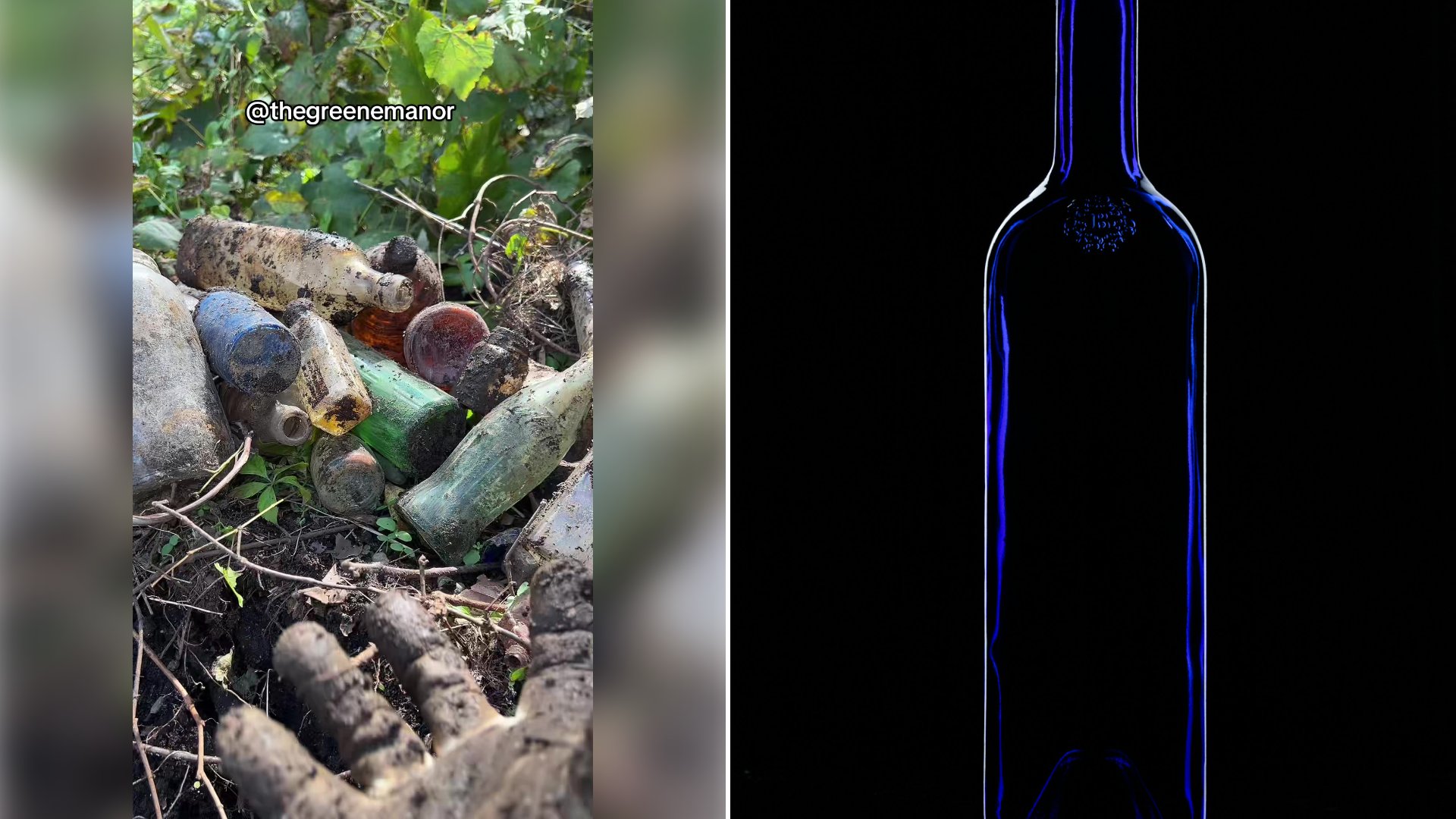
“Good morning!!!” is not the caption most people would choose for a muddy fistful of century-old glass. For a dedicated bottle digger, though, it’s exactly the right one.
The clip, simply captioned “finding cool things while digging,” opens on a tangle of antique bottles pulled half out of the earth in an overgrown, vine-covered patch of ground. A gloved hand brushes away dirt and roots to reveal the haul underneath: a crusted amber bottle still caked in soil, a deep cobalt blue bottle, several pieces in varying shades of green, and at least one bottle with an unusual reddish-amber tint catching the light. They sit jumbled together exactly as they came out of the ground, clearly having been buried as a group rather than lost individually over time.
Finds like this almost always trace back to the same source: an old household trash pit. Before municipal garbage collection became standard across most of the United States in the mid-twentieth century, rural and small-town households commonly dug a pit somewhere on the property, often near a tree line or back fence, and used it for years to dispose of bottles, crockery, and other household refuse. Those pits are exactly what bottle diggers search for today, since a single productive dump can hold decades of a family’s discarded glass in one concentrated spot, all of it dated to roughly the same stretch of years based on what bottle styles and colors were in common use.
Color is one of the first things serious diggers use to sort and date a haul like this. Cobalt blue glass was commonly used for medicine, poison, and some mineral water bottles, in part because the dark tint helped protect light-sensitive contents and in part because it made poison bottles instantly identifiable by touch and sight, a genuine safety feature before modern labeling. Amber glass served a similar protective purpose for beer and medicine bottles, shielding contents from UV light that could degrade them. Green glass, meanwhile, was the default for everyday utilitarian bottles and was often simply a byproduct of the raw, iron-rich sand most glassworks had on hand, making it the cheapest and most common color produced.
The comment section lit up with the kind of enthusiasm only a true bottle-digging audience brings, with more than 500 comments trading guesses about individual pieces and requests to see specific bottles cleaned up and photographed properly. That’s the normal second act for a haul like this: what comes out of the ground caked in dirt rarely tells its full story until it’s been soaked, soft-brushed, and set in the light, at which point embossed lettering, maker’s marks, and manufacture dates the digger couldn’t see in the field tend to surface, turning one muddy pile into a properly sorted collection.
@thegreenemanor
More from Vinyl and Velvet
- Collector Brings His Diet Coke Silver Bar in an Ice Cube Capsule to a Coin Shop, and the Dealer Offers Double Melt, $120 With Silver Sitting at About $60 an Ounce
- Thrifter Spots a Dried Out Carved Folding Book Stand Someone Donated, Brushes Conditioner Into Every Cutout, and Commenters Say It Is a Rehal, a Stand Used for Reading the Quran
- Volunteer Gravestone Cleaner Asked Viewers Who Joseph Lampkin Was, Then Cleaned His 1871 Headstone and Revealed the Railroad Dump Car Accident That Killed Him at 17

Leave a Reply