

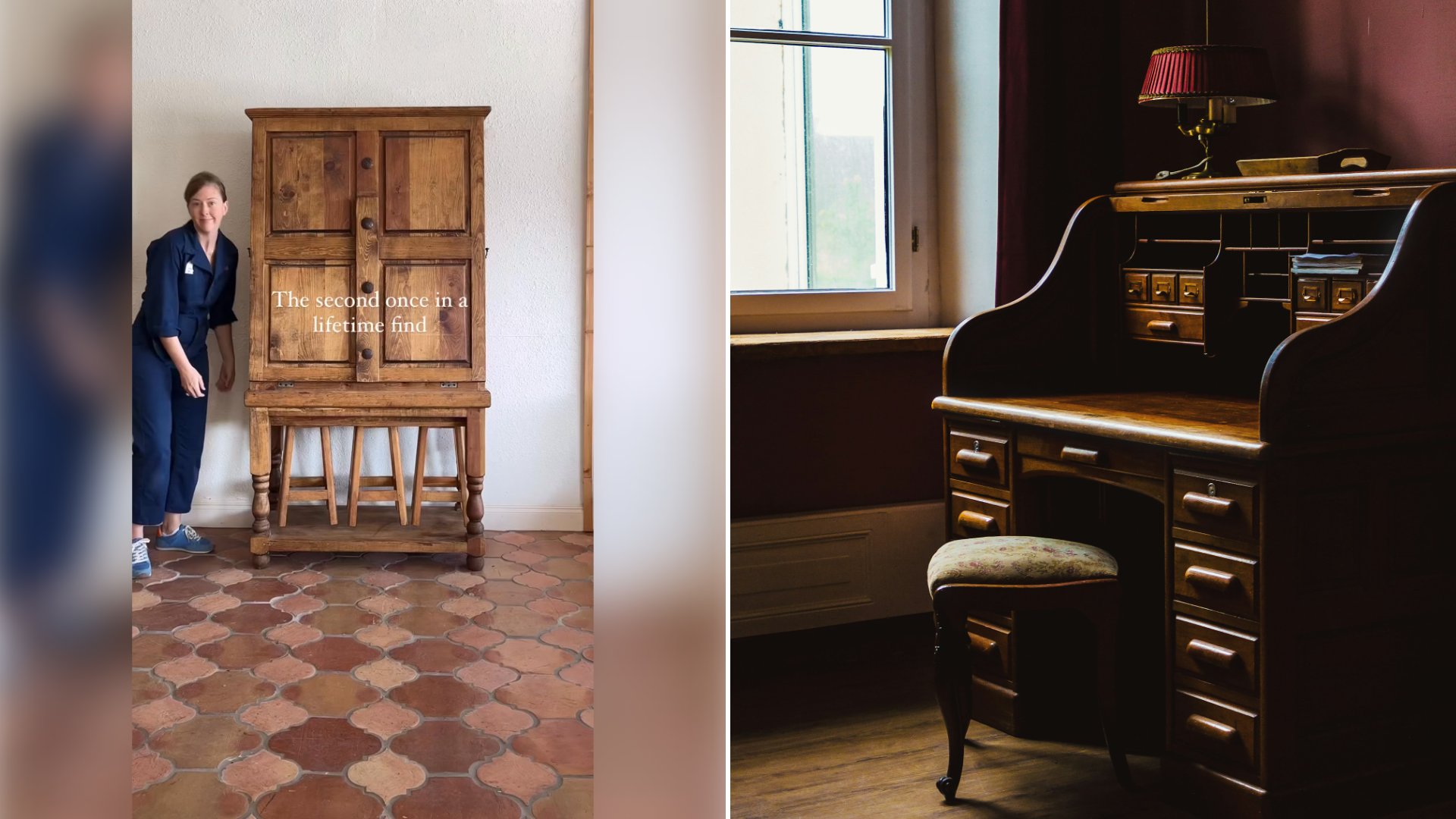
Convertible furniture built to disguise one function inside another has a long history, mostly born out of necessity in smaller homes where every piece of furniture needed to earn its keep by doing more than one job. A vintage dealer recently showed off a striking example of exactly that kind of design: a rustic wooden hutch cabinet that looks, at first glance, like an ordinary storage piece, until its front doors fold down to reveal a fully functional dining table for four hidden inside the whole time.
The reveal starts simply enough, with four matching round wooden stools tucked away underneath the cabinet’s bottom shelf, stored flush against the base where they would be easy to overlook entirely if a buyer were not specifically looking for them. Pulling them out and arranging them in front of the piece is the first sign that this is not a standard storage cabinet, since ordinary hutches have no reason to come with a built-in seating set.
The real transformation happens at the front of the cabinet, where the two vertical doors that would normally swing open on side hinges instead fold straight down and outward, hinged along their bottom edge rather than their side. As the doors drop into a horizontal position, an integrated center support leg swings down from beneath the structure to brace the newly formed tabletop, giving it the stability needed to actually function as a dining surface rather than just flopping open for show. It is a deceptively simple mechanical solution: two flat panels and a single folding leg, combined to turn a vertical storage front into a horizontal table without needing to add a single separate piece of hardware.
Once the table surface is locked into place, the interior shelving that had been hidden behind the closed cabinet doors becomes fully visible and accessible, essentially doubling as a sideboard positioned directly behind where diners would sit. The dealer staged the final reveal by pulling ceramic bowls down from those interior shelves and setting them directly onto the newly formed tabletop, then sitting down at one of the stools to demonstrate the whole arrangement functioning exactly as intended, an elbow resting casually on a table that, moments earlier, had simply looked like the front of a cabinet.
Furniture built around this kind of dual-purpose folding mechanism tends to come out of eras and regions where space efficiency was a genuine design priority rather than a modern marketing gimmick, and pieces that still fold and lock smoothly after years of wear are considerably harder to find than ones that look good sitting closed but have lost the structural integrity needed to safely support a table’s worth of weight and place settings. A piece like this one, complete with all four of its original matching stools still intact and stored in their proper spot, represents the kind of complete, unbroken set that collectors specifically seek out rather than settling for a cabinet alone and improvising replacement seating.
It is easy to walk past a piece like this in a shop and assume it is simply an attractive, slightly oversized hutch. The real value only becomes obvious once someone takes the time to actually open it up, which is exactly the kind of detail that makes browsing an actual vintage furniture dealer, rather than a quick online listing with a single static photo, worth the extra effort for serious buyers.

Leave a Reply