

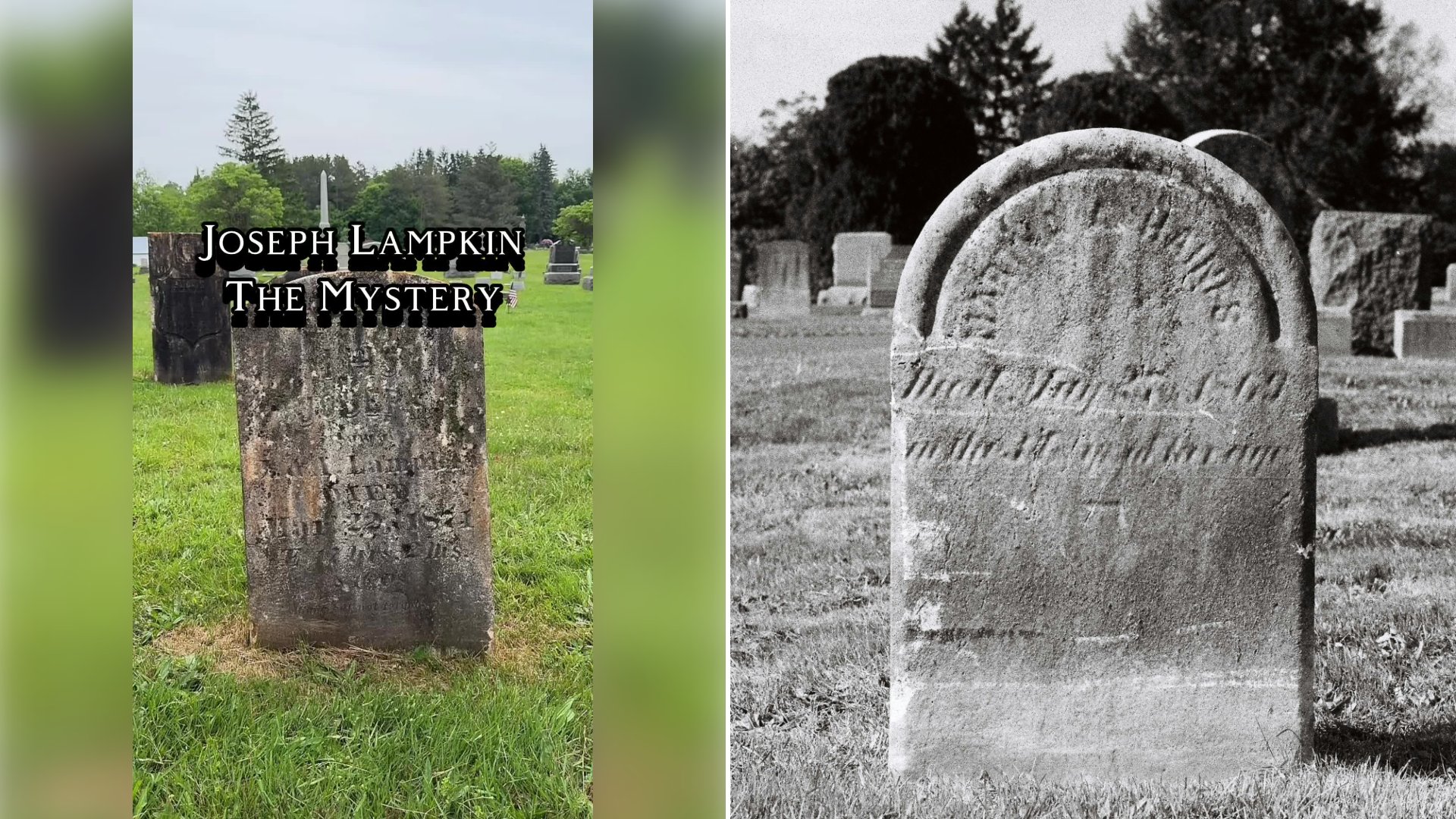
The headstone is so weathered that, in the first video, only a few letters show through the dark growth. Kneeling in the grass at Pulaski Village Cemetery in Pulaski, New York, the volunteer behind @crazycemeterylady points along what is left of the inscription and reads from his memorial: Joseph Lampkin, born 1854, died March 22, 1871. “This means he was only about 16 or 17 years old,” she says. “Parts of the inscription are becoming difficult to read, but his name is still there, waiting for someone to ask who he was and what happened to him.”
That clip, posted on Monday, September 7, 2026, was her weekly Mystery Monday, which she describes as “kind of like a community genealogy challenge.” Her caption asked people to leave their findings “along with the source” in the comments, and in the video her biggest question was “why did Joseph die when he was still so very young?” On Friday, she promised, she would clean the stone and tell his story.
Her profile describes her as volunteering to make cemeteries “a little brighter one stone at a time since 2020.” She kept the promise. In her follow-up, posted Friday, September 11, the cleaned marble reads clearly for the first time on camera: a cross, the letters IHS, then “JOSEPH, Son of J. & A. Lampkin, DIED Mar. 22, 1871,” with his age carved as 17 years, 2 months and 16 days. She gives his birth date, from the headstone, as January 6, 1854, and notes that the records “can’t seem to agree” on whether he was born in New York or Canada.
What the Records Turned Up
According to the follow-up, Joseph was the oldest child of Joseph and Agnes Lampkin, and seven younger brothers and sisters followed. His mother had come to the United States from Canada as a young child, and his father worked as a painter. The family moved through the Fulton and Volney area before settling in Richland. By the summer of 1870, she says, Joseph was no longer listed among the children of the household but had a job of his own, as a canal driver.
The Syracuse Northern Railroad was being built through the area, and where the line crossed the farm of Gilbert Woods, the land dipped, so a temporary track was laid and dump cars loaded with earth ran back and forth to fill the depression. Joseph, she says, was one of the young men driving those cars.
The frames show the source she worked from: column clippings from an 1871 newspaper she identifies as the Pulaski Democrat. One reads that “through some mistake, a car filled with dirt was dumped too soon, falling upon and severely injuring Joseph Lambkin, a young man who drove the car.” Another says those who heard his cry as the load covered him called it “heart rending in the extreme,” and that “his recovery is thought to be doubtful.” The paper spelled his name Lambkin; the stone says Lampkin, so anyone searching should try both.
In the first video’s comments, one viewer cited what the viewer gave as the Pulaski Democrat of March 23, 1871, describing Joseph driving a dirt car on the Syracuse Northern line as it passed Gilbert Woods’s farm. By that commenter’s reading, the accident happened on March 15, a week before he died. The clippings shown in her video carry no date, and the follow-up does not give the day he was hurt, so that date rests on the commenter’s reading of the paper.
Workers pulled him out alive, she says, and a doctor did what he could to ease his suffering, but there was little hope from the start. The detail she calls the most troubling is that, according to the newspaper, Joseph was the fourth person injured by those dump cars. He died on Wednesday, March 22, 1871, and was buried in plot A82. His parents and siblings later moved away from Oswego County to the Amsterdam area, and most of them, she says, were buried at Saint Mary’s Cemetery in Fort Johnson, more than 100 miles from Joseph’s grave.
The Brush Question, Checked
Both videos show her scraping at the growth with a long, flat wooden tool, and the follow-up shows her spraying the stone. Some viewers pushed back. One commenter on the first video asked whether it was a wire brush and wrote that “you NEVER use any brush on stone” because it can leave microscopic scratches. A viewer on the follow-up said headstones should be cleaned with plastic bristles, not metal ones.
The official guidance sits between those two views. The Oregon Heritage Bulletin on cleaning grave markers, from the state’s historic cemeteries program, lists soft natural bristle brushes and soft toothbrushes as standard equipment, allows a soft nylon brush on harder granite, and says never to use metal tools, scouring pads or adhesive tape. It recommends removing lichen and algae with scrapers softer than the stone, such as a wooden craft stick or a plastic putty knife. The South Carolina Department of Archives and History puts it plainly: “ALWAYS use soft bristle brushes” and “NEVER use a wire brush.” So the commenter was right about wire and wrong about all brushes.
Before You Clean or Research a Stone Like This
Get permission first. The Oregon guide says to ask the cemetery before cleaning, and notes that some cemeteries allow only family members, or only staff, to clean stones.
Check the stone before touching it. Per the same guide, push gently on the monument and do not clean it if it moves; skip any stone that is cracking, flaking or eroding; and do not clean in extreme heat or when freezing temperatures are expected.
Keep it wet and gentle. The guide says to soak the stone with clean running water or a garden sprayer and keep it wet while you work, and names D/2 Biological Solution as the one cleaner the National Park Service has recommended: spray the damp stone, wait 5 to 10 minutes, scrub lightly, rinse, and check again about a month later. It advises cleaning a marker no more than once every couple of years. South Carolina’s guide adds no bleach, no muriatic acid and no high pressure washing above 300 psi.
Then read the stone for clues. Joseph’s age, carved down to the day, lines up with the January 6, 1854 birth date she gives, which is why that last line of an inscription is worth reading closely. Search every spelling the clerks might have used, as Lampkin turned into Lambkin in print, and do what her caption asks: write down the source for every fact you find, so the next researcher can check it.
More from Vinyl and Velvet
- A Cook Recreates an Entire 1940s ‘Sunday Dinner’ Straight From an Actual Newspaper Clipping
- A Thrifted Vintage Camcorder Tape Turns Out to Hold a Stranger’s Home Movies, Sparking a Search to Reunite Them
- Forgotten Childhood Object Triggers an Unexpected Wave of Emotion as the Tiny Keepsake Brought Back an Overwhelming Flood of Old Memories

Leave a Reply