

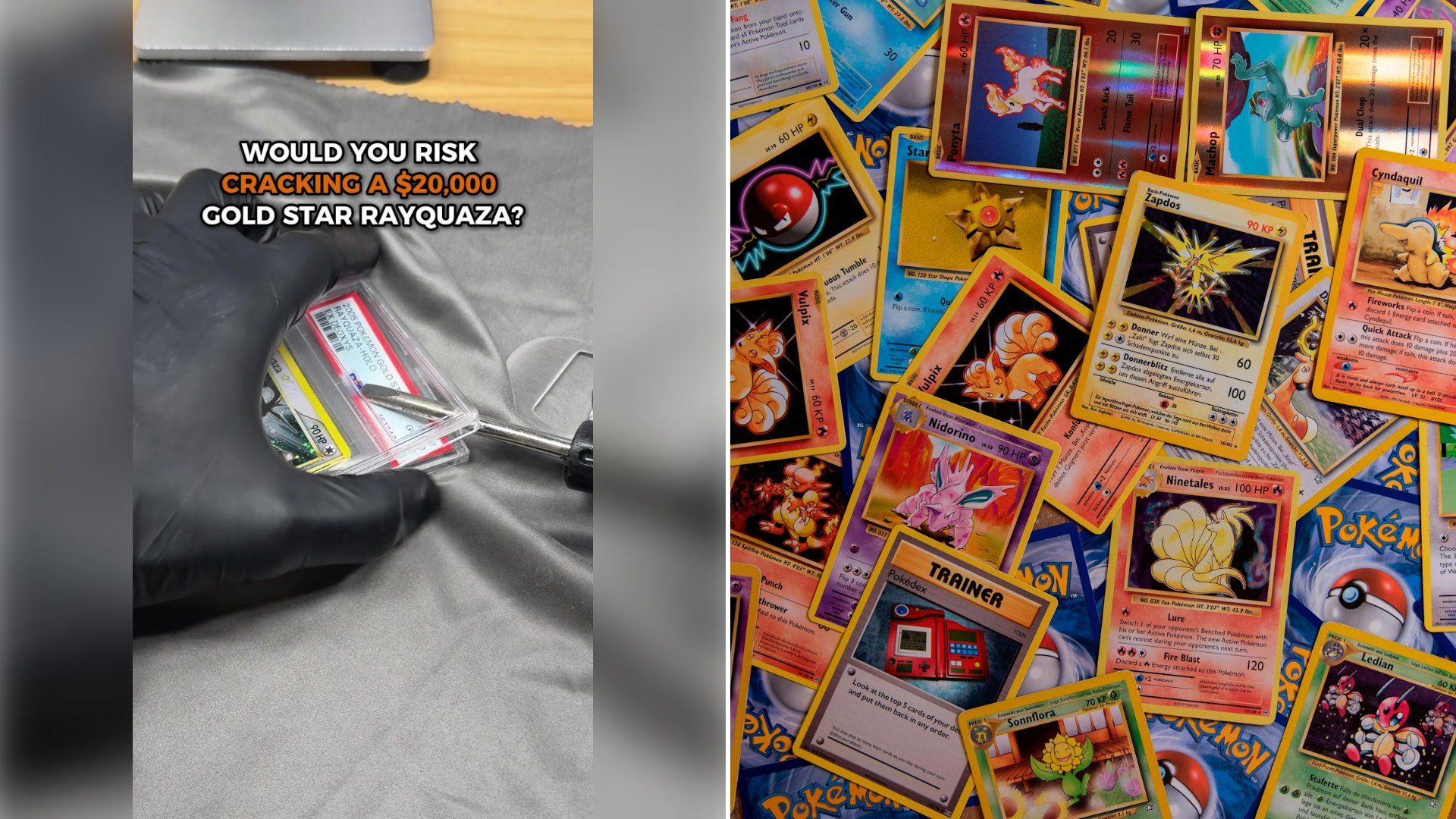
The question on the opening frame is blunt: “Would you risk cracking a $20,000 Gold Star Rayquaza?” The card restoration shop behind @card_care_australia answers it by doing exactly that. Black gloved hands hold the slabbed card, and the narrator sets out the gap between this copy and the best one: “A Rayquaza Gold Star CGC Pristine 10 just sold for over $1 million. But this one is currently graded a PSA 2.” A graphic on screen shows a CGC 10 copy with the figure “$1,020,000.”
“Today, we’re cracking it out of the slab to see what’s really holding this card back,” the narrator says, with a warning that one wrong move could damage the card permanently. The slab comes apart under a small tool, and the bare card goes under the lens.
What the shop says was wrong with the card
Out of the case, the narrator says, the first thing that stood out was severe delamination lifting one corner of the holo layer. The shop’s explanation is that delamination “happens when the foil surface begins separating from the cardboard underneath,” and that moisture, pressure and age can weaken the bond between the layers until the holo lifts. If it keeps spreading, the narrator adds, it becomes harder to stabilize.
The bench is set up for close work. A digital microscope screen sits above the card, a row of small Pokemon figures lines the back of the desk, and the screen fills with magnified print dots as the cleaning starts.
The repair, step by step
First, cleaning. The narrator says the card is cleaned “carefully, working across the surface one small section at a time,” and that “with a card this valuable, brushing is never an option.” Both the front and the Pokemon back are worked over under magnification, with the narrator saying the surface is checked repeatedly to remove contamination “without disturbing the original print.”
Second, the humidor. Once clean, the card goes into a clear tray for “8 hours inside the humidor.” After that, according to the shop, “the card fibers have softened and the card is ready for the lifted corner correction.”
Third, the hard press. The card is positioned between sheets of brown paper and placed “inside the hard press for 24 hours.”
Fourth, heat. The card then “goes straight into the heat press,” where, the narrator says, “the controlled heat and pressure will help re align the fibers and correct that severely lifted corner.” The frame shows a press with a digital readout.
Fifth, one more hard press. The card goes back under pressure “for a full 24 hours.”
Add it up and the card spends at least 56 hours in the process, not counting the heat press. The closing shot shows the card front again, with “Spiral Rush” and “Holy Star” printed in the attack box, and the narrator’s verdict: the card “is now flatter, cleaner and looking its absolute best,” and “The delamination is fixed with a mixture of moisture, heat and a hard press.”
The caption asks viewers what grade they think the card will get when it is resubmitted. The video stops there. No new grade is shown, so whether the work moved it off a PSA 2 is not in this clip.
What the grading companies say about this kind of work
The shop also makes a pitch for checking cards before grading: it “reveals hidden damage, saves you money on grading fees, and gives your cards a better chance at a higher grade.” That is the shop’s view of its own service.
The graders’ published rules are worth reading alongside it. PSA’s grading standards say “PSA will not grade cards that bear evidence of trimming, re-coloring, restoration,” and its N5 “Altered Stock” code lists “crease/wrinkle pressing, scratch removal, or enhanced gloss” among the signs of alteration. Some of those cards can be returned as “Authentic Altered” at the grader’s discretion.
CGC’s grading scale describes a Pristine 10, the grade on the record copy, as “a virtually flawless card to the naked eye” with 50/50 centering, and says it prints “Authentic Altered” in the grade box when a card is authentic but has been altered.
If you own a card with a lifting holo
Look at the card under magnification before you do anything, the way the shop checks this one on a microscope screen before it starts work.
Do not brush the surface. The shop’s own rule on a valuable card is no brushing at all.
Keep cards out of damp storage. The shop names moisture, pressure and age as the causes, so a dry, stable spot in a sleeve and top loader is the low risk first step.
Read your grader’s rules before you pay for any pressing or cleaning. PSA lists pressing under its altered stock code, so ask any restorer in writing what they will do to the card and whether it can be detected.
Get the work documented. Ask for before and after photos under magnification, and keep the old slab label as a record of the original grade.

Leave a Reply