

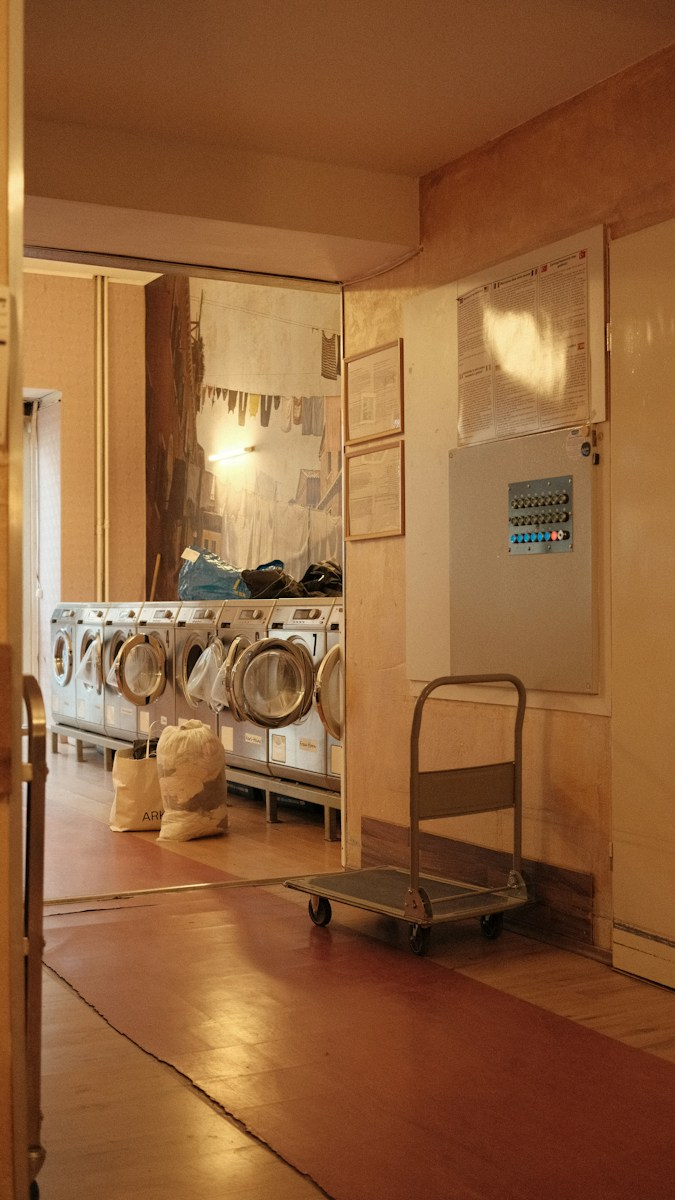
The laundry room hasn’t gotten nearly as much design attention over the decades as the kitchen or bathroom, which means a lot of Boomer-era setups are still running almost exactly as they were installed. It’s function over form, through and through.
Gen Z, doing laundry in everything from studio apartments to shared basements, has a pretty clear list of what they’d fix first. Here are eight laundry room details they wouldn’t leave untouched.
Tucked Away in a Dark Basement Corner
Many older homes placed the washer and dryer in an unfinished basement corner, far from the bedrooms where the dirty clothes actually originate, turning laundry day into a genuine multi-flight hauling operation. It made sense structurally, since basements had the plumbing access needed. Gen Z’s ideal setup keeps laundry close to where clothes are actually stored, whether that’s a main-floor closet or, ideally, right in or near the bedroom itself, cutting the basket-hauling out of the routine entirely.
A Top-Loading Machine With an Agitator
The center post agitator in an older top-loading washer got clothes clean effectively, but it was also notoriously hard on fabric, tangling and stretching items over repeated wash cycles. It was the standard design for decades regardless. Gen Z generally prefers front-loading or agitator-free top-loading machines, both gentler on clothes and more water-efficient, and would replace an old agitator model well before it actually stopped functioning.
No Real Surface for Folding
A lot of older laundry setups were built purely around the machines themselves, with no counter or table nearby for sorting or folding clothes fresh out of the dryer. Folding happened on a bed, a couch, or the floor instead. Gen Z’s laundry room wishlist consistently includes a dedicated folding counter, even a small one, treating it as close to essential rather than a nice-to-have addition to the space.
A Single Bare Bulb and No Ventilation
Basement and utility-closet laundry areas often got minimal lighting, sometimes just one bare overhead bulb, and little to no ventilation beyond the dryer’s own exhaust vent. It reflected a space treated as purely functional rather than a room worth investing in. Gen Z tends to prioritize proper lighting and airflow in every room of a home, including utility spaces, both for practical visibility and to prevent the musty smell that a poorly ventilated laundry area can develop over time.
Loose Powder Detergent Measured by Hand
Before pre-measured pods and pacs became standard, doing laundry meant scooping powder or liquid detergent by hand into a cap, guessing at the right amount based on load size. It worked, but it was imprecise and often led to over-pouring. Gen Z’s laundry routine leans heavily on pre-measured pods specifically for the convenience and consistency, and generally finds hand-measuring detergent an unnecessary extra step in an already routine chore.
A Wall-Mounted Drying Rack, Rarely Unfolded
Some older laundry rooms included a fold-down wall rack for air-drying delicate items, a genuinely useful feature that nonetheless often sat folded flat against the wall, unused for years at a time in favor of just running everything through the dryer. Gen Z, more attentive to fabric care and energy costs, tends to actually use air-drying racks regularly, and would either restore an existing wall unit to real use or add a proper freestanding one if the room doesn’t already have it.
An Ironing Station Eating Up the Whole Room
A permanently set-up ironing board, sometimes paired with a dedicated hanging rod for pressed clothes, could take up a meaningful chunk of an already small laundry space, treated as a fixture rather than something to store away between uses. Gen Z, who irons far less frequently than previous generations, would rather reclaim that space for storage or counter room and pull out a compact, foldable board only on the rare occasion it’s actually needed.
Side-by-Side Units Instead of Stacked
Older laundry room layouts often placed the washer and dryer side by side, a setup that made sense when the room had ample width to spare but eats up significant floor space compared to a stacked configuration. In smaller modern homes, that footprint matters. Gen Z living in tighter spaces generally opts for a stacked unit wherever possible, freeing up the extra square footage for that folding counter and storage shelving the old layout never had.

Leave a Reply