

Few features in American home design are as instantly polarizing across generations as the popcorn ceiling. For decades it was simply the default, an unremarkable part of nearly every new build. Understanding why it stuck around so long actually requires appreciating what it did right — even if Gen Z remains entirely unmoved by the case for it.
Here are eight genuine reasons the texture won over an entire generation of homeowners, and why none of them land the same way today.
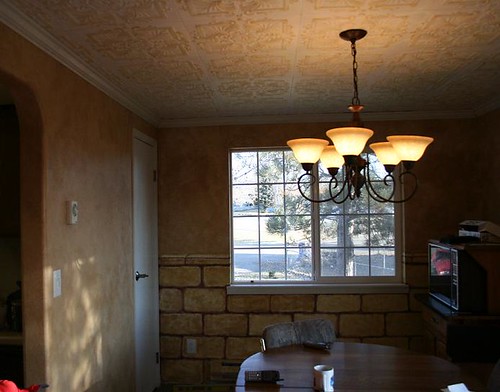
1. It Hid Drywall Seams and Imperfections
Achieving a perfectly smooth, flawless ceiling requires real skill and multiple rounds of sanding and finishing, which adds real labor cost to any build. As The Kitchn explains, spraying on a textured finish let builders skip that finishing work entirely while still delivering a presentable ceiling. For homeowners and builders alike, that trade-off made complete practical sense. Gen Z, having grown up with drywall and finishing techniques that make smooth ceilings far more standard and affordable, has no real memory of the problem popcorn texture was solving in the first place.
2. It Dampened Sound Between Floors
The rough, uneven surface of a textured ceiling genuinely absorbs and diffuses sound better than a flat one, which mattered in an era of thinner floor-ceiling assemblies and larger families sharing close quarters. That acoustic benefit was a real selling point, not just a cosmetic afterthought. Gen Z, generally living with better-insulated, more soundproofed modern construction, doesn’t experience the same daily need that made this a meaningful advantage decades ago.
3. It Was Extremely Cheap to Install
Spray-applied texture could be installed quickly across an entire ceiling with basic equipment, dramatically speeding up construction timelines during the postwar building boom when homes needed to go up fast and affordably. As Mental Floss notes, that speed and cost advantage is a major reason it became the default in new construction for decades. Gen Z, evaluating homes purely on current appeal rather than original construction economics, sees none of that original cost-saving logic reflected in how the finish actually looks today.
4. It Was Considered Genuinely Stylish at the Time
Far from being viewed as a cheap shortcut, textured ceilings were marketed and perceived as a modern, sophisticated architectural detail when they first became widespread, a step up from a plain, flat surface. Homeowners actively chose it as an upgrade in many cases. That sense of it as an aspirational, stylish choice has simply not survived the decades, and Gen Z encounters it purely as a dated texture with no memory of its original status as a desirable feature.
5. It Concealed Ductwork and Wiring Imperfections
Texture could hide minor irregularities where ceiling penetrations for wiring, vents, or plumbing weren’t perfectly finished, giving builders more flexibility during construction without requiring flawless precision in areas nobody was meant to scrutinize closely. It was a practical builder’s tool as much as a design choice. Gen Z, generally unaware of what’s happening above a ceiling in the first place, has no appreciation for a problem the texture was quietly solving out of sight.
6. It Required Minimal Maintenance Once Installed
Once applied, a textured ceiling didn’t show minor cracks, settling, or small imperfections the way a smooth painted ceiling eventually does over the life of a house, meaning less touch-up work was needed over the years. For a homeowner focused on low-maintenance living, that durability was a genuine, practical benefit. Gen Z, weighing a home’s overall move-in readiness rather than its long-term crack resistance, doesn’t factor that maintenance advantage into how appealing the texture looks today.
7. It Signaled a Well-Built, Finished Home
For buyers in the decades when popcorn ceilings were standard, the texture wasn’t a red flag at all — its presence simply meant a home had been built to the completely normal standard of the time, nothing more or less. It carried no negative connotation whatsoever within its own era. Gen Z, shaped entirely by a market where the same texture now signals an unrenovated, dated property, has inherited none of that neutral original context.
8. It Was Simply Familiar
Perhaps the simplest reason Boomers never developed any particular dislike for popcorn ceilings is that it was everywhere, in nearly every home they grew up in or bought into, for most of their adult lives. Familiarity bred a kind of comfortable neutrality rather than any strong aesthetic opinion either way. Gen Z, having grown up almost exclusively around smooth ceilings in newer construction, never had the chance to develop that same neutral familiarity, and instead sees the texture as an unmistakable, unwelcome outlier the moment they spot it.

Leave a Reply