

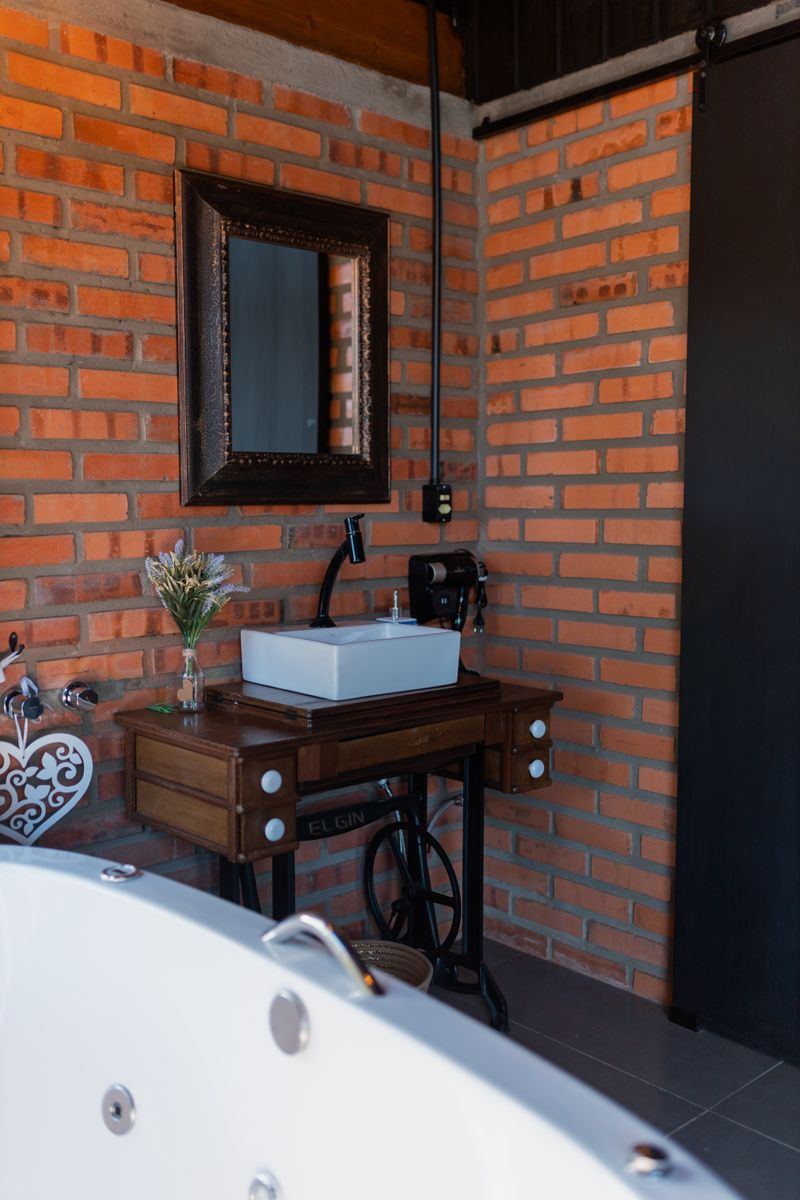
There’s a very specific bathroom that exists in some form in almost every grandparent’s house: a little dated, a little fragrant, and decorated with a level of commitment that modern minimalist bathrooms simply don’t attempt anymore.
It’s not that any of it was a mistake — these were genuinely popular, considered choices at the time. But six decades of accumulated bathroom decor tends to look pretty different through Gen Z’s eyes. Here’s what would be first on the demo list.
1. Pink and Black Tile
A full bathroom tiled floor-to-ceiling in pastel pink with black accent trim was an enormously popular, genuinely stylish choice in the 1950s, installed in millions of American homes during the postwar building boom. As Domino has documented, this specific pink-and-black combination has actually become a beloved preservation cause among design enthusiasts who argue it shouldn’t be torn out at all. Gen Z’s reaction tends to be more mixed on first encounter, reading the color scheme as charmingly retro at best and simply outdated at worst, depending entirely on how well the rest of the room has aged alongside it.
2. The Matching Fuzzy Toilet Cover and Rug Set
A plush, carpeted cover fitted over the toilet lid and tank, paired with a coordinating fuzzy bath mat, was a near-universal bathroom accessory through the 1970s. As Apartment Therapy explains, the trend partly grew out of a genuine desire for warmth and softness in bathrooms with cold tile floors, at a time when heated flooring wasn’t standard. Gen Z, more attuned to hygiene concerns around porous fabric surfaces in a bathroom, tends to view the whole set as one of the first things worth throwing out on sight.
3. Seashell-Shaped Guest Soaps Nobody Is Allowed to Use
A dish of decorative soaps, often shaped like shells or flowers and dyed to match the bathroom’s color scheme, sits untouched for years, existing purely as a finishing touch for guests who, by unspoken rule, also aren’t really supposed to use them. It reflects a genuine hospitality instinct paired with a reluctance to let something so carefully chosen get used up. Gen Z, generally confused by decorative objects with an implied “look but don’t touch” rule, tends to just want a bottle of normal hand soap they can actually use.
4. Frosted Glass Shower Doors With Gold-Tone Frames
A sliding shower door with an etched or frosted pattern, framed in shiny gold-tone aluminum, was the standard bathtub-shower enclosure for decades, replacing the shower curtain in countless remodels. It solved a real problem — keeping water contained without a curtain sticking to your legs — but the specific combination of frosted glass and gold trim has become one of the most reliable visual shorthand for an untouched bathroom. Gen Z touring a home with this exact setup tends to mentally file the whole bathroom as “needs a full renovation” on sight.
5. Wallpaper With a Coordinating Border, Floor to Ceiling
A busy floral or geometric wallpaper covering every wall, finished off with a contrasting border along the ceiling line, turned bathroom walls into a fully committed design statement rather than a neutral backdrop. It represented real effort and a clear point of view about the room. Gen Z’s preference for simpler, more neutral bathroom walls — often just paint, sometimes a single accent tile wall — makes a fully wallpapered, bordered bathroom feel visually overwhelming in a small, humid space.
6. A Tiny Medicine Cabinet Mirror With Its Own Strip Light
A small mirrored cabinet mounted directly above the sink, topped with a narrow strip of exposed bulbs for lighting, was standard bathroom equipment for generations, doubling as both mirror and medicine storage in one compact unit. It made efficient use of limited space in smaller, older bathrooms. Gen Z, used to larger vanity mirrors and softer, more flattering lighting setups popularized by ring lights and bathroom renovation content, tends to find the small mirror and harsh exposed-bulb strip one of the more immediately dated details in an older bathroom.

Leave a Reply