

Riley Gaines walked up the steps of the Supreme Court with her 3‑month‑old daughter in her arms and a bulletproof blanket tucked around the baby’s tiny body. The former collegiate swimmer has been a central figure in the fight over transgender participation in women’s sports, but this detail from her trip to Washington cut through the legal jargon and culture‑war talking points with something far more basic: fear for her child’s safety. Her account of wrapping a newborn in protective gear, she says, is the direct result of the threats that now shadow her advocacy.
What played out outside the marble building was not just another protest scene, in her telling, but a snapshot of how toxic the debate has become. Gaines describes a crowd split between supporters and opponents, a line of police, and a sense that the rhetoric around her has escalated to a point where she no longer feels she can show up in public with her daughter unprotected.
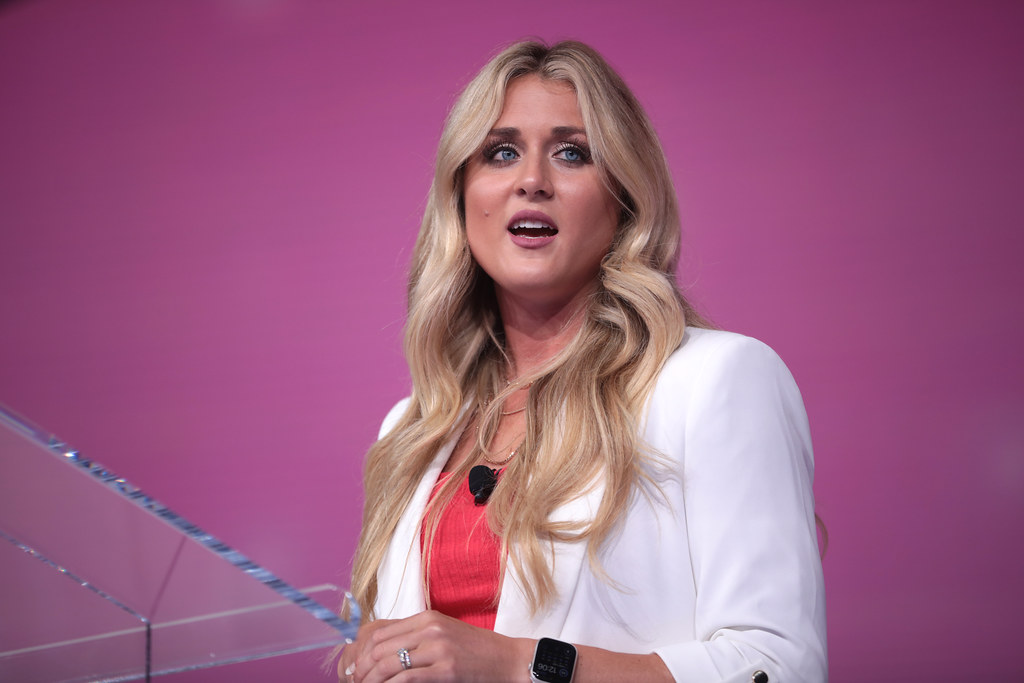
The moment on the Supreme Court steps
Gaines has spent the past few years turning from NCAA standout into one of the most visible critics of transgender women competing in women’s events, and that path eventually led her to the Supreme Court as justices weighed state bans on trans athletes. She brought her infant daughter along, then made the kind of calculation most parents never imagine, deciding to shield the baby with a bulletproof blanket before stepping into a crowd she viewed as volatile. In interviews, she has framed that choice as a grim commentary on where the national argument over sex and gender in sports has landed, saying the scene outside the Supreme Court made her feel that even a 3‑month‑old was not off limits.
Her appearance came as the justices heard challenges tied to bans in places like West Virginia and Idaho, cases that could reset how schools and colleges handle transgender participation nationwide. Gaines has argued that the stakes are not only about podium spots but about whether women’s categories retain any meaning at all, a point she has pressed in speeches, campus visits, and a recent sit‑down where Jan asked her to reflect on how becoming a mother has sharpened her sense of responsibility. Looking at her daughter, she said, changed how she thinks about “everything,” and that includes the risks she is willing to take to stand outside the country’s highest court and make her case.
“They are giving the middle finger to my little baby”
Gaines has not been shy about describing the crowd dynamics outside the building, painting a picture of dueling groups separated by barricades and officers. On one side, she says, were conservative activists who greeted her with cheers and prayers; on the other, demonstrators who opposed her stance and, in her words, hurled insults in her direction. In a clip shared by supporters, she recounts how They were “giving the middle finger” toward her and the child, a gesture she holds up as proof that the anger around her has crossed a line.
That description has ricocheted through conservative spaces, where commenters have called the scene “awful and not like America” and fixated on the idea that a mother would feel compelled to wrap a newborn “in a bullet proof blanket” just to speak at a public institution. In one widely shared post, supporters debated why she would bring the baby at all, with some asking, “She has a baby?” and others insisting that if something were to happen, they would be “praying for mercy,” a reaction captured in a thread that linked her story to broader worries about “violence” being “out of control” and praised her for standing firm while holding a 3 month old.
From campus flashpoint to national test case
Gaines did not arrive at the Supreme Court out of nowhere. Her profile exploded after she spoke out about racing against transgender swimmer Lia Thomas, and she has since become a regular presence at rallies, legislative hearings, and media hits focused on keeping transgender women out of women’s categories. Earlier this year, she joined other activists in arguing that the current legal fight is about more than sports, warning that if the justices side against state bans, People who question gender identity policies could be “bullied for being trans [and] receive no protection,” while, as that same reporting notes, Some activists, including Gaines, hope the court will affirm that sex‑based categories can be protected under equal protection law.
Her advocacy has unfolded alongside a broader federal fight over how Title IX should apply to gender identity. The Education Department has been working on regulations that would spell out when schools can limit transgender participation, a process that has drawn intense lobbying from both sides. Gaines has argued that the agency is stretching the law beyond what Congress intended, pointing to the way The Education Department is trying to define sex and warning that the final rule, “whatever it ends up being,” could either shore up or erode protections for women’s sports. That regulatory backdrop is part of why she sees the Supreme Court cases as “pivotal,” a term echoed when Riley Gaines Opens described arguments that stretched for nearly four hours and could reset the rules for school sports across the country.
Inside the decision to use a bulletproof blanket
For Gaines, the bulletproof blanket is not a metaphor but a piece of gear she says has become part of her travel routine with her daughter. She has cited specific death threats as the reason she now wraps the baby in what she has also called a bulletproof vest, describing a level of hostility that, in her view, justifies that kind of protection. In one account, she explained that she “wraps her 3‑month‑old daughter in bulletproof blanket due to threats,” a detail that surfaced when Riley Gaines talked about giving birth and then almost immediately returning to the front lines of a polarizing national fight.
She has repeated that story across platforms, telling one interviewer that “She was there with me on the Supreme Court steps,” referring to her daughter, and that the threats were serious enough that she felt she had no choice but to cover the baby in protective material. That line, “She was there with me,” has become a shorthand for how she blends motherhood and activism, and it surfaced again when She described standing on the steps, talking about fairness in women’s sports while also worrying about the possibility of violence. In another write‑up, she is quoted saying she “wraps baby daughter in bulletproof vest due to death threats,” a phrase that appeared in coverage by Owen Scott, who noted that she made the comment while again referring to her daughter’s presence at the court.
How TV and social media amplified the story
The image of a baby in a bulletproof blanket did not stay confined to the Supreme Court steps. It quickly migrated to television, where Gaines sat down on the midday show Outnumbered and walked through the decision in front of a national audience. She told the panel that she had to wrap her 3‑month‑old baby in the blanket as she spoke outside the court, tying that choice directly to the threats she says she has received. The segment framed her as a mother forced into extraordinary precautions simply for showing up to argue that women’s sports should remain separated by sex, and it gave her a chance to contrast what she described as an upbeat conservative crowd with a more hostile group of opponents.
More from Vinyl and Velvet:

Leave a Reply