

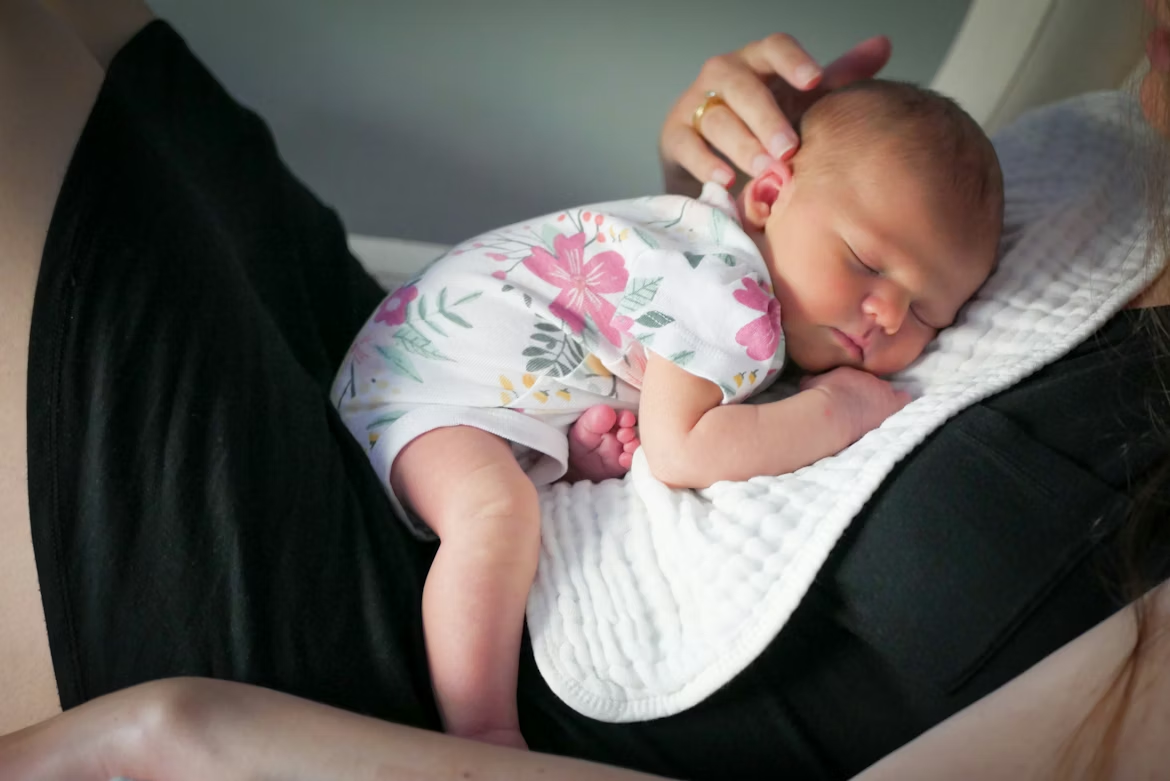
Twenty-three days before her youngest child’s first birthday, one mother posted a confession that stopped thousands of parents mid-scroll: she could not stop crying. Not because anything was wrong. Because everything was right, and it was almost over.
Her post, shared in a forum for working mothers, struck a nerve. She wrote that she would have loved a third child but could not have one, and that the approaching birthday felt less like a celebration and more like a closing door. Hundreds of parents responded with versions of the same story: pride tangled with grief, gratitude laced with loss.
The reaction was not surprising to reproductive psychologists. What these parents are describing has a name, and it is more common than most people realize.
Frankie
The psychology behind “last baby” grief
Dr. Alexandra Sacks, a reproductive psychiatrist and co-author of What No One Tells You: A Guide to Your Emotions from Pregnancy to Motherhood, has written extensively about a concept she calls “matrescence,” the developmental transition a woman undergoes when she becomes a mother. That transition does not end at birth. It resurfaces at every major milestone, and the first birthday of a last child can trigger a particularly intense wave of identity renegotiation.
“When parents know there won’t be another baby, the first birthday becomes a marker of finality,” Sacks explained in a 2017 essay for The New York Times. The grief is not pathological. It is a normal response to losing a role that shaped daily life for months or years.
Research supports this. A 2016 study published in the Journal of Reproductive and Infant Psychology found that mothers who identified their current child as their last reported higher levels of emotional ambivalence around developmental milestones than mothers who planned to have more children. The study’s authors noted that this ambivalence was distinct from postpartum depression, though the two can overlap.
Why the 12-month mark hits so hard
The first birthday is not just a number on a cake. It is a line drawn by medicine, culture, and commerce.
The American Academy of Pediatrics defines infancy as the period from birth through 12 months, with its own set of developmental benchmarks, feeding guidelines, and well-child visit schedules. At 12 months, pediatricians typically recommend transitioning from formula to whole milk, retiring the bottle, and shifting to a toddler sleep schedule. Insurance codes change. Clothing sizes jump. The word “baby” gets quietly replaced by “toddler” on every form and pamphlet.
Parents absorb that framing even when they are not conscious of it. The result is that the first birthday can feel less like a party and more like a graduation ceremony nobody asked for. For a mother watching her youngest approach that line, every routine carries extra weight: the last time buying size 3 diapers, the last time warming a bottle at 2 a.m., the last time checking “infant” on a medical intake form.
The tension between relief and loss
What makes this grief so disorienting is that it coexists with genuine relief. Parents in online communities describe the contradiction with striking honesty.
In a thread on the parenting forum Mommit, one mother wrote that she was “seriously struggling” with her baby turning one and said she finally understood the meaning of the word “bittersweet.” Another, in a separate parenting discussion, described being “SO happy” her son was healthy and thriving, yet unable to stop crying the night before his birthday.
Writer Danielle Campoamor captured the same tension in a 2018 essay for Romper, describing her last baby’s first birthday as a reckoning with time itself. “The year disappeared in a blur,” she wrote, “and I wasn’t ready for it to be over.”
The relief is real: more sleep, fewer pediatrician visits, a personality emerging where a bundle of reflexes used to be. But so is the loss. Parents are not mourning their child. They are mourning a version of themselves that existed only during that chapter.
When grief signals something deeper
For most parents, the sadness around a last baby’s first birthday is temporary and manageable. But clinicians caution that it can sometimes mask or intensify postpartum mood disorders, which can persist well beyond the first year.
The Postpartum Support International (PSI) notes that postpartum depression and anxiety can emerge or worsen at any point during the first 12 months and sometimes beyond. If the sadness around a birthday feels consuming, interferes with daily functioning, or is accompanied by intrusive thoughts, PSI recommends reaching out to a trained provider. Their helpline (1-800-944-4773) is available in English and Spanish.
The distinction matters. Normal “last baby” grief tends to come in waves and coexist with moments of joy. Clinical depression tends to flatten everything.
What actually helps
Parents who have navigated this transition offer practical advice that therapists tend to endorse.
Name it. Simply acknowledging “I am grieving the end of a stage” can reduce the shame many parents feel about crying over a happy milestone. Sacks has noted that giving the feeling a name helps parents stop pathologizing a normal response.
Create a closing ritual. Some parents assemble a photo book spanning the first 12 months. Others write a letter to their child to be opened years later. One parent in the Mommit thread described learning to “stop and be in the present” during the final weeks of infancy rather than racing ahead to party logistics.
Talk to other parents. The volume of responses in online threads suggests that simply hearing “I felt this too” carries real therapeutic weight. For parents who prefer structured support, PSI maintains a directory of online support groups organized by topic and stage.
Look forward honestly. Multiple parents in these discussions noted that toddlerhood, while different, brings its own rewards. “Serious fun” is how one mother described it. First words, first jokes, first attempts at independence all carry their own magic, even if it is a different kind.
The birthday will still be beautiful
The mother counting down those 23 days will almost certainly throw the party, sing the song, and watch her youngest smash a piece of cake with both fists. She will also probably cry in the kitchen while cutting that cake, and that is fine.
What thousands of parents keep confirming, in forums and essays and quiet conversations after bedtime, is that the tears are not a sign of weakness or ingratitude. They are proof that the first year mattered deeply. And the fact that it ends does not erase what it built.
More from Vinyl and Velvet:

Leave a Reply