

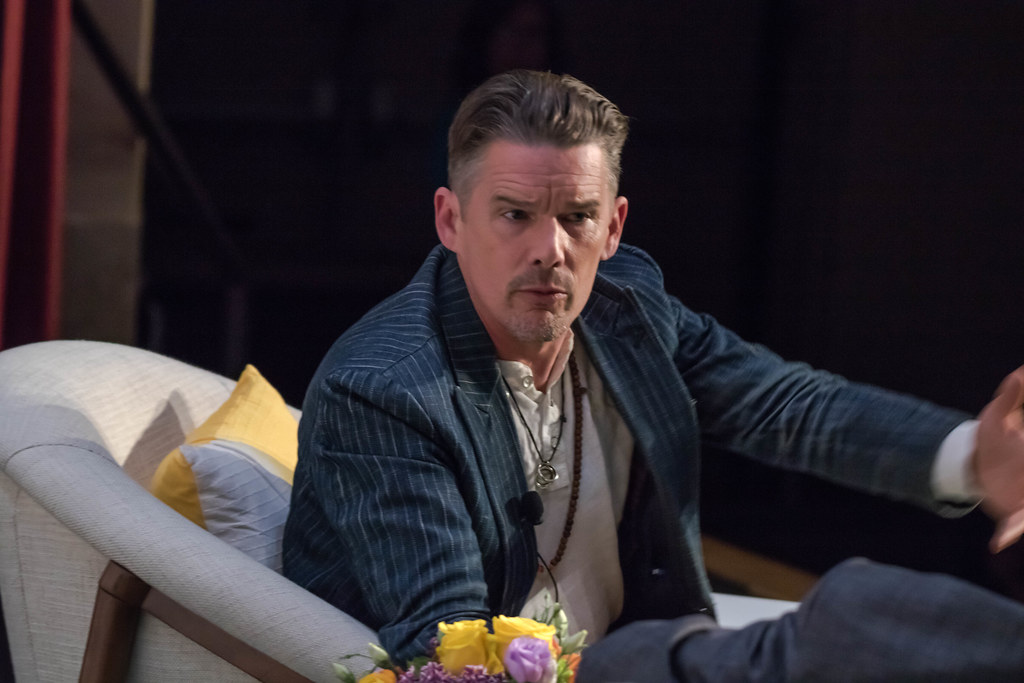
Ethan Hawke and his son Levon are not just sharing cheekbones and a jawline sharp enough to slice through Broadway ego, they are also sharing a heartfelt salute to the late playwright Tom Stoppard. Their recent tribute folds family resemblance, stagecraft, and genuine grief into one neatly lit theatrical moment, turning a public remembrance into something that feels almost like a curtain call for three generations at once.
What might have been a standard memorial instead plays like a living footnote to Stoppard’s legacy, with Hawke and his lookalike heir stepping into the spotlight as proof that the playwright’s influence is still very much in repertory. The result is a rare thing in celebrity culture: a father and son using their shared fame not to promote a project, but to honor the writer who helped shape the way they both think about language, performance, and the strange comedy of being alive.
A father–son double act steps into the light
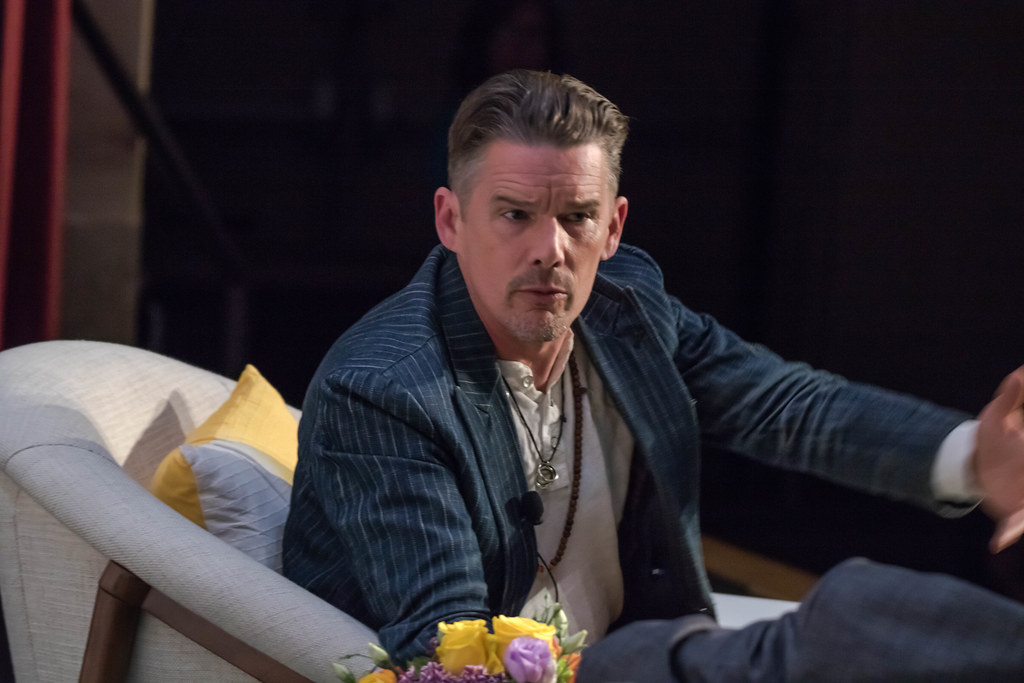
The first thing anyone notices about Ethan and Levon Hawke is that they look like a casting director’s idea of “same character, twenty-five years apart.” The second thing, at least in this tribute, is how naturally they fall into a kind of two-person ensemble, with Ethan’s seasoned gravitas setting up Levon’s quieter, watchful presence. Their appearance together turns the remembrance into a family scene, as if Stoppard’s work has been passed down like a very wordy heirloom. That dynamic gives their homage an easy rhythm, more like a backstage conversation that wandered onto the main stage than a stiff formal statement.
In their joint tribute, Ethan frames Stoppard as a lodestar for serious actors who still like to have fun, while Levon’s participation signals that the playwright’s influence is not stuck in the era of rotary phones and ashtrays in rehearsal rooms. The younger Hawke’s presence underscores how Stoppard’s intricate, joke-laced scripts still speak to performers who grew up with streaming queues instead of VHS shelves, reinforcing the idea that the playwright’s work remains a living text rather than a museum piece.
Tom Stoppard’s language, and why actors keep chasing it
For actors, Stoppard’s plays are the theatrical equivalent of a marathon with punchlines: exhausting, exhilarating, and slightly unhinged in the best way. Ethan Hawke’s tribute leans into that reality, treating Stoppard’s dialogue as both a privilege and a dare. The playwright’s fondness for philosophical banter, time-bending structures, and jokes that arrive three pages after their setup has long made his scripts a proving ground for performers who like their roles with a side of existential crisis. Hawke’s praise reads less like polite memorial etiquette and more like a veteran runner tipping his hat to the architect of the course.
That affection for Stoppard’s language also explains why the tribute feels so personal. Hawke has built a career on characters who talk their way through moral knots, and Stoppard’s writing offers exactly that kind of terrain. By highlighting the playwright’s verbal fireworks, Hawke is effectively admitting that some of his favorite acting muscles were built in the gym Stoppard designed, where every line is a small puzzle and every scene is a debate disguised as entertainment.
Levon Hawke, the next generation of Stoppard devotees
Levon’s role in the tribute is quieter but no less telling. He stands as living evidence that Stoppard’s work still appeals to actors who were not alive when some of the playwright’s most famous scripts first hit the stage. For a performer whose peers are more likely to quote TikTok audio than 1970s theatre, embracing Stoppard signals a taste for material that expects audiences to keep up. His participation suggests that the playwright’s blend of wit and melancholy still feels relevant, even to someone whose formative cultural references include apps, not analog.
There is also a subtle comedy in watching a young actor who looks so much like his father step into the same artistic orbit. Levon’s presence in the tribute hints at a kind of theatrical inheritance, as if Ethan has handed down not just his face but his bookshelf. It frames Stoppard as a shared language between generations, the sort of writer whose scripts can be argued over at family dinners and then tested on stage, turning the Hawke household into a miniature repertory company with very strong opinions about iambic rhythm.
Grief, gratitude, and the strange comfort of a shared stage
What keeps the tribute from tipping into pure sentimentality is its balance of grief and gratitude. Ethan and Levon acknowledge the loss, but they also treat Stoppard’s death as a cue to celebrate the sheer volume of life packed into his work. Their tone suggests that the best way to honor a playwright who loved paradox and punchlines is not with hushed reverence, but with the kind of lively appreciation that might actually make him roll his eyes and mutter something clever. In that sense, the tribute feels less like a eulogy and more like a curtain call, with the Hawkes stepping forward to say, in effect, that the show goes on because the scripts are still that good.
There is a practical comfort in that idea. For actors, writers, and audiences who have spent years inside Stoppard’s worlds, the knowledge that his plays will keep being staged offers a kind of ongoing conversation with the man himself. Ethan and Levon’s shared salute taps into that feeling, suggesting that every future production is another chance to meet Stoppard halfway, to wrestle with his ideas, and to enjoy the fact that he never made it easy. Their tribute lands as a reminder that in theatre, absence is always a little bit negotiable, because the words stay put even when the person who wrote them does not.
A legacy that keeps rewriting the family script
By appearing together, the Hawkes quietly turn Stoppard’s legacy into a family story. Ethan’s career has long been intertwined with literary-minded projects, and Levon’s emerging path suggests that the apple has not fallen far from the script pile. Their joint tribute hints at a future in which father and son might share more than a memorial moment, perhaps collaborating on productions shaped by the same playwright who helped define Ethan’s artistic sensibility. In that light, Stoppard’s influence becomes less a chapter that has closed and more a thread that will keep weaving through whatever the Hawkes do next.
There is a certain comic symmetry in that prospect. Stoppard spent decades writing about time, identity, and the way people echo one another across generations, and now two actors who look like a before-and-after photo are standing up to say thank you. The tribute captures that irony without belaboring it, letting the visual joke of their resemblance sit alongside the sincerity of their words. It is a fitting farewell: a little bit funny, a little bit sad, and very aware that the best lines have already been written, waiting patiently for the next pair of actors to pick them up and see what they can do.
More from Vinyl and Velvet:

Leave a Reply