

Stellan Skarsgård turned a routine awards beat into a statement of principle at the Golden Globes, pairing his supporting actor win with a pointed defense of big-screen moviegoing. Accepting the prize for his work in the drama “Sentimental Value,” the Swedish veteran used his time onstage to argue that cinema is at its best when audiences experience it together in a theater. The moment crystallized a broader tension in Hollywood, where streaming convenience keeps colliding with filmmakers’ desire to preserve the communal ritual of going to the movies.
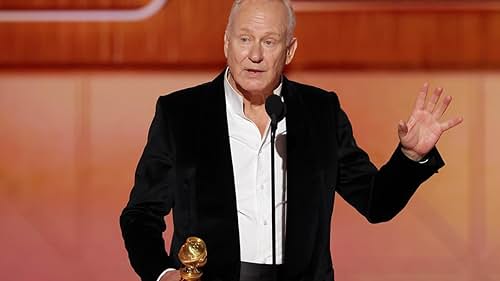
Skarsgård’s surprise win and a family-backed career peak
At 74, Swedish actor Stellan Skarsg added a late-career milestone by taking best supporting actor for the film Sentimental Value, a performance that many awards watchers had treated as a contender but not a lock. The win, in the male supporting actor in a motion picture category, was notable enough that some live coverage flagged it as a result that “many pundits” had not fully banked on, underscoring how the veteran outpaced a field of younger, heavily campaigned rivals. As he stepped to the microphone, he admitted he had not prepared a speech, a small confession that underlined how genuinely surprised he appeared to be by the outcome.
Skarsgård’s remarks quickly moved from self-deprecation to gratitude, and then to something closer to a manifesto. He thanked his wife for what he called her “brutal support,” describing her as a “tough lover” whose honesty has shaped his work and life, and he acknowledged their two children, Ossian and Kolbjörn, as part of the support system that kept him grounded while he chased roles around the world, a dynamic he highlighted while saluting his family. He also folded in a wry nod to his older children, joking that his famous offspring had taught him “what a bad father is,” a line that landed as both self-mockery and acknowledgment of the complicated balance between parenting and a globe-trotting acting career, as captured in coverage of how Stellan Skarsgard Jokes that role has meant.
“Cinema should be seen in cinemas”: a speech with an agenda
Once the thank-yous were out of the way, Skarsgård pivoted to the line that instantly defined his speech: “Cinema should be seen in cinemas.” The actor, who accepted the Golden Globe for WINNER in the supporting category, framed the point not as nostalgia but as a defense of the shared emotional charge that comes from watching a story unfold with strangers in the dark. His argument echoed through the ballroom, where many in the crowd have spent the past few years fighting to keep theatrical windows alive in the face of aggressive streaming rollouts. Commentators quickly tagged his remarks as the “Most Hollywood” speech of the night, a label that captured both the idealism and the self-interest in a star using a global broadcast to lobby for the survival of the big screen, a reaction reflected in assessments of Most Hollywood moments.
Skarsgård’s plea landed in a room already primed for statements about belonging and visibility. Earlier in the evening, another winner, Teyana Taylor, used her own time at the podium to insist that “Our depth is not too much. Our light does not need permission to shine. We belong in every room we walk into. Our voices matter,” a declaration that framed the ceremony as a stage for broader cultural claims about who gets to participate in the industry, as captured in coverage of how Our presence is asserted. Against that backdrop, Skarsgård’s insistence on the primacy of theaters read as a parallel argument about space and legitimacy, this time for the movie house itself. His comments about the magic of watching a film with “other people” and feeling the room breathe together, relayed in live updates that noted how Stellan Skarsg described that experience, turned a standard acceptance into a small manifesto about what is at stake when viewing habits migrate to couches and phones.
A streaming era flashpoint wrapped in a sentimental win
Skarsgård’s stance carries particular weight because of the project that brought him to the stage. “Sentimental Value” is a character-driven drama rather than a franchise spectacle, the kind of mid-budget film that has struggled most to secure long theatrical runs in the streaming era. The movie’s presence in the awards conversation, and its eventual victory in the supporting race, signaled that there is still room for intimate stories to break through when they are given the right platform, a point underscored by the attention paid to Sentimental Value across the season. When Skarsgård later reiterated that “cinema should be seen in cinemas” in backstage comments, as noted in reports that highlighted how Stellan Skarsg tied his win to that belief, it reinforced the idea that his argument was not a throwaway line but a considered position about how films like his can still find an audience.
The emotional tenor of the night also helped his message resonate. Live blogs described how Stellan Skarsg looked genuinely shocked as his name was read for Best Film Male Actor in a Supporting Role, a reaction that made his subsequent advocacy feel less rehearsed and more like a veteran seizing an unexpected microphone. The combination of humility, family anecdotes, and a clear stance on theatrical exhibition turned his Golden Globe into more than a personal triumph. It became a rallying point in an ongoing debate over whether the future of movies will be defined by living-room algorithms or by the flicker of light on a theater screen, a question that now has a newly minted Best Supporting Actor as one of its most vocal champions.
More from Vinyl and Velvet:

Leave a Reply