

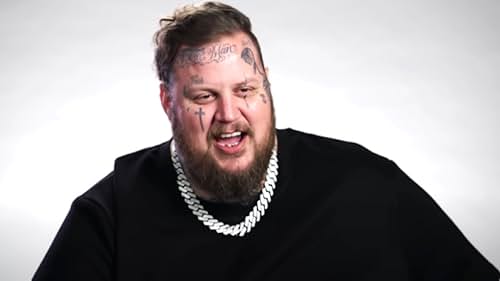
Jelly Roll has never hidden his ink, but he is no longer hiding the hurt that came with it. The country star now says the face tattoos that helped define his image were born from feeling, in his words, like “a small, insecure human,” and he is unpacking how shame, bravado and survival all ended up etched across his skin. As his career soars, he is using that same canvas to explain how much he has changed from the man who first picked up a needle.
“A Small, Insecure Human” Behind the Ink
The artist who once leaned on a hard-edged persona is now describing his earliest tattoos as armor for a frightened kid. In a recent reflection, he framed the decision to mark his face as the act of “a small, insecure human,” a phrase he has emphasized so strongly that he rendered it in all caps as Jan, WAS, SMALL, INSECURE and HUMAN while revisiting the pain behind those choices. That confession, shared as Jelly Roll Breaks His Silence On His Face Tattoos, makes clear that what looked like swagger was, in his telling, rooted in something “much darker,” a past he is now willing to confront in public as his profile grows.
That reckoning has unfolded alongside a visible evolution in how he presents himself. In a clip highlighting some of the BIGGEST COUNTRY MUSIC MOMENTS of the year, he appeared with a noticeably different look, prompting fans to marvel at his “new appearance” and ask What they might remember most about his transformation. The reel, posted in Nov, underscored how the same face that once telegraphed defiance is now associated with vulnerability and gratitude, a shift that mirrors the way he is talking about the ink that first drew so much attention to it.
Shame, Fatherhood and Tattoos He “Hates”
As Jelly Roll has opened up, he has tied his tattoos directly to the way shame can disguise itself. He has said that people often imagine shame as someone hiding in a corner, but in his experience it can show up as loud bravado, the kind that dares the world to look away. That idea has filtered into his parenting, too. He has admitted that when his daughter first asked about the designs on his face, he sugarcoated the truth, softening the story of how those marks were really born from insecurity and hurt before later acknowledging more of that reality to her, according to a detailed account of what he used to tell his daughter about his face tattoos.
That honesty extends beyond his face. He has been blunt about regretting much of the artwork scattered across his body, including a “pick-and-poke” image of Jesus on his back that he has described with a mix of humor and disbelief at his younger self. In one conversation about his ink, he joked that he regrets 98% of his tattoos, then immediately undercut himself by saying it might really be 97%, a self-deprecating riff that still lands as a serious admission about how little those old symbols match his current values. He has repeated that theme in a short video where he talks through how many pieces he would erase if he could, reinforcing that the man who once chased any available design now looks at most of them as mistakes he has outgrown, a point he underscored while discussing how many tattoos he regrets in detail and again while reflecting in a short clip on that 98% and 97% figure.
Not a Cry for Attention, But No Longer Who He Is
For years, critics have read Jelly Roll’s face tattoos as a plea to be noticed, a visual shout in an industry that often rewards spectacle. He has pushed back hard on that narrative, insisting that the ink is “the polar opposite” of a cry for attention and instead traces back to the way shame can masquerade as toughness. He has pointed to specific designs, including the cross under his right eye, the teardrop beneath it and the phrase “music man” across his hairline, as examples of how he tried to write his identity on his skin long before the world knew his name. In interviews about those markings, he has stressed that what some see as a stunt was, for him, a misguided attempt to survive, a point he has made while responding to critics of his face tattoos.
That message has been consistent across multiple conversations. He has brushed off the idea that his look is about shock value, repeating that “behind real bravado is real shame” and linking his old image to the same internal battles he now sings about onstage. When he posed in the Broadcast room during the 2025 iHeartRadio Music Festival at T-Mobile Arena, the tattoos were still there, but the story he told about them had shifted toward healing, a nuance he highlighted while again addressing critics. In another exchange, he reiterated that behind the real bravado of his heavily inked face was a young man drowning in insecurity, a point he drove home while explaining that his tattoos were not a plea for attention but a misguided shield, as he told one outlet while again responding to criticism and another while emphasizing that the ink was “not a cry for attention” in a separate interview.
At the same time, he is clear that those designs no longer reflect who he is. He has said outright that his face tattoos do not match the man he has Become, a sentiment captured in a profile that noted how Jelly Roll’s Face Tattoos No Longer Match the Man He is today. In a separate cover story, he went even further, saying he “hate[s] them all” when asked about the artwork on his face, a stark statement that underlines how thoroughly he has outgrown the image they project, as he explained while reacting to a false narrative about his tattoos. Yet he has also suggested that erasing them would erase part of the story he now tells from the stage, a story that runs from the Jan moment he first called himself a SMALL, INSECURE HUMAN through the Nov reel that celebrated his BIGGEST COUNTRY MUSIC MOMENTS and into a future where the ink remains as a warning, not a blueprint, for anyone tempted to mistake bravado for strength. That tension, between regret and acceptance, is what makes his evolving relationship with his own face such a compelling chapter in the ongoing narrative of transformation, one he continues to unpack even as he revisits the Broadcast room, the Music Festival stage and the Mobile Arena spotlight that first magnified every line of ink.
Along the way, he has kept returning to the same core idea: that NEED and KNOW are intertwined when it comes to understanding why someone would mark their face in the first place. He has urged listeners to look past the surface and see the scared kid who chose permanent ink as a temporary solution, a perspective he has reinforced while talking about Jelly Roll in the context of Men’s health and emotional honesty. That willingness to dissect his own past, from the Jan confession to the Nov celebration, has turned his tattoos into more than decoration or controversy; they are now teaching tools, etched reminders of how far he has come from the HUMAN who once believed he had to wear his pain where the world could not miss it, a journey he has chronicled in part through candid posts and in-the-moment clips that invite fans to see the person behind the ink.
More from Vinyl and Velvet:

Leave a Reply