

Picture the basement door off the kitchen, the one that sticks in summer. Flip the switch, one bulb comes on over the stairs, and that cool, damp, sweet smell hits you before you see a thing. Down there sit the figurines, the tea sets, the platters on edge, the old trunk and the spinning wheel your mother bought because it looked like history.
Walter Ashford has spent 40 years buying and selling at estate sales, farm auctions and house clearances across the Midwest. In a long walk through the typical American basement on his channel, @WalterAshfordd, he lays out what each of those basement staples actually sold for at sales that closed this year. He is careful to say he is a dealer, not a certified appraiser, and that his talk is general information rather than a formal appraisal.
His opening warning sets the tone. “Nobody wants” is not quite literal, he says, because almost everything on those shelves will sell to somebody, just not for anything close to what the family expects.
A Spinning Wheel Brought $7, And The Genuinely Old Ones Did Not Do Much Better
Start at the bottom of the stairs. A large walking wheel described as colonial revival style sold for $7 at Everything But the House in late August. A 19th century vertical wheel with its distaff and spindle brought $41 there the same month, and another 19th century wheel sold for about $45 in September.
Ashford says he looked hard for a happy exception and refused to invent one. Every wheel he could confirm this year landed between $7 and $45, including the honestly old ones.
The Sled, The Accordion And The Prints Tell The Same Story
A vintage Flexible Flyer sled sold for $40 in October, and a lot of several Flexible Flyer Airline Ace sleds went for $90 together back in March. The exception he found was a hand-painted wooden sled from the late 1800s with a horse on the deck, which sold for $180 in June, and even that fell short of its $200 estimate.
The accordion in the case under the stairs fared no better. A piano accordion marked Castelfidardo, with its carrying case, sold for $17 in October. A mid-century Petromilli did far better at $403, and Ashford says the difference is grade, because student instruments were made in great numbers and professional ones were not.
Framed pictures are even softer. A set of botanical giclee prints sold for $31 for the whole lot, which he says is often less than the frames cost new.
Why The Basement Itself Is Quietly Wrecking The Value
Here is the twist Ashford keeps returning to. He cites the Library of Congress advice against storing paper in a basement, garage or attic, and its guidance that mold spores grow on almost any surface once relative humidity climbs above 65%. A lot of basements, he says, live above that number for half the year.
Wood swells and shrinks with humidity, he explains, citing the American Institute for Conservation, which is how a spinning wheel’s pegs work loose. Iron and steel can corrode once humidity passes roughly 30%, so sled runners rust and the red lettering lifts. Leather is prone to mold when damp, which matters for that accordion, and he adds that an old lamp should be checked by someone qualified before anyone plugs it in.
Lamps, Platters And Vases Where A Name On The Bottom Made All The Difference
A ceramic table lamp with a monkey on the vase sold for $3, while a hand-painted Gone with the Wind style parlor lamp brought $45. The exception was a Fenton blue satin glass parlor lamp with poppies at $185. Ashford puts it simply: Fenton is a maker collectors look for, while Gone with the Wind style is only a description.
Turkey platters came in at about $40 for Johnson Brothers pieces and $5 for an unmarked hand-painted one. Then came the early 19th century Staffordshire platter in deep blue showing Lake George, which sold for $500 in January at Freeman’s.
Vases follow the same pattern. A pair of Satsuma style porcelain vases sold for $25 and a floor vase for $20, yet a Meiji period Kincozan workshop vase painted with courtly figures sold for $1,600 in October. “The name on the front is the story they tell you,” he says. “The mark on the bottom is the truth.”
Rockers, Curios And Tea Sets Were Hardest To Believe
A 19th century Boston rocker sold for $5 in January. A pressed back chair, a spindle rocker and a braided rug went together for $6 in New Jersey. The makers carried the money, with a signed Shaker rocker at $275 and a Hunzinger platform rocker at $800, though two other Hunzinger pieces at the same sale brought $275 and $500. His line on that: a name is a floor, not a promise.
Dragonware tea sets ran from $12 for a nine-piece set to $100 for a complete Nippon era set. Lighted corner curio cabinets sold for $5 and $32.50, with a large Howard Miller reaching $675. Capodimonte figurines went for $2, $1 and $20, while a signed, genuinely old Victorian courting couple under a glass dome brought $185.
The Trunk That Sold For $1, And The Louis Vuitton That Changed The Math
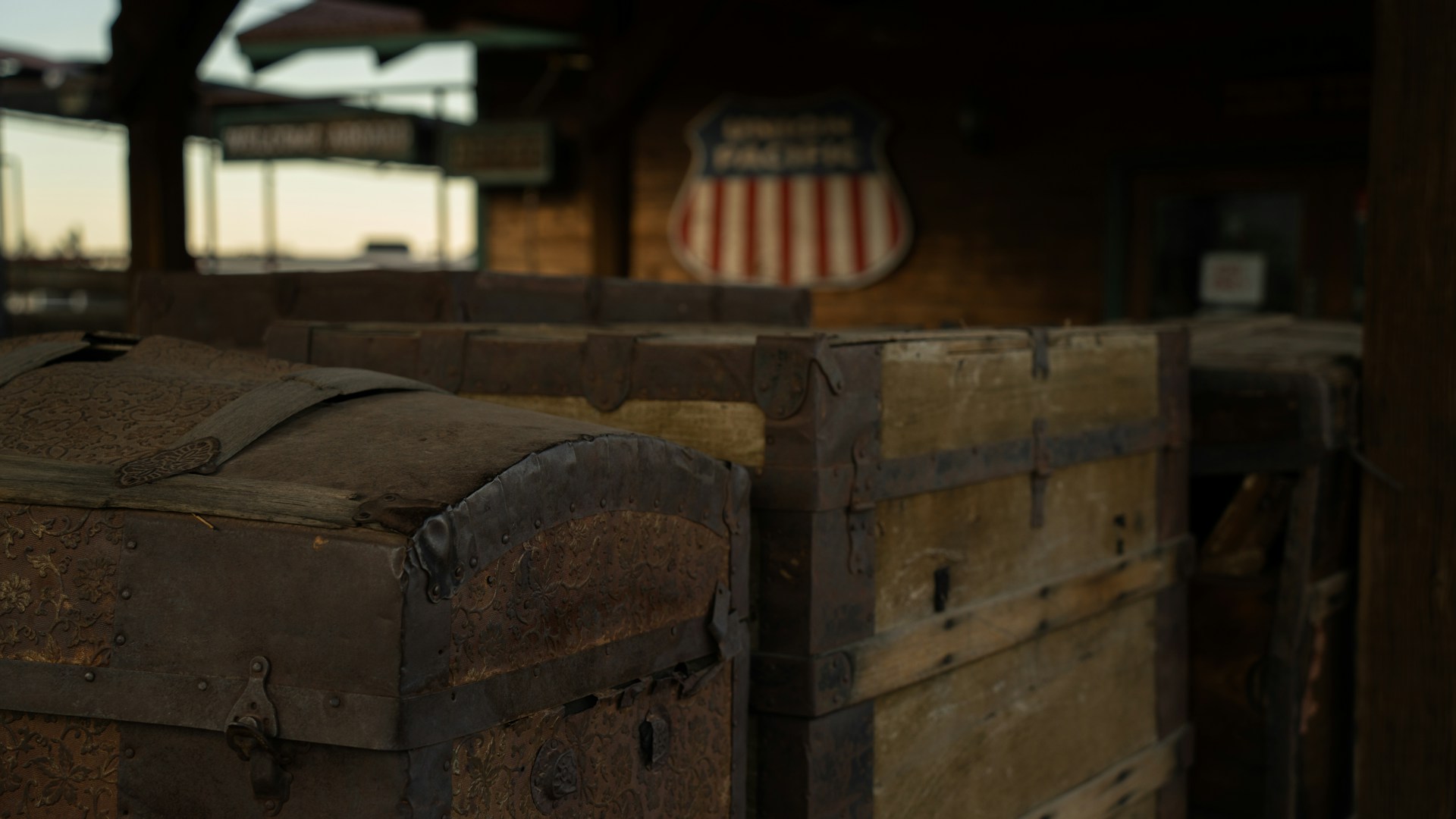
Steamer trunks tell the sharpest tale. Ashford says one flat top trunk sold for $1 in New Jersey in July, while a Victorian humpback and an antique flat top each went for $15.
Then came the shock. On the 13th of October, John Moran Auctioneers in California sold a large Louis Vuitton steamer trunk for $11,000, nearly twice its high estimate, and a Goyard trunk reached $5,250 in Massachusetts. Another Louis Vuitton steamer trunk sold for $500 in September, so even a famous name varies. His advice is to look inside the lid for a label and have anything with a famous name looked at in person.
Three Things To Do Before You Clear A Single Shelf
Ashford keeps his advice to three steps. First, put an inexpensive hardware store humidity gauge on a basement shelf for a week in summer, and if it reads over 65, you have your answer about the basement.
Second, bring whatever you plan to keep upstairs to a room people live in, such as a spare bedroom closet or the top of a wardrobe. Do not clean it, polish it or glue anything, just move it to dry air and leave it alone.
Third, decide now about whatever you already know you do not want, because waiting does not make these things more wanted. If something turns out to be an exception, he says, have it looked at in person before selling, and take tax or estate questions to an attorney or accountant.
His closing thought is a kind one. A basement is the one room that keeps everything a family could not decide about, and he calls that “love that ran out of shelf space.” Before you take the first dollar anyone offers for your mother’s figurines, he says, turn it over, read the bottom and believe what it tells you.
More Stories You May Like
- Woman Scores Two 136 Year Old Oil Paintings Painted In 1890 By A Seller’s Great Grandmother Plus A French Louis XV Chest, Then Gets Angry We Ever Stopped Making Furniture Like This
- 8 Movie Soundtrack Albums That Sold Millions Of Copies, From The Bodyguard To Saturday Night Fever
- 7 Of The Most Valuable Records Ever Sold, From A One Of A Kind Wu-Tang Album To Rare Beatles Pressings

Leave a Reply