

Nothing beat the moment the car turned into the parking lot and you spotted the sign. For a few magical minutes, the toy store was the best place on earth, and the whole holiday season rode on what you found inside.
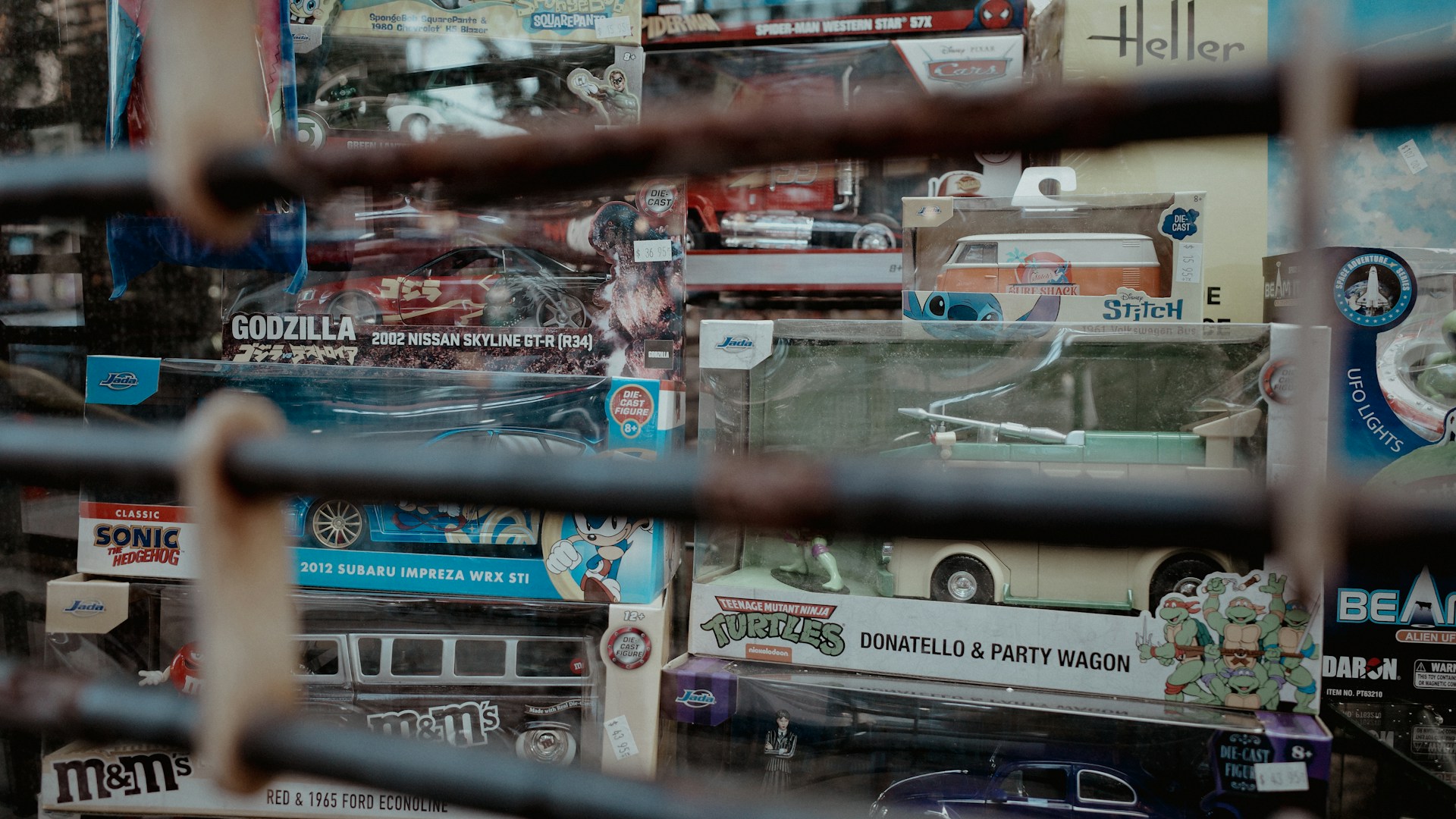
Many of those stores are gone now. Dave Farquhar, in his piece on toy stores that went out of business (published in 2018 and updated in 2023 on The Silicon Underground), traces what happened to the big names. Here are eight of them.
Some of these stores closed for reasons that had nothing to do with kids losing interest in toys. Debt, buyouts and sudden changes in ownership played a big part, as you will see.
Take a walk down memory lane, and see how many you can say you visited.
Kay Bee Toys Was The King Of Mall Toy Stores Until 2009
Farquhar calls KB Toys the king of mall toy stores for decades. The chain went out of business in 2009.
He points to a 2000 leveraged buyout by Bain Capital that left it with debt. He counts it among perhaps three chains that closed unnecessarily because of parent-company mismanagement.
Toys R Us Filed For Bankruptcy In 2017 And Closed In Summer 2018
The giraffe’s big stores were a childhood dream for millions. According to Farquhar, Toys R Us filed for bankruptcy in late 2017 and closed in the summer of 2018.
A 2005 leveraged buyout, also involving Bain Capital, left the company with debt, and it had $5 billion in liabilities in 2017. Farquhar also cites chaotic store layouts, higher prices, poor customer service and a lack of a destination-style experience.
The story has a twist. A store-within-a-store partnership with Macy’s began in 2022, so the brand has returned in a smaller form.
Lionel Kiddie City And Lionel Playworld Went Under In 1993
These were big-box toy stores similar to Toys R Us. They were run by a holding company formed after Lionel sold its train business to General Mills in 1969.
Farquhar says both chains, and the parent company, went under in 1993 after financial difficulty in the early 1990s. A planned merger with Children’s Palace did not go through.
Child World Grew To 182 Stores Before Its 1992 Liquidation
Children’s Palace was founded in 1967, and Child World was founded in 1970 and acquired Children’s Palace in 1975. At its peak the chain had 182 stores and $830 million in annual revenue.
Child World filed for Chapter 11 bankruptcy in April 1992, and its remaining stores were liquidated by the end of September 1992. Farquhar writes that its parent, Cole National, restricted its cash flow, which caused disputes with toy makers.
Combined with the 1990 recession and a weak holiday season, that produced a shortfall of more than $190 million. Merger talks with Lionel were abandoned on August 2.
FAO Schwarz, Founded In 1862, Changed Hands Again And Again
This was once the oldest toy store in the United States. Farquhar says it changed hands several times, and in 2001, 18 stores closed, followed by bankruptcies and more closures.
In 2009, Toys R Us ended up owning what remained. The Las Vegas store closed in 2010 and the New York flagship closed in 2015. Toys R Us sold the brand in 2016, and a new owner announced a New York location for fall 2018.
Zany Brainy Had 187 Stores Before It Closed In 2003
Zany Brainy was an educational toy chain with 187 stores. Farquhar says it closed in 2003.
Noodle Kidoodle, another educational toy chain, was acquired by Zany Brainy in 2000, three years before Zany Brainy itself went under.
The Warner Bros Studio Store Sold Cartoon Magic From 1991 To 2001
This chain sold Warner Bros.-themed merchandise, from Bugs Bunny to the rest of the gang. Farquhar dates it from 1991 to 2001.
It survived a few more years overseas and is now defunct.
All Wound Up Was A Mall Toy Store From 1994 To 2001
Mall regulars may remember this one. Farquhar says All Wound Up ran from 1994 to 2001, and its parent company also owned Borders and Waldenbooks.
The store closed in 2001, part of a run of toy-store endings around that year.
Which of these did you beg your parents to stop at? Each one holds a memory for somebody, whether it was a Saturday trip to the mall or a big holiday run to a giant store with aisles that seemed to go on forever.
Look at the dates and a pattern appears. Big chains fell in 1992 and 1993, mall and educational stores in the early 2000s, and the biggest of all in 2018.
Debt shows up again and again in Farquhar’s telling, from the Bain Capital buyouts to the cash flow squeeze at Child World. The kids were never the problem. The balance sheets were.
If you saved a store bag, a catalog or a gift card from one of these places, hold on to it. Paper from a closed chain is a small piece of everyday history, and it may be worth more to your grandchildren than you think.
More Stories You May Like
- He Bought Pyrex For 50¢ In Thrift Stores In The Late 70s And Now Sees The Same Glass Dishes Selling For Tens Of Thousands
- Old Cereal Premiums And Cartoon Memorabilia Are Mostly Common So Here Is What Is Worth Saving Versus What Is Just Clutter
- Fruit Stripe Gum And Hershey’s Kissables Are Among The Halloween Candies Fans Still Miss And Life Savers Holes Were Pulled Over A Choking Hazard

Leave a Reply