

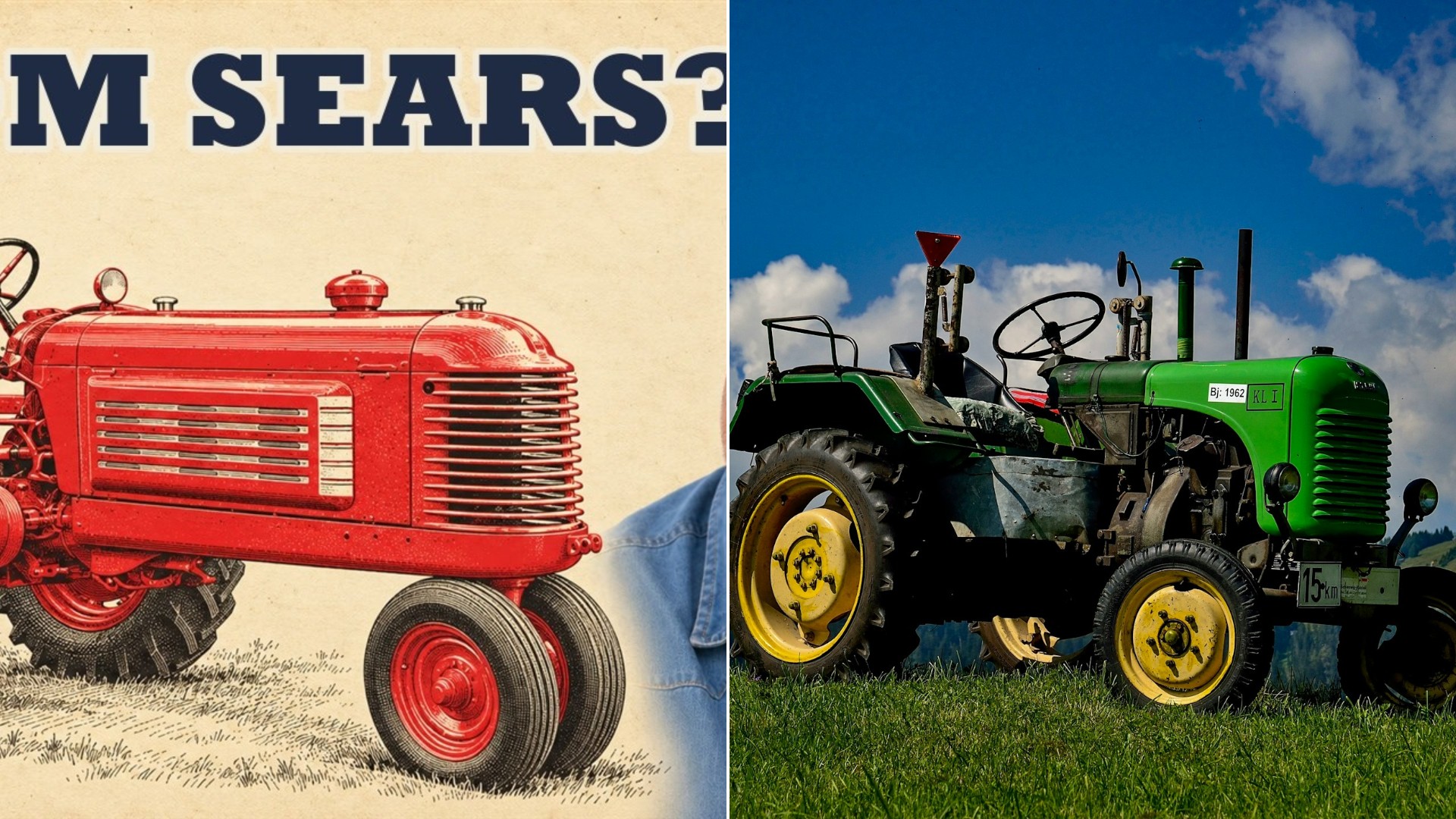
In the spring of 1938, an Iowa farmer could sit at his kitchen table, open the Sears catalog, flip past the work boots and washing machines, and order a tractor. It was a real farm tractor with a six-cylinder engine, built by a car company in Detroit, fitted out by a plow works in Illinois and sold by the biggest store in America.
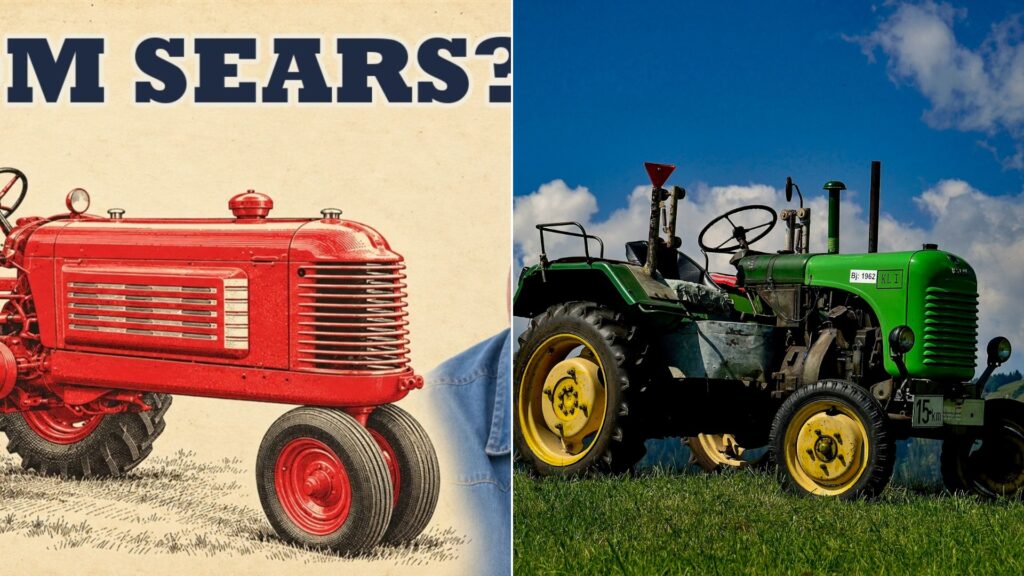
It should have worked, says the host of @implementrow. Sears was in every farmhouse in the country. Yet within a few years, that tractor was gone, and today most people have never heard of it.
The Wish Book Put The Whole Country On The Kitchen Table
Out in the country, the nearest real store might be a long wagon ride away, and you got what it had at the price the storekeeper set. Then free mail delivery reached rural addresses around the turn of the last century, and the catalogs followed.
Sears put clothes, stoves, tools, guns, sewing machines, medicine and even whole houses you could order as a kit on the kitchen table. Farm families called it the wish book. Children wore out the toy pages, and parents studied the prices.
A store that sells to farmers wants to sell the expensive things, and the most expensive thing on the farm is the tractor. To build one, Sears needed a factory.
A Plow Maker’s Town Became Sears’ Factory Floor
David Bradley was born in New York in 1811 and went west to Chicago in 1835, when it was still a raw town on the prairie. By the 1870s he was making plows, and by 1884 the business carried the family name as the David Bradley Manufacturing Company.
Prairie soil was thick, sticky and full of roots, and a plow that would not scour clean was useless. Bradley’s did well. In 1895 the company moved to North Kankakee, Illinois, a town that changed its name to Bradley in his honor. It is still Bradley today.
Around 1910, the family sold the factory to Sears. A catalog company now owned the plow works and could put its own name and Bradley’s on whatever came out of it. For half a century, many of the farm and garden tools Sears sold carried the Bradley name, including walking plows, cultivators, harrows and feed grinders.
The First Bradley Tractor Cost $795 And Still Flopped
That worked well for a plow, which is iron and wood and can often be fixed by a farmer with a forge. A tractor is a different animal.
The first Sears tractor arrived in the Depression, when many farmers could barely pay their taxes. It was a small tractor called the Bradley, designed by engineer Dent Parrett, with a four-cylinder Waukesha engine. It went to the University of Nebraska for testing in June 1931 at a list price of $795, which was cheap even then. It did not sell well, and production soon stopped.
“Built By Graham, Equipped By Bradley, Guaranteed By Sears”
By 1937, things were looking up on the farm, and Sears wanted back in, this time with something that would turn heads. It went to Detroit and Graham-Paige Motors, a car maker with more factory than customers.
The result was one of the best-looking tractors of its time. The Graham-Bradley had a long, smooth, streamlined hood with louvered panels down the sides covering the engine. Most tractors looked like an engine bolted to a frame, but this one looked as if it had driven out of a car showroom. Sears was granted a design patent for the hood in 1937.
Under it sat a six-cylinder engine and a four-speed transmission. It came as a row crop tractor with close front wheels and as a standard with a wide front end. Sears’ slogan, as the host quotes it, was “Built by Graham, equipped by Bradley, guaranteed by Sears.”
It Tested At 30 Horsepower And Hit 25 To 28 Miles An Hour
The Graham-Bradley went through the Nebraska tractor test in April 1938 as test 296. It made a little over 30 horsepower on the belt and about 25 on the drawbar, and pulled just over 3,000 pounds in low gear. That put it in the class of the popular two and three plow tractors.
Fourth gear was meant for the road, and owners reported speeds of 25 to 28 miles an hour, which was flying for a tractor in 1938. But speed has a price. Collectors say a lot of people rolled them over, since a narrow front end, a high center of gravity, a ditch on both sides and 25 miles an hour do not mix.
The handsome side panels looked wonderful in the catalog. In the field on a hot July day, they trapped heat, and many owners simply took them off.
A Farmer Wants A Man In Town With A Part On The Shelf
The host says the part that hurt most was service. Every tractor breaks, and in the middle of planting, a farmer does not want to write a letter to Chicago. He wants a man in town with a part on the shelf and a truck to come out to the field. The big companies had that man in every county seat. Sears had a catalog.
To be fair, Sears had retail stores by then, and some farmers bought their tractors over the counter in cities like Davenport and Iowa City. But a department store is not an implement dealership.
Collectors estimate fewer than 3,000 Graham-Bradleys were built, with only a handful of the wide-front standards. The big makers were building tractors by the tens of thousands.
The War Ended It, And Sears Went Small
Then the war came. Graham-Paige turned its factory to war work, and the tractor never came back. In 1947 the company sold its car business to Kaiser-Frazer.
Sears gave up on big tractors but kept the Bradley works. In 1946, it brought out a walk-behind garden tractor, with two wheels, a small engine and two handles, just as millions of veterans came home and bought houses with big lots. Models ranged from about 1 horsepower to 6, with more than 40 attachments, and it stayed in production for about 20 years.
Sears also tried a small three-wheeled riding tractor in the 1950s, the Tri-Trac, built from about 1954 to 1957 to take on International Harvester’s Cub. It never caught on. But in 1958, Bradley introduced a garden riding tractor, and the company said it became the largest maker of those in the world.
What Became Of The Works
In 1962, Sears merged the Bradley works with another company it controlled in Newark, Ohio, and in 1964 that company merged into the George D. Roper Corporation. The plant kept building garden equipment for years, and in 1982 Roper gave it to the village. On July 14, 1986, a fire destroyed six of the old buildings.
Today the Graham-Bradley is one of the rarer American tractors of its era, and collectors love that long hood. The 1931 Bradley is rarer still, and the little walk-behind has clubs, manuals and parts, and owners who keep one running for their grandchildren.
What Collectors And Sellers Can Take From It
- Check the badge. Bradley and Sears names turn up on plows, cultivators, harrows and garden tractors, so a barn find may be more interesting than it looks.
- Look at the hood. Collectors say the Graham-Bradley is a long, rounded, louvered hood, and some owners removed the side panels.
- Know the rarity. Fewer than 3,000 Graham-Bradleys were built, and the 1931 model is rarer.
- Look at the garden tractors. The walk-behind models ran from about 1 to 6 horsepower with more than 40 attachments.
The host sums it up simply. A tractor is not something you buy, it is something you keep running, and for that you need somebody close by. Sears learned that twice, then built a little machine you could fix in your own garage, and that one ran for 20 years.
More Stories You May Like
- Goodwill Night Trip Turns Up A Trinket Box Inside Another Trinket Box For Just $1.99 Plus A Salvation Army Stop
- Thrift Couple Hit A Goodwill After Someone Cleaned Out A Whole House And Donated It But One $15 Buy Had A Hole They Missed
- Machine Washing Bleaching Or Tumble Drying Vintage Clothing Can Ruin Delicate Old Fabrics So Here Is The Safer Way

Leave a Reply