

Some people inherit a watch or a set of dishes. The creator behind @whatsongrandpasturntable inherited his grandfather’s record collection, and he has been working through it one album at a time. This time he let his followers choose. He asked them to recommend albums from the collection, got a pile of responses, and the one that came up most often was Nine Inch Nails’ The Downward Spiral from 1994.
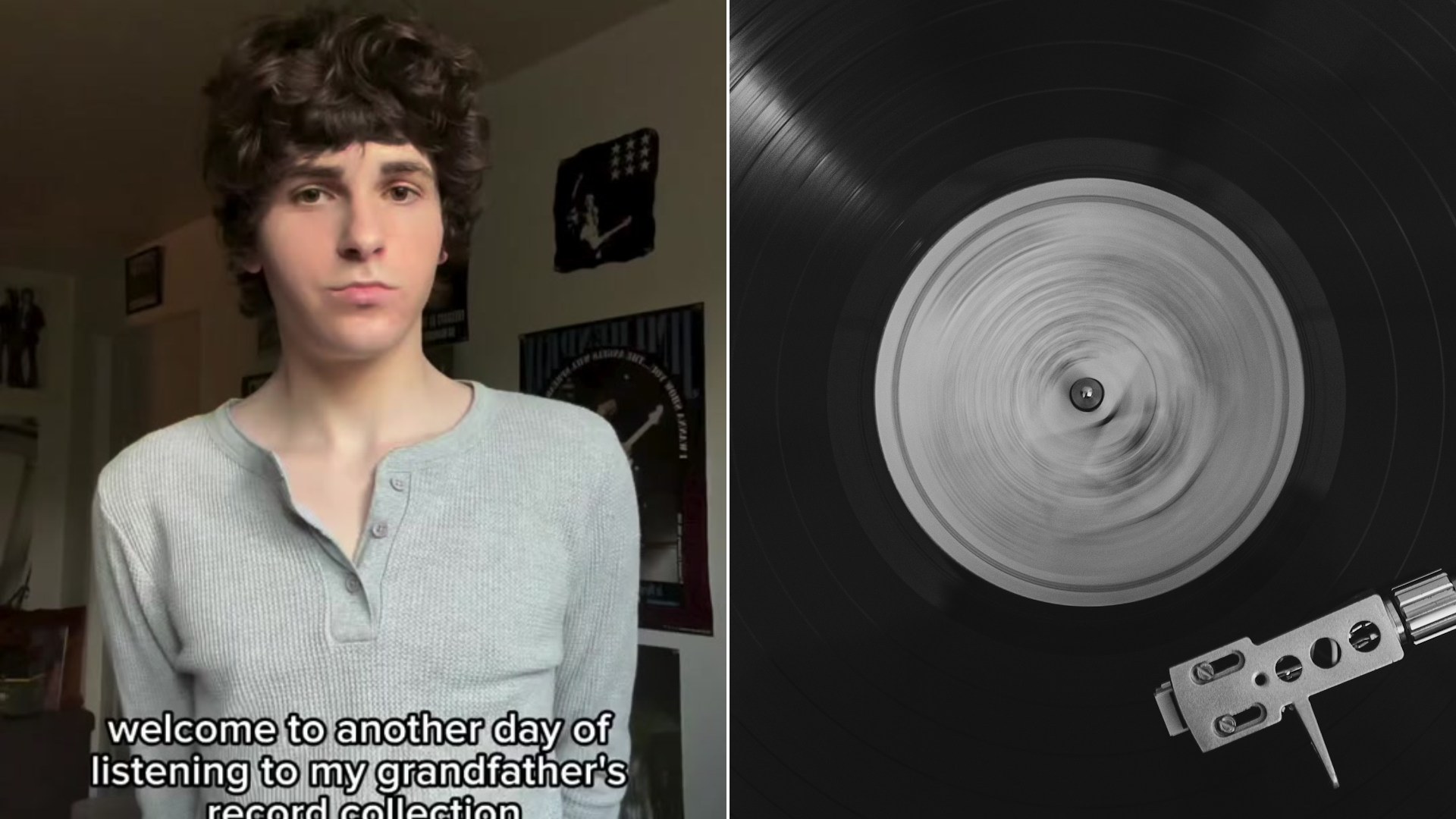
He introduces it the way he opens every installment, as another day of listening to the collection he inherited, this one on the Nothing and Interscope label. Then he drops the needle and tells us, track by track, what he hears. His caption sums up the mood: “My goodness.”
What He Heard, Song By Song
The album opens with “Mr. Self Destruct,” and the creator says he could not tell whether the sharp hits in the intro were a snare drum or punches. He felt the song matched the title of the album, as if he were being let in on a secret. He describes the lyrics as very dark and raw, the kind of writing that sounds like a person confessing. He admits he felt a little guilty listening to them, yet the honesty is exactly what pulled him in.
His favorite part is the singing of frontman Trent Reznor. He loves how Reznor mixes a rough, raspy, screaming delivery with a higher, almost beautiful melodic voice. In his words, Reznor is “kind of hiding” the fact that he is a real singer. The raspy voice gets under his skin, but the high notes are what stay with him, especially because they arrive at surprising moments.
He was struck by how electronic the record is and could not believe it came out in 1994. He called it far ahead of its time. “March of the Pigs” impressed him as a fast, punky track that suddenly slows down and shifts the pitch of the vocal, which showed him how well the band could pace a song. He says the band was so sneaky with their progressions that his eyes widened over and over. On “Closer,” he says he had never heard synth bass sound that good, and he did not even realize it was synth bass until later.
“A Warm Place” gave him what he calls a breath of fresh air in the middle of a heavy album. He first thought “Big Man With a Gun” was silly, then decided it was actually clever, a sarcastic song that pokes fun at powerful men who throw their weight around. And he thought “Hurt” was the perfect ending, especially the one last loud bang after the song seems to be over, which he took as the band reminding you that they are still loud. He ends by asking his audience which 90s albums he should try next and thanks the band for a great album.
A Little Background On The Record
If you did not buy this one when it came out, here is some context. According to Wikipedia’s entry on the album, The Downward Spiral was released on March 8, 1994, on Nothing Records and Interscope. It was produced by Reznor and Flood, with Alan Moulder mixing, and it debuted at number 2 on the Billboard 200 by selling nearly 119,000 copies in its first week. It has since been certified four times platinum in the United States.
The creator’s comment about electronics holds up. Reznor handled the vocals and programming and most of the performances himself, and the sound came from samplers, synthesizers, drum machines and studio effects, with guest drummers and a guitar contribution from Adrian Belew. The album blends industrial rock, alternative rock and electronic music and mostly avoids standard verse and chorus structures, which may be why it still sounded so unusual to a listener decades later.
“Closer” and “March of the Pigs” were the official singles. The “Closer” music video, directed by Mark Romanek, got heavy rotation on MTV, although the network censored the original version, and the video is part of the collection of the Museum of Modern Art. Critics were divided at first, with some praising the record’s abrasive, melodic range and others objecting to its shock value. Over time the verdict has become much warmer, and it is now widely treated as a landmark of 1990s rock.
“Hurt,” the song he calls the perfect ending, has its own legacy. Johnny Cash recorded a cover on his 2002 album American IV: The Man Comes Around, and Reznor, who was skeptical at first, later praised it. If you only know the song from Cash’s version, hearing the original closing track in the context of the whole album is a very different experience.
A Note For Anyone Sensitive To Heavy Themes
This is a loud, dark record. Plenty of listeners from our generation never picked it up because the subject matter was heavy, and that is a fair choice. If you want to try it, an easy approach is the way this creator did it: listen with a fresh mind, treat it as a piece of 1990s art, and notice the musicianship, the production and the way the songs move from fierce to quiet. If the lyrics are not for you, you can still appreciate how much work went into the sound.
How To Explore A Collection You Inherited
What makes this series charming is the process. A grandson takes a box of records he did not choose and listens to every one with open ears. If you have inherited or found a stack of albums, you can borrow his method.
Start with a clean record. Use a soft carbon fiber brush or a microfiber cloth to remove dust before each play, and always hold records by the edges and the label. Check the sleeve for a date, a name or handwriting, because those small notes can tell you who owned the album and when.
Make it a ritual. Listen to one album all the way through, side by side, without skipping. Many records from the 1990s were designed to be heard in order, and this one, with its slow burns and sudden bangs, is a good example.
Ask for input, just as he did. Letting other people vote on what to play next turns a private hobby into a conversation, and it is a good way to discover music you would not have picked yourself.
Finally, keep the story with the record. Write down who owned it and when you first played it. A turntable and a shelf of albums are more than music. They are a way to know someone through what they chose to listen to, and it is a lovely thing to see a grandson getting to know his grandfather’s taste, one album at a time.

Leave a Reply