

If you grew up in the 1950s or 1960s, you probably have a few stories that would make a modern parent clutch their pearls. The creator behind @we.are.baby.boomers put together a quick tour of exactly those memories, and the opening line says it all: our childhood would absolutely terrify parents today.
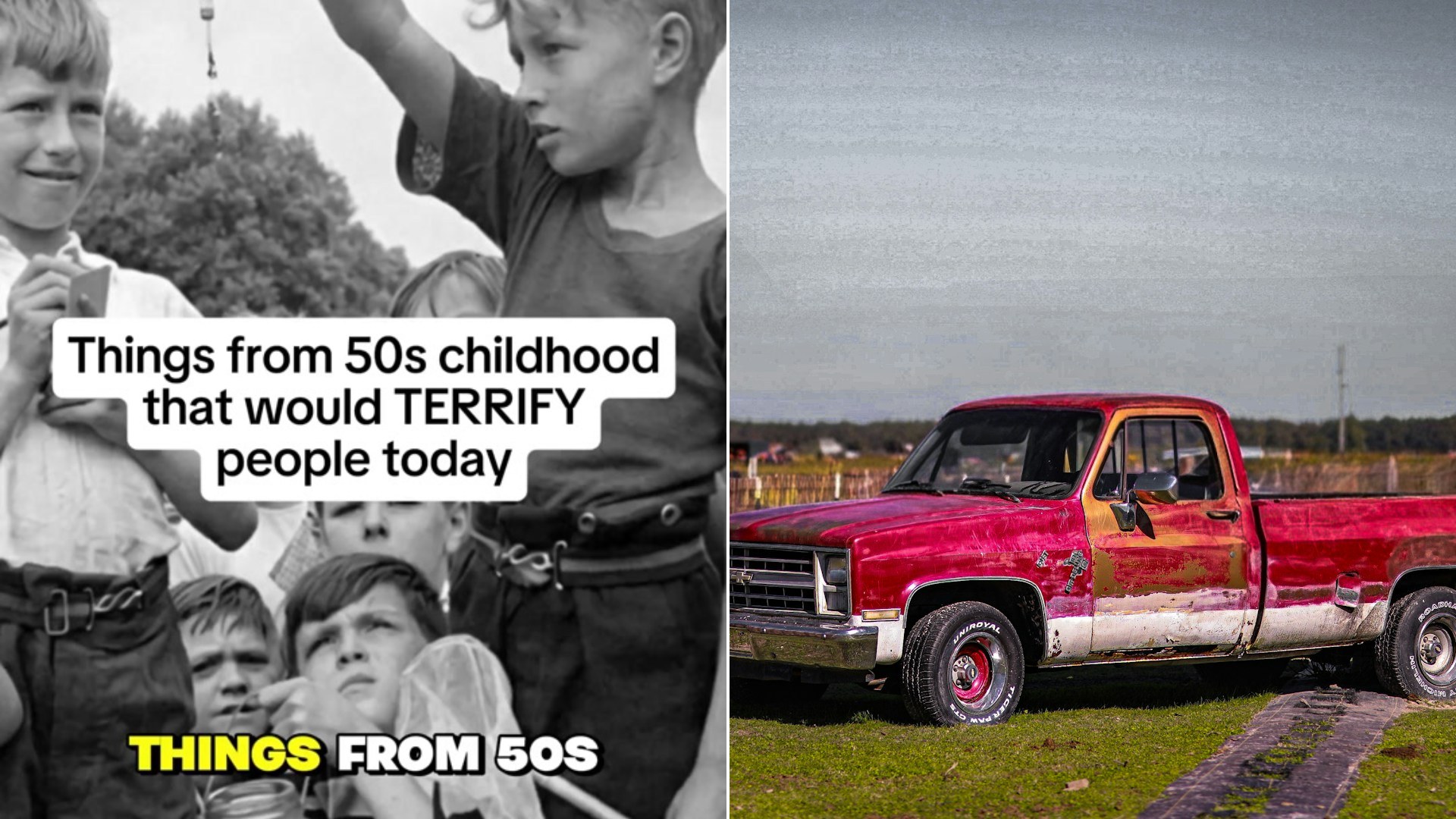
The message is not complaining and it is not bragging. It is a gentle wink to anyone who remembers a world where kids were handed a bike, a curfew, and a big wide neighborhood to figure out on their own.
A Different World, In The Creator’s Words
The creator describes growing up in a completely different world. Kids drank unfiltered water straight from a rusty pump, set up sidewalk lemonade stands, and played in the dirt all day long. Nobody thought twice about any of it.
Then comes the part that makes today’s parents gasp. Seat belts? Forget about it. Kids rode freely in the back of pickup trucks and waved at passing cars from the rear-facing seats of station wagons. They walked miles to school all by themselves and rode their bikes absolutely everywhere, without a helmet in sight.
Playgrounds, the creator says, were basically survival tests. There were scorching hot metal slides in July, massive trees that kids scaled to the very top, and towering monkey bars over solid ground. And yes, there were even unsupervised bow and arrow fights in the yard. The only real rule was simple: be home by dark.
The post closes by asking the question every boomer wants to answer. Did you survive any of these? Tell us in the comments.
Why The Rules Were So Different
It is easy to look back and decide that parents of the 1950s simply did not care. That is not quite fair. They were working with the information and the products they had, and a lot of what we now consider ordinary safety simply did not exist yet.
Take seat belts. According to a history of U.S. seat belt laws, a federal standard requiring seat belts in most new vehicles did not take effect until January 1, 1968, and the first state law requiring people to actually wear them, in New York, did not start until December 1, 1984. For most of the 1950s, a family station wagon often had no belts at all, so a child waving out the back window was not breaking any rule. There was no rule to break.
The same goes for bike helmets. Cycling helmets were not part of everyday childhood in that era, and the idea of strapping one on for a trip to the corner store would have drawn puzzled looks from neighbors. Kids simply hopped on and went.
Even the water question has a story behind it. Many homes and farms had a hand pump or an outdoor spigot, and drinking from it, or from the garden hose, was just part of a summer afternoon. Bottled water as a daily habit was still decades away.
The Long Road To The Bike Helmet
The creator’s no-helmet line has a surprisingly specific history. According to Wikipedia’s article on bicycle helmets, the dominant style before the 1970s was the so-called hairnet helmet, an open design of rubber bars covered in leather. It guarded against scrapes and cuts but offered little impact protection, and it was worn mainly by racing cyclists, not by kids on the block.
The first commercially successful helmet made for bicycles, the Bell Biker, did not arrive until 1975. It used a hard shell lined with polystyrene. A national standard for bicycle helmets, from the American National Standards Institute, followed in 1984, and the Snell B85 standard in 1985. A mandatory federal standard for every bicycle helmet sold in the United States did not take effect until March 1999. In other words, a kid of the 1950s rode without a helmet because there was not yet such a thing as a helmet for kids on bikes.
The Freedom Side Of The Story
What stands out in this list is not really the danger. It is the trust. Children were expected to be capable. A seven-year-old walking to school, a ten-year-old running a lemonade stand, a pack of kids disappearing until the streetlights came on: that was normal, and it taught a whole generation how to handle small problems without a grown-up stepping in.
Many boomers say that is what they miss most. The scraped knees and hot slides are funny to remember, but the real treasure was the long, unscheduled days. No phone to check in on, no calendar of activities, just friends, a bike, and a neighborhood to explore.
What Is Worth Keeping, And What Is Not
Remembering the good old days does not mean wishing every old habit back. Here is a sensible way to think about it, especially if you are a grandparent being asked for advice.
- Keep the freedom, add the gear. Letting kids ride bikes and explore is wonderful. A helmet on the way out the door costs nothing and does not take any of the fun away.
- Buckle up, always. Whatever rode in the back of a pickup in 1955, today every child belongs in a proper seat with a belt or car seat that fits them.
- Keep the outdoor time. The dirt, the trees, and the long afternoons are as good for kids today as they ever were. Shorten the screen time and lengthen the yard time.
- Retire the risky games. Bow and arrow fights and scorching metal slides make for great stories. They make for poor plans.
- Tell the stories. Grandchildren love hearing about the time you climbed to the top of the tallest tree on the block. Just add the part about how you would do it a little differently now.
Your Turn
So how many of these did you live through? The rusty pump, the lemonade stand, the open tailgate, the walk to school, the home-by-dark rule? Most boomers are happy to count at least four or five. The funny thing is that almost everybody who grew up this way says the same thing at the end of the list: we turned out just fine, and we would not trade those long summer days for anything.
Share this one with the cousins and the old neighborhood gang. Chances are good that somebody will remember a story that did not make the list, and it will be even wilder than the ones above.

Leave a Reply