

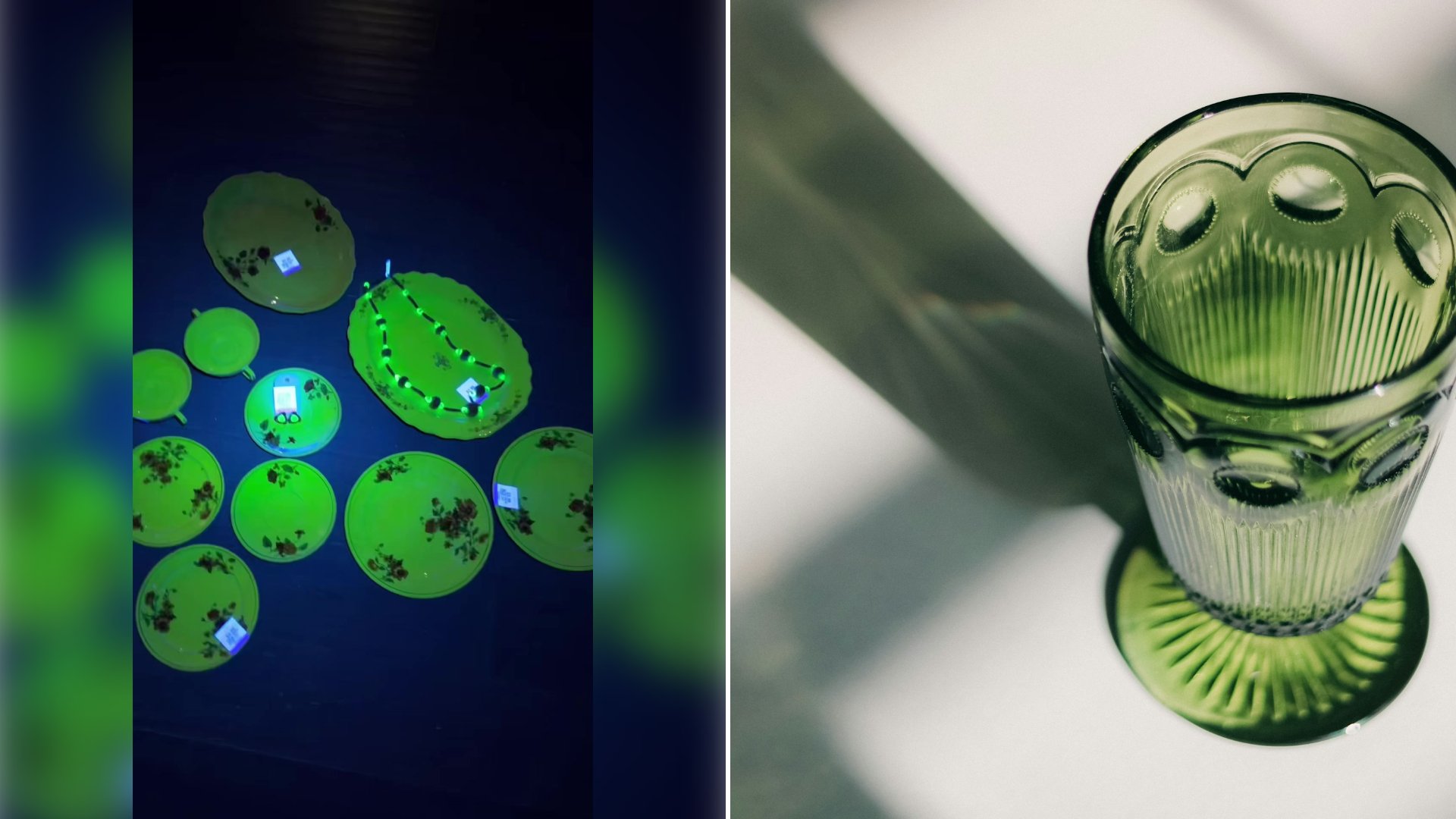
Most thrift store hauls involve a cart and a sharp eye for labels. This one involves a Geiger counter. A collector walks the glassware aisle holding the detector in one hand and a UV blacklight in the other, scanning shelf after shelf of ordinary-looking vintage glass until, near a cluster of pale green pieces, the counter starts clicking. Under the blacklight, the glass glows an unmistakable, almost electric green. It’s not a trick. It’s uranium glass, and it really is mildly radioactive.
@radioactive.loonie turns the hunt itself into the appeal of the video, letting the clicking sound build tension the same way a metal detector does on a beach. The payoff isn’t just finding old glass, it’s finding glass that sets off an actual radiation detector in the middle of a thrift store full of unsuspecting shoppers.
@radioactive.loonie
Uranium glass is exactly what it sounds like: glassware made with small amounts of uranium oxide mixed into the glass during manufacturing, a practice that goes back to the 1830s in Europe and became especially popular in the United States from the 1880s through the mid-20th century. Glassmakers used it specifically because of the glow effect, uranium causes the glass to fluoresce a vivid yellow-green under ultraviolet light, which made it a novelty and a selling point rather than a safety concern at the time. It’s often sold today under the nicknames “Vaseline glass,” for its waxy yellow-green color in daylight, or “depression glass” when it overlaps with the mass-produced glassware of the 1920s and 1930s.
Production slowed sharply during and after World War II, when the United States government restricted civilian access to uranium as the material became strategically important, and it never fully returned to its earlier popularity once newer glass styles took over. That production gap is part of why genuine antique uranium glass, especially pre-war pieces, has become a specific, identifiable collecting category rather than just a generic vintage glass type.
As for the safety question the video raises just by existing: uranium glass is real, it is technically radioactive, and it will register on a sensitive Geiger counter, but health physicists and radiation safety researchers who have studied it consistently describe the radiation levels in typical pieces as extremely low, far below levels considered hazardous for owning, displaying, or handling. The uranium content is generally under 2% by weight and tightly bound within the glass itself, so the main theoretical risk discussed by radiation safety sources involves prolonged, direct ingestion-level exposure or grinding the glass into dust, not simply owning a bowl or candy dish. Normal handling, display, and even drinking from a piece occasionally is considered safe by the collecting community and the radiation safety information commonly cited around it.
That combination, real science, a genuinely startling detector response, and a collecting niche most thrift shoppers have never heard of, is exactly why this kind of hunt plays so differently than a typical vintage glass haul. It turns a routine browse through dusty shelves into something that looks almost like fieldwork, and it gives uranium glass collectors a very literal way to prove their find is the real thing.
More from Vinyl and Velvet
- Digger Unearths a Tangled Pile of Antique Glass Bottles in Cobalt Blue, Amber, and Green Buried Together in an Overgrown Patch of Woods Behind an Old Property
- Thrifter Wonders If a Silver Toned Grape Cluster Stand on a Store Shelf Is the Perfect Match for Her Red Glass Strawberry Salt and Pepper Shakers, Then Tests It at Home
- Thrifter Pulls a Black Bowling Ball Off a Goodwill Shelf, Turns It to Reveal the Grim Reaper From Billy and Mandy Painted on It and Calls It a God Tier Pull

Leave a Reply