

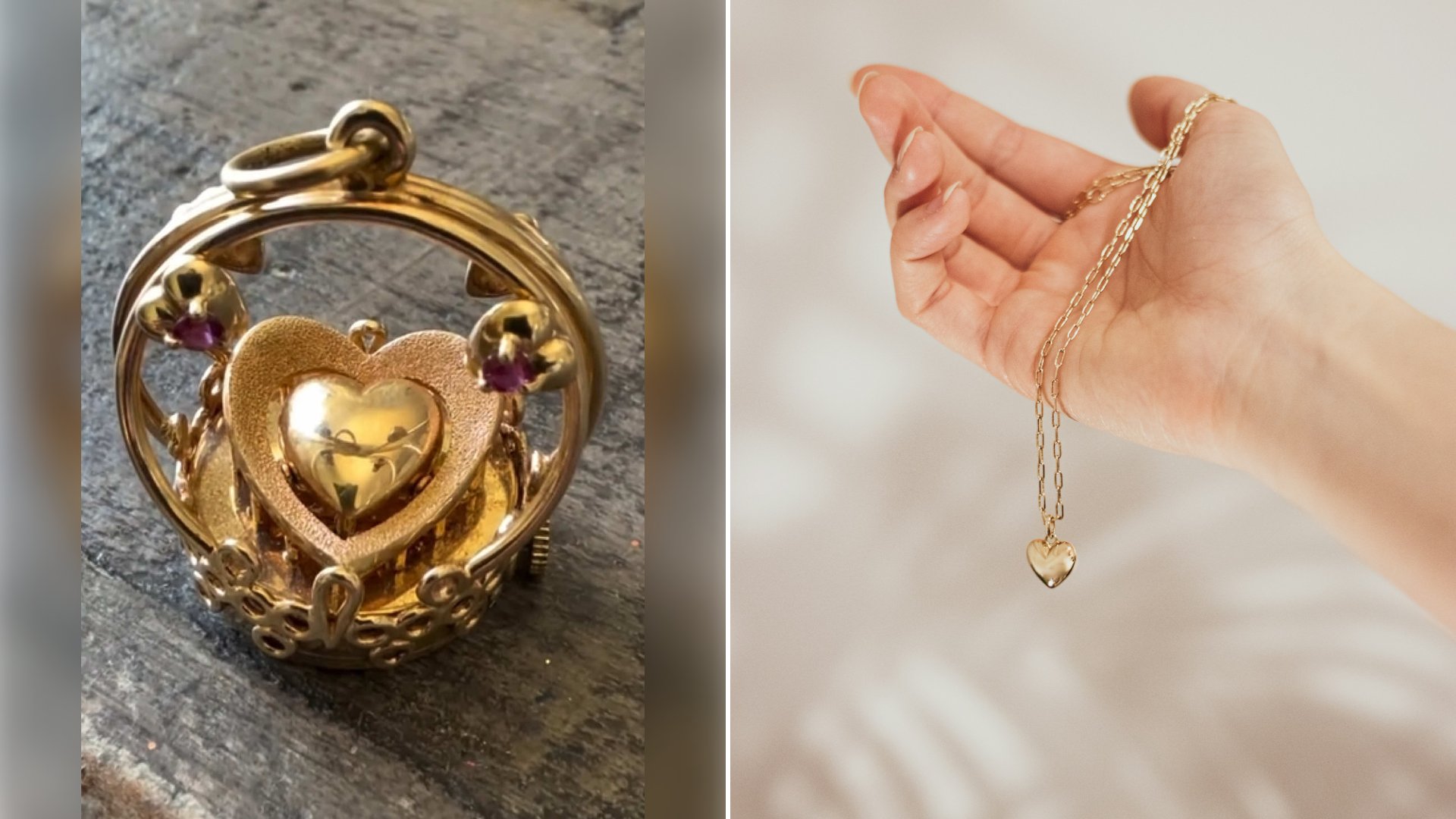
From the outside it’s just a gold heart-shaped pendant, the kind of piece someone might glance past on a jewelry tray without a second thought. Then the close-up demonstration hits, and the heart swings open on a tiny hinge to reveal something nobody expects from a locket: a fully functioning miniature watch face, complete with hands, numerals, and a working movement, all packed into a space smaller than a thumbnail.
@artvangarde lets the macro shot do all the talking, slowly opening the pendant and letting the camera linger on just how small the moving parts inside actually are. It’s the kind of reveal that only works in extreme close-up, because at arm’s length the piece reads as nothing more than decorative gold jewelry from the 1960s.
@artvangarde
Pendant watches disguised as jewelry rather than displayed as timepieces have a long history that actually predates the wristwatch itself. Before wristwatches became socially acceptable for women in the early 20th century, and widely acceptable for men only after World War I made them practical for soldiers, watches were carried as pocket watches or worn as pendants, often concealed inside decorative cases shaped like hearts, lockets, or other jewelry forms so the mechanism itself stayed hidden until opened.
By the 1960s, when a piece like this would have been made, Swiss and European watchmakers were producing small-scale mechanical movements specifically sized for jewelry-style cases, a specialty that required cramming a full gear train, balance wheel, and escapement into a fraction of the space used in a standard pocket or wrist movement. That kind of miniaturization demanded extremely fine tooling and hand-finishing, since machine tolerances at that scale left very little room for error, which is part of why well-made vintage pieces like this are genuinely difficult to reproduce cheaply even with modern manufacturing.
That era also sat right at the tail end of mechanical watchmaking’s dominance before quartz movements, introduced commercially in the early 1970s, reshaped the entire industry by making accurate timekeeping dramatically cheaper and easier to mass-produce. A hand-wound or manually set mechanical pendant watch from the 1960s represents watchmaking from just before that shift, built using skills and small-batch production methods that quartz technology would make largely unnecessary within a decade.
Pieces like this tend to surface today through estate sales, inherited jewelry boxes, and antique dealers who specialize in both horology and vintage jewelry, two collecting worlds that don’t always overlap. Because a hidden-watch pendant has to satisfy both categories, decorative enough to function as jewelry and mechanically sound enough to function as a watch, well-preserved examples with a working movement tend to draw interest from both vintage jewelry collectors and mechanical watch enthusiasts, which is exactly the crossover appeal that makes a close-up reveal like this one so satisfying to watch.
More from Vinyl and Velvet
- Depop Reseller Sorts Through a Jar Packed Solid With Tangled Vintage Jewelry Piece by Piece, and Commenters Spot a Pendant Necklace They Say Deserves a Real Appraisal
- Jeweler Says She Took One Look at a Customer’s Family Gold Presidential Style Watch, Knew It Was Not Authentic and Suggested He Keep It and Wear It Anyway
- Carole Radziwill Says She Inherited Jackie Kennedy Onassis’s Cartier Watch, Sold It at Christie’s to Break a Widowhood Curse, and Watched Kim Kardashian Place the Winning Bid

Leave a Reply