

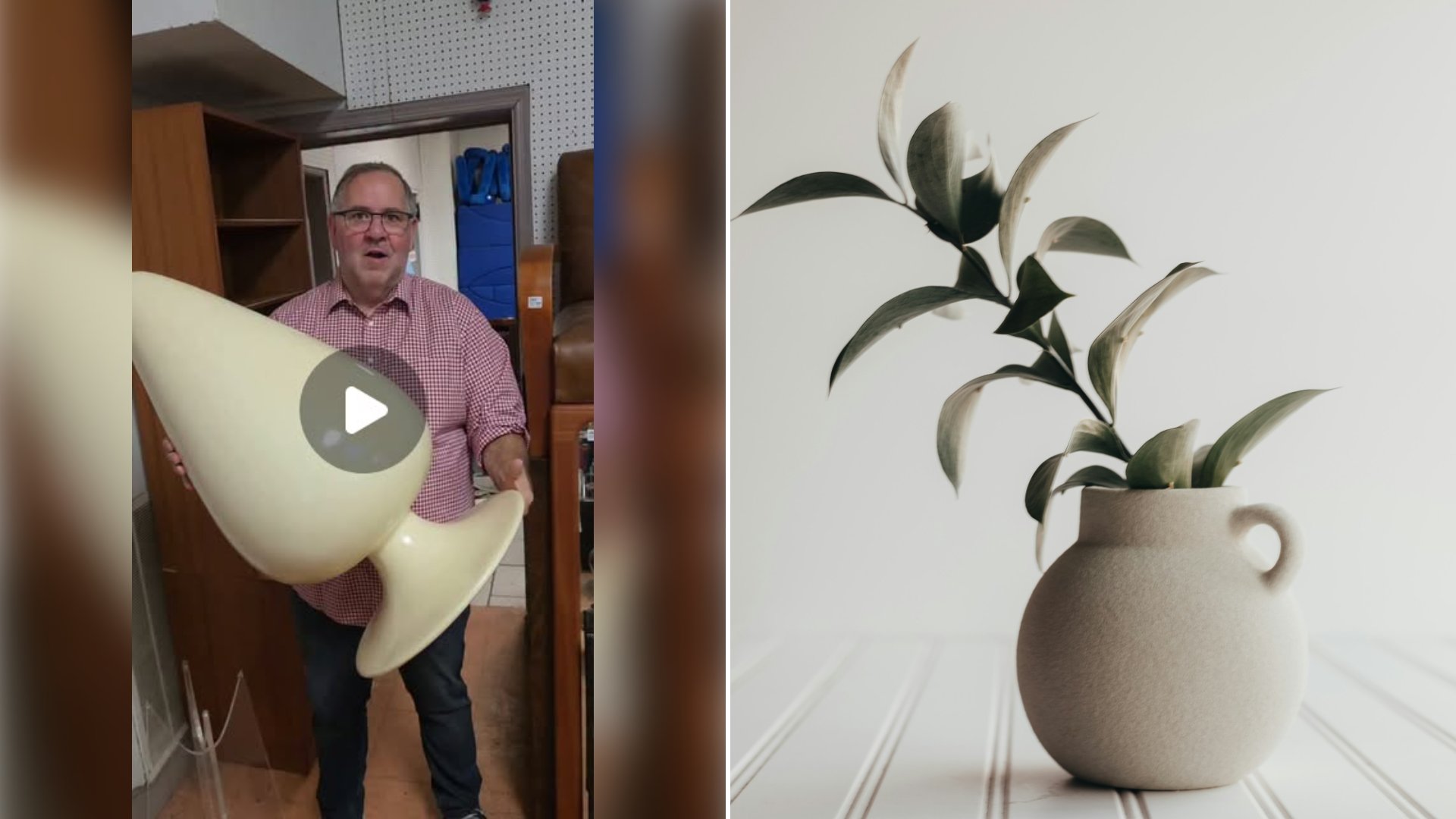
Estate sale host @salesbyhelen is doing exactly what an estate sale host is supposed to do here: standing a large piece up on its acrylic stand, describing it clearly, and giving potential bidders the information they need ahead of an upcoming auction. The piece in question is a sizable postmodern ceramic vase, cream glazed and unusually shaped, listed as lot number three ninety five in an antiques and uniques sale. The pitch starts professionally enough, right up until the shape of the vase becomes impossible to describe with a straight face.
That tension between professional presentation and an object that is obviously, unmistakably shaped like something else entirely is the whole joke, and it works because the vase itself is a completely genuine piece of design history underneath the laughter. Postmodern ceramics leaned hard into exactly this kind of provocation, treating a household object as a vehicle for humor, irony, and sometimes outright absurdity rather than pure function or classical beauty.
Postmodern design emerged in the 1970s and 1980s as a direct reaction against the strict minimalism and rigid rules of the modernist movement that came before it. Where modernism preached that form should follow function and ornamentation was a kind of moral failing, postmodern designers deliberately broke those rules, mixing unexpected shapes, bold colors, and even humor into furniture and decorative objects. Ceramics were an especially fertile ground for this attitude because a vase or vessel has no real structural requirements to satisfy, which meant designers were free to push shape and silhouette as far as they wanted without worrying about whether the piece would still function as furniture needs to.
That willingness to be playful, strange, or even provocative is exactly why postmodern design objects have built such a devoted following among collectors decades later. A piece that looks genuinely odd or funny stands out instantly on a shelf in a way that a tasteful, restrained modernist piece often does not, and that visual memorability has translated into real demand at auction. Postmodern furniture and decorative objects from this era, especially pieces with a clear design pedigree or an unmistakable visual signature, have seen steadily growing interest from a generation of collectors drawn to maximalism after decades of minimalist design dominance.
Estate and antique auctions remain one of the most reliable places for pieces like this to surface, since postmodern decorative objects were often produced in limited runs by smaller studios rather than mass manufactured, and they tend to turn up when an original owner’s collection is being liquidated decades later. Cataloging a piece honestly, shape and all, actually serves bidders well in this market. Collectors chasing postmodern ceramics specifically want pieces that commit fully to the era’s willingness to be a little outrageous, and a vase that gets a laugh out of the auction host on camera is, in its own way, doing exactly what it was designed to do.
That is really the heart of why this clip works as well as it does. It is not mocking the piece, it is accidentally proving the piece’s entire point. Postmodern design set out to make objects that provoked a reaction, and a host who cannot finish a sentence about lot three ninety five without laughing is about the most honest review a piece of postmodern ceramic could ask for.
More from Vinyl and Velvet
- An Antique Warehouse Tour Reveals a Working Miniature Salesman’s Sample Barber Chair and a Mystery Object Several Commenters Swear Looks Like a Bazooka
- Thrifter Wonders If a Silver Toned Grape Cluster Stand on a Store Shelf Is the Perfect Match for Her Red Glass Strawberry Salt and Pepper Shakers, Then Tests It at Home
- Estate Sale Shopper Says She Leaves Every Estate Sale With a Little Trinket and This Time the Trinket Is a Red Stained Glass Koi Fish Lamp She Cradles in Her Arms

Leave a Reply