

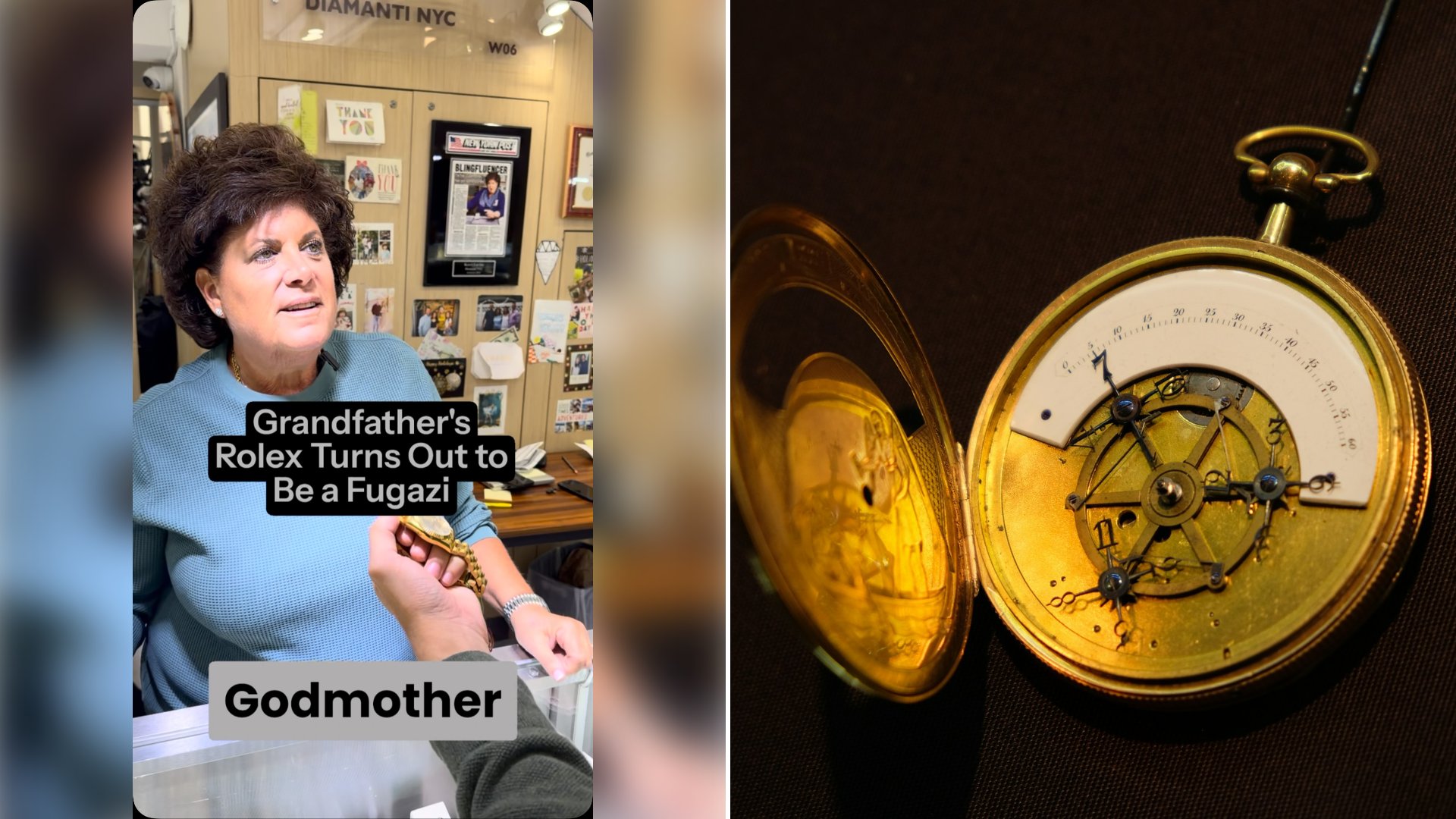
A man brought a gold presidential style watch with a family story attached to a jeweler’s counter, hoping she could take a look, and within seconds she knew something was off. The jeweler, who posts as @kerrilavine, shared the 173 second reel on September 26, 2026, with a caption that reads, in part, “I took one look and knew something wasn’t right. Unfortunately, I had to give him the news, this watch wasn’t authentic.”
The caption goes on: “I know that’s never an easy thing to hear, especially when there’s a family story attached.” Her advice to everyone, she writes, is “before you buy, sell, or pass down a luxury watch, have it properly authenticated.”
The video shows her at a glass counter in a blue sweater, with framed articles, photos and certificates behind her. White captions run across the bottom of the screen for the whole reel. Early on she holds the watch up and a caption reads “It’s not real.” As she turns it over in her hands the captions continue with fragments such as “It’s very” and “gold,” then “Do you have any…” followed by “Nothing?”
She spends much of the next minute handling the watch in close up. At about 0:40 she holds it up to her eye while a caption reads “a feeling to it,” at 0:46 the caption is “fugazi,” and at 0:49 it reads “bearer of bad.” She bends back the bracelet to look at the clasp and the underside, and turns the watch over to show the back of the case, where a green element shows. A caption at about 1:03 reads “is not at all gold.” Then comes a pivot: “Here’s my suggestion” (1:12), followed by a caption that begins “keep it and wear…” (1:15). The rest of that sentence is not readable in the frames. Between 1:26 and 1:38 captions include “thousand” and “maybe nineteen,” but the frames do not show what those figures refer to.
Later she closes in on the dial and the bracelet. The dial shows a day and date window, diamond style hour markers and a ribbed gold bezel, and at 1:47 a caption reads “phony.” At 1:58 a caption reads “Let’s fix that,” and around 2:18 comes “We’ll set the.” At 2:23 the watch is fastened onto a wrist. By 2:34 she is seated and showing it to a man in a dark blue shirt, who studies it while captions read “Feels really” (2:39) and “That’s not” (2:42). The last frames show the watch in a hand with the caption “copying.”
Her caption tells viewers to get a watch authenticated before they buy, sell or pass it down, and federal agencies say the same about where to buy. The U.S. Patent and Trademark Office describes counterfeit goods as products “intended to trick consumers who rely on brand names and logos,” and lists three checks it calls price, packaging and place: be cautious of deals that seem too good to be true, compare labels and certification marks with known authentic products, and buy directly from brand owners or authorized retailers. The agency notes a 2018 Government Accountability Office report that found close to half of the products it bought online from third party sellers on popular websites were counterfeit.
U.S. Customs and Border Protection reports how large the problem is in watches specifically. In a June 2021 release, CBP said officers at JFK seized 19 Rolex watches from a Hong Kong shipment that import specialists determined were counterfeit, with an estimated retail value of $285,000 had they been genuine. The same release says CBP seized 26,503 shipments of counterfeit goods in fiscal year 2020, worth nearly $1.3 billion if genuine, and advises shoppers to buy from the trademark holder or authorized retailers and to be suspicious when “the price of a product seems too good to be true.”
For anyone holding a watch that came down through a family, the reel and those guidelines point to a short sequence. Have it looked at by an independent jeweler or watchmaker before anything else, ideally in person, not from photos. If a buyer or seller is involved, ask for the box, papers and any service records, but treat them as clues, since packaging can be faked too, as the USPTO notes when it tells shoppers to compare labels and printing on packaging. Do not insure, sell or gift the watch as genuine until it has been authenticated. If it turns out to be a copy, the video shows one jeweler’s answer: keep it and wear it, as a keepsake and not as the real thing.
More from Vinyl and Velvet
- Thrifter Lifts A Goyard Print Bag She Says She Knew Was Fake Off A Thrift Store Rack, Then Unzips It And Finds A Tag From The RealReal Tucked Inside
- Reseller Says He Paid $2,100 for an Abandoned Storage Unit, Opened a Duffel Bag to Find an Audemars Piguet Box With No Watch, Then Pulled Out Dior, Balenciaga and Chrome Hearts
- Several Named TikTok Collectors With Real Public Businesses Are Turning Vintage Cartier and Rolex Watches Into a Legitimate Industry Right Now

Leave a Reply