

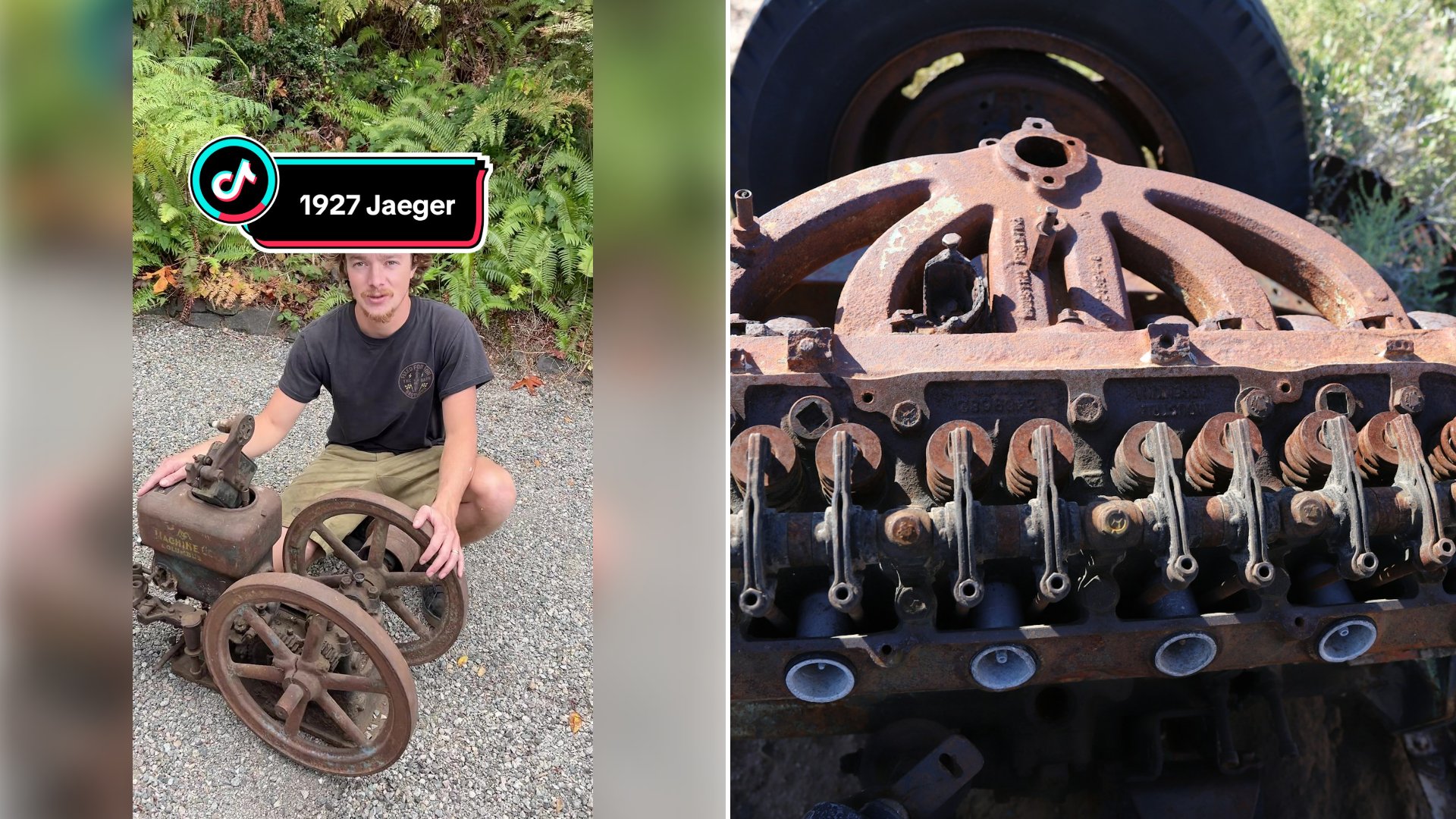
A video from the account The Barn Brothers opens with a simple, direct question: “1927 Jaeger engine off of a concrete mixer. Will it run?” The creator kneels beside a rust-caked single-cylinder engine mounted on two heavy cast-iron wheels, hashtagged #antique, #engine, and #hitandmiss, and the clip pulled in 32,000 likes, 237 comments, and more than 2,500 saves from people invested in finding out whether a century-old motor could actually be coaxed back to life.
@thebarnbrothers 1927 Jaeger engine off of a concrete mixer. Will it run? #antique #engine #hitandmiss
The “hitandmiss” hashtag identifies exactly what kind of engine this is. Hit-and-miss engines were a widely used category of early gasoline engine built from roughly the 1890s through the 1930s, named for the distinctive way their governor worked: rather than firing on every stroke like a modern engine, a hit-and-miss engine only fires when its speed drops below a set threshold, coasting on a heavy flywheel the rest of the time. That irregular, chugging rhythm is instantly recognizable to anyone who has heard one running, and it made these engines ideal for exactly the kind of steady, low-maintenance industrial work this one was built for.
The Jaeger name points to a well-documented manufacturer. The Jaeger Machine Company, based in Columbus, Ohio, built concrete mixers and the stationary engines that powered them throughout the early 20th century, supplying equipment that was used on construction sites across the country before gas-powered mixers were eventually phased out in favor of more modern machinery. An engine like this one would have spent its working life bolted to a mixer drum, turning concrete all day on a job site rather than doing anything glamorous, which is part of why finding one still intact, nearly a hundred years later, is notable to people who collect this kind of machinery.
Getting it running again is not a simple matter of adding gas. Commenters who clearly knew their way around antique engines focused on the mechanical specifics: one person suggested eBay would be “the best bet for a rocker arm unless you already found one,” pointing out that a nearly century-old, parts-specific component like that is far more likely to turn up through a dedicated vintage-machinery marketplace than any hardware store. That kind of restoration work typically means sourcing period-correct parts, freeing up pistons and valves that have sat seized for decades, and rebuilding ignition systems designed for an era before standardized spark plugs.
Reactions ranged from awe to disbelief. One commenter from Kenya wrote, simply, “in Kenya we can’t even make this,” reflecting on just how much industrial manufacturing capacity went into building equipment like this a century ago. Another joked it was “too early to watch” the restoration unfold, the kind of comment people leave when they know a project like this is going to take a long time to pay off but want to see it through anyway.
Whether or not this particular Jaeger engine ultimately fires back up, the clip captures something that a lot of modern machinery simply can’t offer: a piece of equipment built to be understood, maintained, and repaired by hand, nearly a hundred years after it left the factory.

Leave a Reply