

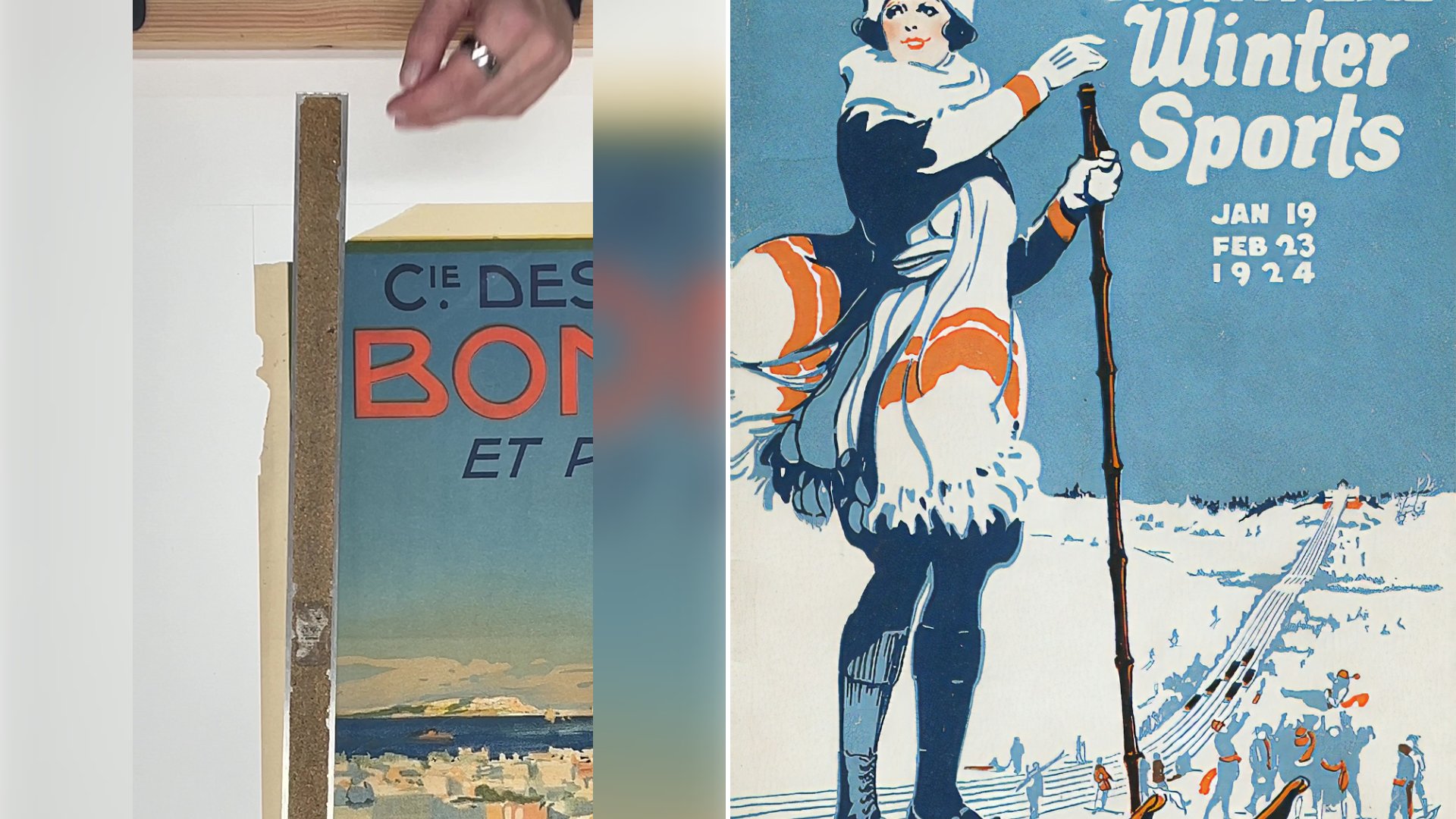
A torn corner usually means a piece is gone for good. A professional poster conservator’s latest video shows that’s not quite true, it just means someone has to go find a replacement piece from an almost identical source.
The clip, posted by Poster Conservation Inc, a conservation studio based in Bridgeport, walks through the restoration of a vintage French maritime travel poster, its lower corner torn away entirely, the backing board visible where the printed paper should be. “Ever wonder how a missing piece of a vintage poster gets restored?” the caption asks, before explaining the technique by name: “We use ‘Donor Posters’ to replace the missing area and then we use water based art materials to restore the pigment back.”
A donor poster is exactly what it sounds like: a second, otherwise less valuable or more heavily damaged copy of the same, or a closely matching, printed piece, kept specifically to be cut apart and used as replacement material for other restorations. Since the missing corner of this poster can’t be recreated from nothing without guessing at the original artwork, conservators instead source paper from a print of matching age, weight, and printing method, physically grafting that donor material into the gap so the restored area is period-correct paper stock rather than a modern substitute glued in to fill space.
Once the donor piece is seated into the missing corner, the real skill shows up in the paint. The caption is specific about materials, watercolors, gouache, colored pencils, and water-based markers, used to rebuild the printed pigment across the seam so the grafted section visually disappears into the surrounding artwork. Just as specifically, it rules out a material plenty of amateur restorers might reach for instead: “We never use Acrylic Paints like Golden Acrylic.” That’s not a brand preference, it’s a conservation principle. Acrylic paint dries permanent and essentially impossible to remove without damaging what’s underneath, while water-based mediums like watercolor and gouache can be lifted back off with water alone if a future conservator needs to undo or redo the work. Reversibility is the line that separates professional art and poster conservation from a well-meaning touch-up job, the same principle that governs how paintings, not just posters, get restored at the professional level.
Vintage advertising posters like this one, particularly French maritime and travel pieces from the early twentieth century, are a genuinely collected category, prized for the lithographic printing techniques and bold commercial art styles of the era. A torn or incomplete example sells for a fraction of a pristine one, which is exactly why donor-poster restoration exists as its own specialty: it’s often more practical, and more respectful of the original printing, to borrow paper from a lesser copy than to attempt a from-scratch recreation that a trained eye could spot as fabricated.
@posterconservation
More from Vinyl and Velvet
- Thrifter Who Has Checked the Art Section of Every Secondhand Store for Years Finally Scores Four Framed Patrick Nagel Prints in One Go Through Facebook Marketplace
- Collector Brings His Diet Coke Silver Bar in an Ice Cube Capsule to a Coin Shop, and the Dealer Offers Double Melt, $120 With Silver Sitting at About $60 an Ounce
- Volunteer Gravestone Cleaner Asked Viewers Who Joseph Lampkin Was, Then Cleaned His 1871 Headstone and Revealed the Railroad Dump Car Accident That Killed Him at 17

Leave a Reply