

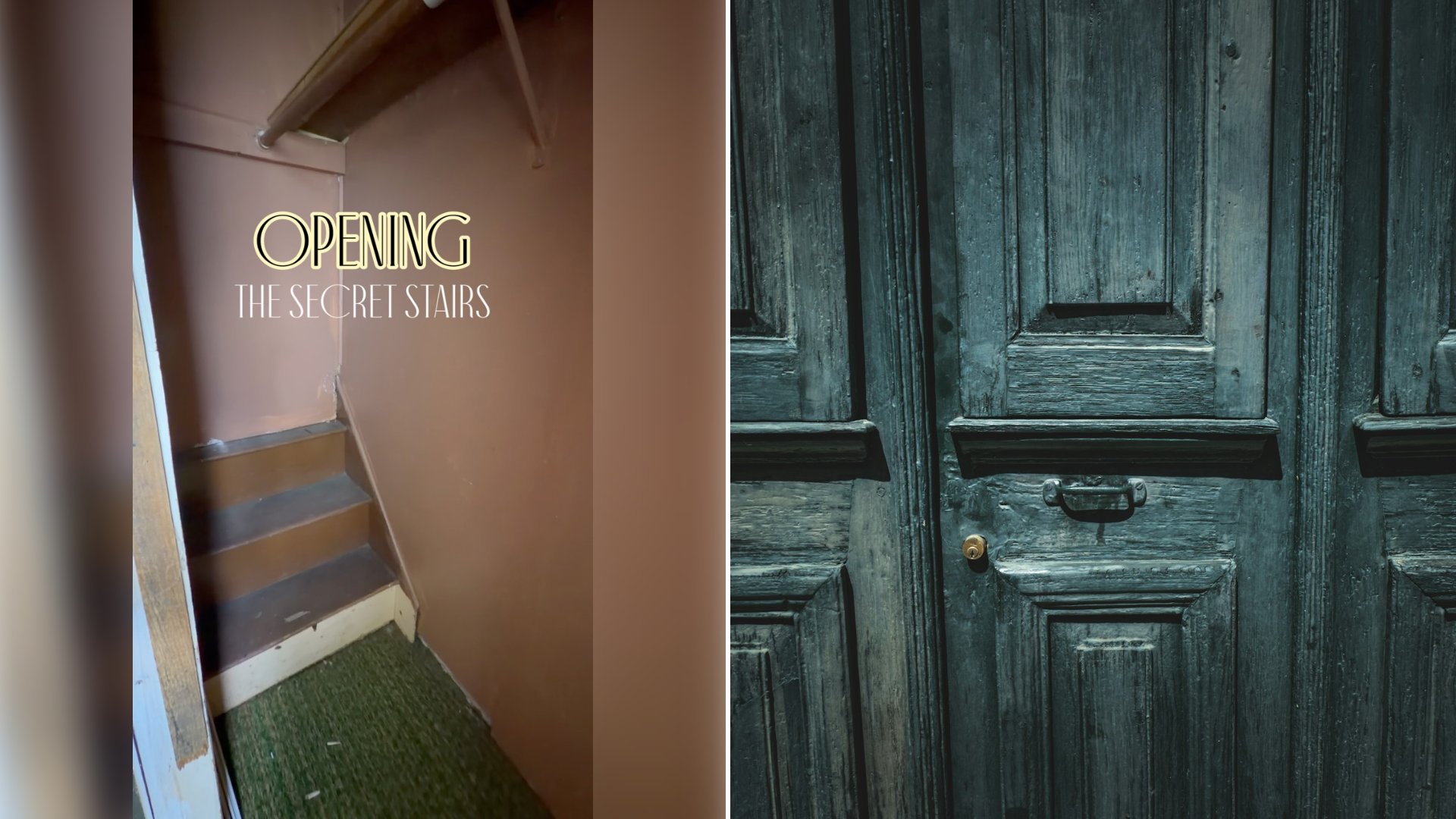
Every old house keeps a few secrets behind drywall. This one kept an entire staircase.
A renovation account captioned the clip plainly: “Opening the Secret Stairs.” The footage opens inside a cramped closet space, with just a sliver of wooden steps visible behind a wall of pallets and drywall that someone, years earlier, had sealed shut. Working with crowbars and power tools, two people tear through the barrier piece by piece, prying out nails and hauling away broken boards while Etta James’ “At Last” plays underneath the whole demolition. No one narrates it. The steps speak for themselves.
Once the wall finally comes down, the camera looks straight up a staircase that had clearly been serving as a dumping ground for longer than anyone currently living in the house had been alive. What spills out, piece by piece, is a small time capsule of a working-class American household somewhere in the back half of the twentieth century: a four-person group photograph, a vintage can of Diet Pepsi with its old “One Calorie” branding, a box of King Edward Cigars matches, a twelve-pack Diet Pepsi carton, a pair of heavily distressed work jeans, and a Christmas card addressed to simply “Dad.” Near the bottom of the pile sits an Owens-Corning Fiberglas sign advertising suspended ceilings, the kind of point-of-sale display a hardware store or home-improvement contractor would have hung decades ago to sell customers on insulation and drop-ceiling kits.
None of these objects are individually valuable. That is sort of the point. Diet Pepsi’s early marketing leaned hard on the “one calorie” claim when the drink first rolled out nationally in the 1960s, a detail that dates the can to an era when diet soda was still being sold to Americans as a genuine novelty rather than a grocery store staple. King Edward Cigars has been a drugstore-counter fixture in the United States since the early 1900s, cheap and widely available, exactly the kind of brand that would leave a crumpled matchbook behind in a man’s coat pocket without anyone thinking twice about it. And Owens-Corning spent much of the mid-century advertising its pink Fiberglas insulation and acoustic suspended-ceiling tiles directly to homeowners doing their own basement and attic work, which is likely how a branded sign for it ended up as scrap lumber in a stairwell instead of hanging in a showroom.
Taken together, the debris sketches a rough outline of a dad, a cigar habit, a taste for diet soda, a Christmas card he kept or was given, and a house that, at some point, decided it would rather have a closet than a second staircase. Whoever boxed it in didn’t bother clearing it out first. They just built a wall and moved on, leaving the next owner to find a photograph, a soda can, and a pair of worn jeans exactly where they landed.
By the end of the clip, the staircase is fully exposed, swept, and climbing cleanly up into the rest of the house, debris finally cleared after who knows how many years sealed behind that closet. It is a reminder that a lot of “secret” finds in old houses aren’t treasure in the traditional sense. They’re just the stuff of an ordinary life, preserved by accident because nobody ever thought to open that wall again.
More from Vinyl and Velvet
- Collector Brings His Diet Coke Silver Bar in an Ice Cube Capsule to a Coin Shop, and the Dealer Offers Double Melt, $120 With Silver Sitting at About $60 an Ounce
- Safe Technician Empties a Hidden Safe He Says a Family Found Two Months After Losing Their Sister and Pulls Out Coin Collection Books, a Pouch of Rolled Coins and a Revolver Booklet
- Volunteer Gravestone Cleaner Asked Viewers Who Joseph Lampkin Was, Then Cleaned His 1871 Headstone and Revealed the Railroad Dump Car Accident That Killed Him at 17

Leave a Reply