

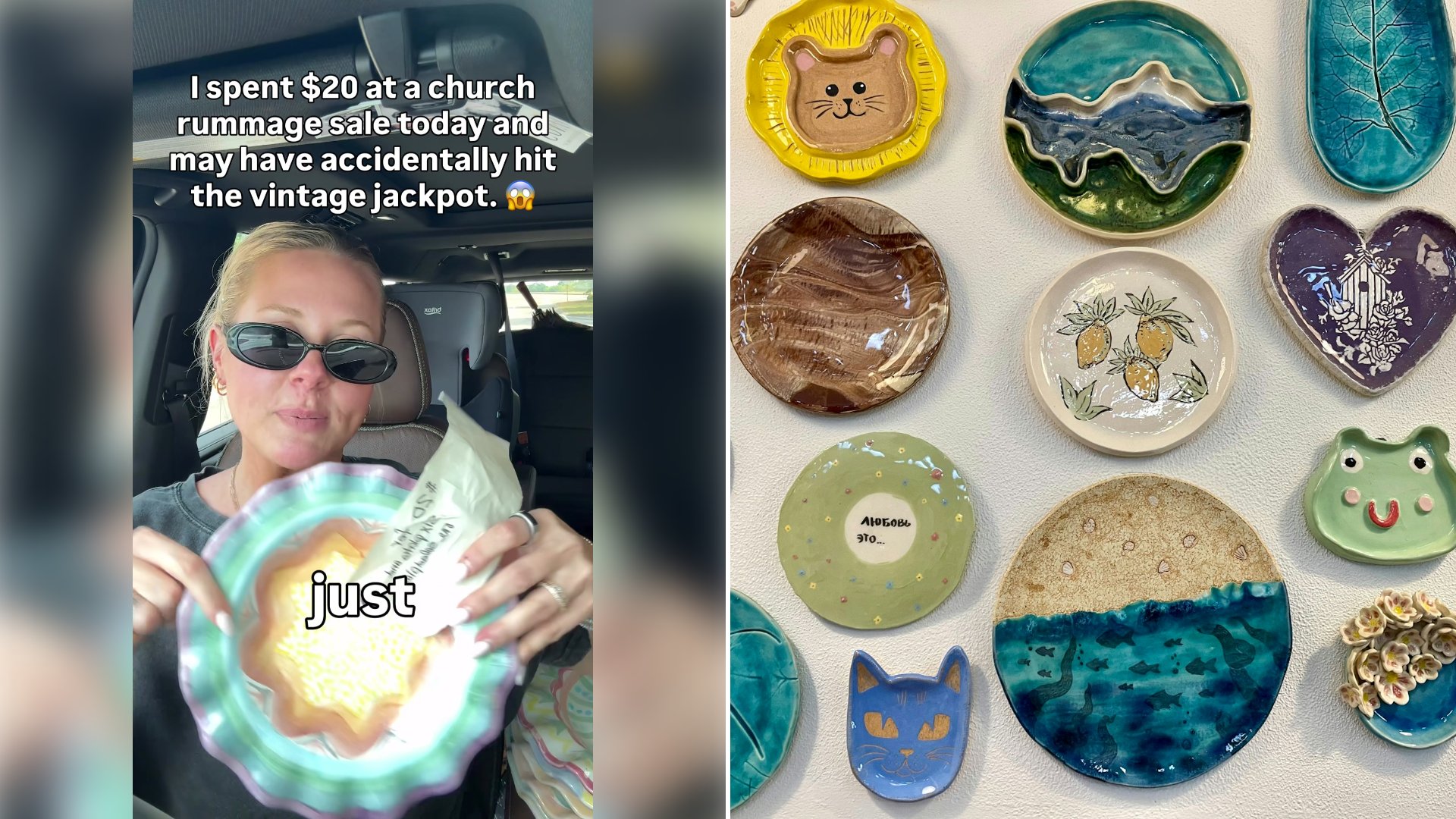
She is filming from the driver’s seat in the elementary school pickup line, sunglasses on, a stack of ruffled, hand painted plates beside her. “I just paid $20 for a stack of plates at a church rummage sale, and I think they might be worth over 1,000,” says the mom behind @musiccitymom. The text on screen puts it more simply: “I spent $20 at a church rummage sale today and may have accidentally hit the vintage jackpot.” She explains that she “quite literally cannot wait” until she gets home to show them.
The sale itself, she says, was the kind she describes as an estate sale, a garage sale and “your grandmother’s basement all combined into one giant room.” Walking through it, she spotted “this stack of seven plates,” and her first reaction was not that she had struck gold but that “someone’s eccentric, rich aunt definitely owned these.”
The mark on the back
Then she flipped one over. The back, she says, reads “Victoria and Richard MacKenzie-Childs, Ltd, 1988.” Her reaction: “Excuse me?” She calls them “original, vintage, hand painted” ceramic plates from 1988, “which just so happens to be the year I was born,” and places them in the company’s early years, “before the black and white courtly check pattern became the thing we all immediately associate with” the brand.
What she holds up to the camera backs up the “every single one is different” line. One has a green ring around a center of tiny painted tulips. Another has a yellow lattice center ringed with grey scallops and small red flowers. A third has a blue and white grid in the middle inside a yellow zigzag band. She calls them “basically like tiny pieces of art,” pointing out the scalloped edges and the colors.
The $200 search result
Then she started searching “because I need to know exactly what I’m holding.” What she found, she says, were “individual vintage plates from this era listed for approximately $200 a piece each.” Her math follows: seven plates for $20. Those are listings she found, not an appraisal, and the “over 1,000” in her opening line is her own estimate from them.
That leaves her with what she calls a new problem. She bought them thinking she could resell them, “But now that they’re mine, I don’t know if I can.” She runs through the options out loud: sell to “some hardcore vintage MacKenzie-Childs collector who understands what these are,” hang all seven on her wall, or “eat dinner off of potentially 200 dollar vintage plates every night.” For now, she jokes, they are buckled into the passenger seat while she waits for her children.
Her closing line is the case for digging through church sales: “every once in a while, the twenty dollar stack of plates is not just a twenty dollar stack of plates.”
Before you eat off vintage painted plates
The third option is the one to think through. MacKenzie-Childs’ own care and use page says its ceramics meet FDA and California standards for lead and cadmium release, and that it does not recommend using pieces that are “cracked or chipped.” That statement is about the company’s ceramics as sold today; it does not tell you how a 1988 plate has worn.
The FDA’s guidance on traditional lead glazed pottery lists “antique” pieces among the types to watch, and notes that bright orange, red and yellow decoration can be a flag “as lead is often used with these pigments.” It says home swab kits are sold in hardware stores and online, that a positive result means the agency “strongly advises against using the pottery for cooking, serving, or storing food or drinks,” and that “no amount of washing, boiling, or other process can remove lead from pottery.” For pieces of unknown safety, the FDA’s advice is to consider not using them for food at all.
The same MacKenzie-Childs page says Courtly Check and any pattern with lustre, decals or special embellishments must be washed by hand, and should not go in the microwave, oven or freezer.
If you find a stack like this
Flip every piece, as she did, and photograph each backstamp. Hers names the makers and the year; that line is what took her from “interesting” to a search.
Count and compare. She stresses that all seven are different, so photograph each front too; buyers of hand painted pieces want to see the exact design they are paying for.
Search sold results, not just listings. Her $200 figure comes from listed prices, and asking prices are not what a plate actually sold for.
Check rims and centers for chips, cracks and wear before you decide whether they are for the wall or the table, since the maker itself says not to use chipped pieces.
If you want to eat off them, test first and hand wash only. If you would rather not take the chance, the wall is the safe choice for all seven.
More from Vinyl and Velvet
- Woman Shined a Simple UV Flashlight on Her Grandmother’s Old Dinner Plates Just to Test Them, and What Actually Lit Up Changed Everything
- Thrift Shopper Discovers a Complete Set of Vintage Spode Christmas Dinnerware as the Thrift Store Shelf Was Quietly Hiding a Complete Holiday Treasure
- 9 Things Sellers Commonly Price Too Low at Garage Sales

Leave a Reply