

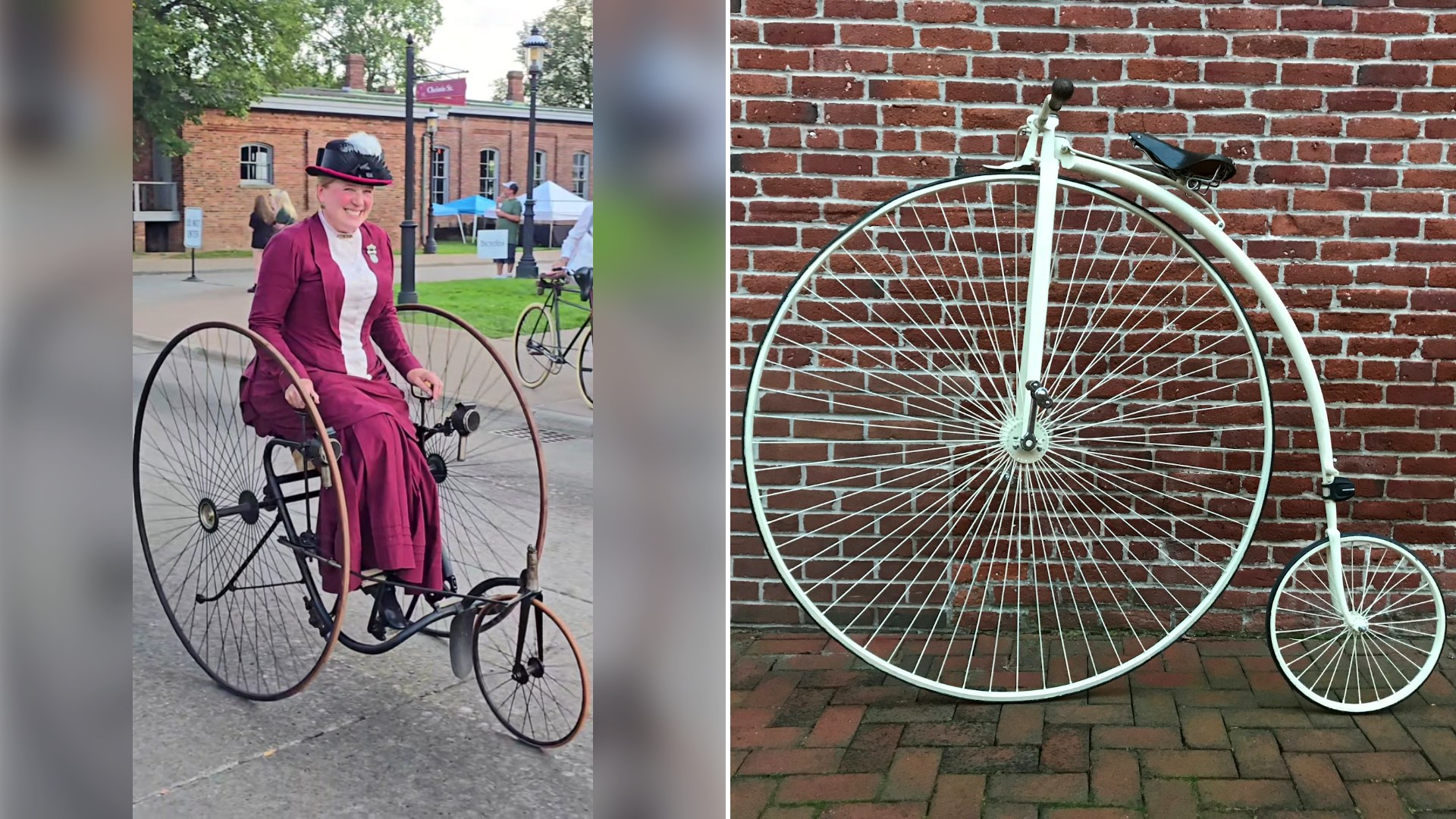
Long before the automobile transformed personal transportation forever, inventors experimented with some genuinely striking contraptions, and creator @caseyfaitel captures one in glorious motion in a recent TikTok video, riding an antique Victorian high-wheel tricycle around a classic car festival at Greenfield Village. The sight of this elegant, oversized relic weaving among far more modern vintage automobiles makes for a genuinely delightful collision of eras.
High-wheel tricycles emerged during the Victorian era as one of several experimental personal transportation designs that flourished before the modern bicycle and automobile settled into their now-familiar forms. Unlike the more commonly remembered high-wheel bicycle, or “penny-farthing,” with its precarious single large front wheel, the tricycle variant offered considerably more stability, making it a popular choice for riders, particularly women in long skirts, who found the two-wheeled alternative impractical or outright dangerous given the fashion and social norms of the era.
Greenfield Village, part of The Henry Ford museum complex in Dearborn, Michigan, provides an especially fitting backdrop for a vehicle like this one, given the institution’s dedicated mission of preserving and showcasing American innovation across the full sweep of transportation history, from pre-automotive contraptions through the earliest automobiles and beyond. Classic car festivals held at venues like this one increasingly make room for exactly this kind of pre-automotive vehicle, recognizing that the story of personal transportation innovation extends well beyond the car itself.
What makes watching a high-wheel tricycle in actual motion so captivating is the genuine mechanical and physical novelty on display. These vehicles required real skill and balance to operate safely, with their elevated seating position and specific pedaling mechanism creating a riding experience entirely different from anything a modern cyclist would recognize. Seeing one actually ridden competently, rather than simply displayed static in a museum exhibit, offers a far more visceral sense of how genuinely challenging and specialized operating this kind of Victorian-era vehicle actually was.
This kind of pre-automotive vehicle occupies a fascinating historical position, representing an era of genuine experimentation in personal transportation before internal combustion engines and standardized bicycle designs converged into the forms we recognize today. High-wheel tricycles, along with numerous other short-lived Victorian transportation innovations, illustrate just how much genuine trial and error went into solving the basic problem of individual human-powered mobility before modern engineering settled on more efficient, standardized solutions.
Collectors and restorers of pre-automotive vehicles like this one occupy a genuinely specialized niche within the broader antique vehicle collecting world, facing unique challenges around sourcing historically accurate parts, understanding period-correct construction techniques, and safely operating machinery that predates modern engineering safety standards by well over a century. A functioning, rideable high-wheel tricycle represents a genuinely impressive restoration and preservation achievement, requiring expertise considerably different from the skills needed to maintain a classic automobile.
There’s also something genuinely charming about the visual juxtaposition this video creates, placing a Victorian-era vehicle directly alongside classic automobiles from the twentieth century at the same event. That contrast visually illustrates just how dramatically personal transportation evolved across a relatively compressed historical timeframe, offering viewers an immediate, tangible sense of technological progress that a written historical timeline could never convey quite as vividly or directly.
It’s also worth noting how content showcasing genuinely obscure pre-automotive transportation serves an important educational and preservation function, introducing audiences to a chapter of transportation history that receives far less popular attention than either classic cars or standard vintage bicycles, despite representing a genuinely fascinating and formative period of mechanical innovation.
Ultimately, @caseyfaitel’s lap around the festival grounds succeeds because it treats a genuinely obscure piece of transportation history with the same enthusiasm and respect typically reserved for classic cars, inviting viewers to appreciate an entire overlooked chapter of mechanical ingenuity. Sometimes the most interesting vehicle at a classic car show isn’t a car at all — it’s the thing that came before cars existed in the first place.

Leave a Reply