

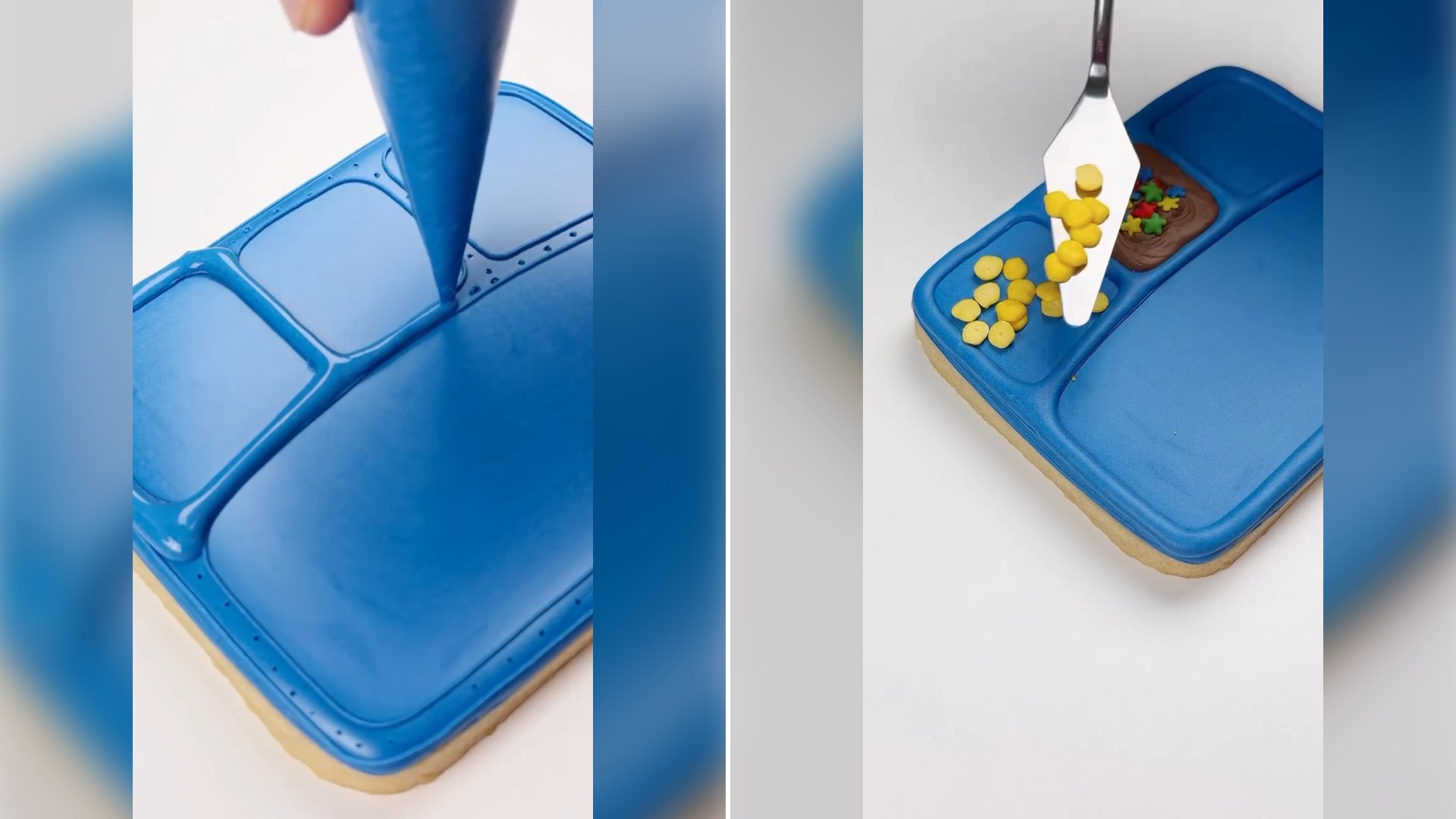
Food nostalgia has a way of hitting harder than almost any other category, and creator @hanamade.cookies proves it with a recent Instagram reel that recreates a childhood Kid Cuisine frozen dinner tray — compartments and all — entirely out of decorated sugar cookie. Every tiny compartment, every miniature “food” item, is rendered in painstaking edible detail, transforming a once-ordinary freezer aisle staple into a genuine piece of culinary art.
Kid Cuisine, along with competitors like Swanson’s kids’ meals, occupied a very particular place in late-1990s and 2000s childhood: the frozen dinner that felt like a special occasion rather than an everyday meal, usually reserved for nights when a parent needed a quick, kid-approved dinner solution. The segmented tray itself — a main dish, a side, a dessert brownie, sometimes a tiny treat compartment — became as iconic as the food within it, instantly recognizable to anyone who grew up peeling back that thin plastic film after the microwave beeped.
What makes this cookie recreation so impressive from a craft perspective is the sheer technical difficulty of translating a three-dimensional, compartmentalized object into a flat, edible medium. Sugar cookie decorating at this level requires careful planning around multiple layers of royal icing, precise color matching, and an almost architectural approach to structure — recreating the illusion of depth and separate compartments on what is, fundamentally, a single flat surface. It’s a discipline that sits at the intersection of baking, visual art, and nostalgic product design replication.
Food nostalgia content like this has become an enormously popular subcategory within the broader nostalgia internet, and for good reason — taste and smell are among the most powerful triggers for autobiographical memory, and even a visual recreation of a specific food product can summon an intensely vivid recollection. Seeing a meticulously rendered Kid Cuisine tray doesn’t just remind viewers of a product; it conjures the specific feeling of a particular kind of evening, a specific kitchen, a specific period of childhood when a frozen dinner felt like an event.
There’s also an interesting layer of brand archaeology happening in content like this, since many of the specific frozen meal brands and products that defined 1990s and 2000s childhoods have since been discontinued, reformulated, or rebranded entirely. Kid Cuisine itself has gone through various packaging redesigns and menu changes over the decades, meaning a cookie recreation of a specific era’s tray design functions almost like a historical reconstruction, preserving visual details that the actual product itself may no longer even replicate.
This genre of nostalgic baking — recreating recognizable consumer products, snack packaging, or childhood meals in cake or cookie form — has flourished across baking-focused social media for years, with creators tackling everything from cereal boxes to fast food meals to, in this case, frozen dinner trays. Part of the appeal for viewers is the dual payoff: genuine admiration for the technical baking skill on display, combined with the immediate, almost involuntary nostalgia hit of recognizing the specific product being honored.
It’s worth noting, too, how this kind of content bridges generational gaps in a way that’s relatively rare online. Older viewers who remember the original product get the full nostalgic payoff, while younger viewers who may have grown up with different frozen meal brands can still appreciate the craftsmanship and specificity of the recreation, even without the personal memory attached. That crossover appeal — skill admiration plus generational recognition — is part of why food-nostalgia content performs so consistently well.
There’s also something quietly poignant about elevating a product that was, by design, inexpensive and utilitarian into a piece of fine decorative baking. Kid Cuisine trays were never meant to be beautiful — they were meant to be convenient, affordable, and kid-friendly — yet recreating one with this level of care implicitly argues that even the most mundane, mass-produced objects of childhood deserve to be remembered and honored, simply because they mattered to the people who grew up with them.
In the end, @hanamade.cookies’s edible recreation works because it understands that nostalgia doesn’t require grandeur to be effective. A frozen dinner tray is about as unglamorous a childhood artifact as exists, yet rendered carefully in sugar and icing, it becomes something genuinely moving — a small, sweet monument to the specific, unremarkable evenings that somehow end up forming the backbone of so many people’s fondest childhood memories.

Leave a Reply