

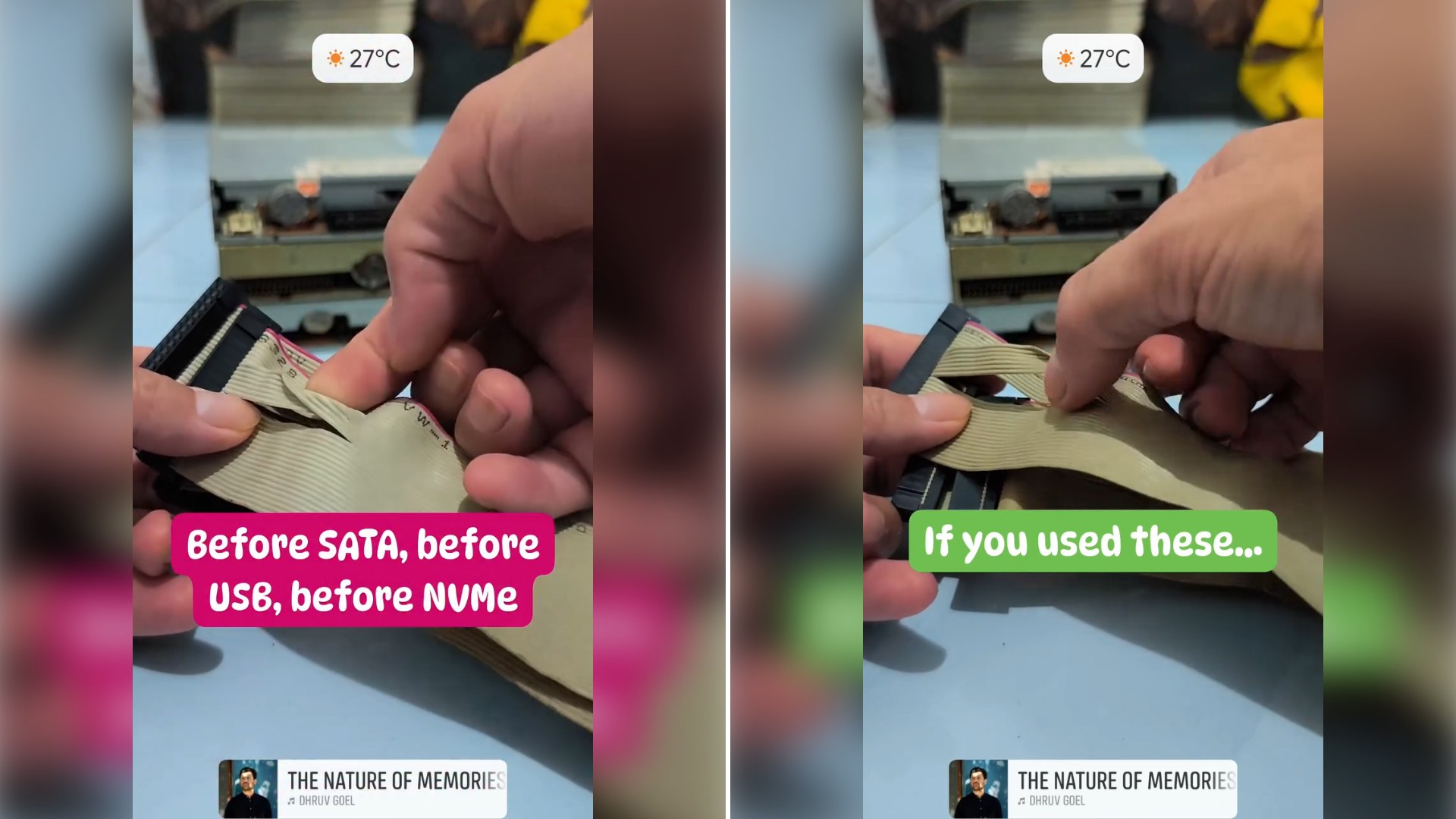
Not every piece of nostalgia is pretty, and creator @khairul_harris leans fully into that truth in a recent Instagram reel centered on, of all things, an old IDE ribbon cable. The video shows the flat, gray, multi-wire cable — once an absolutely essential component inside nearly every desktop computer — being pulled apart and examined, triggering a wave of recognition from anyone who ever built, repaired, or upgraded a PC in the late 1990s or early 2000s.
For anyone who didn’t grow up elbow-deep in computer cases, it’s worth explaining just how central the IDE ribbon cable was to desktop computing for roughly two decades. These wide, flat cables connected hard drives, CD-ROM drives, and other internal components to a computer’s motherboard, and their sheer physical bulk inside a case became almost a running joke among PC builders — they blocked airflow, tangled with other components, and turned even simple hardware swaps into an exercise in cable management frustration long before cable management became a design priority for case manufacturers.
What makes this particular object such effective nostalgia bait is that it represents a very specific and very relatable kind of frustration — not the warm, soft nostalgia of a favorite toy or TV show, but the sharper, more specific nostalgia of a technical headache that an entire generation of hobbyist PC builders and IT-adjacent tinkerers shares. Anyone who’s ever misaligned the cable’s connector pins, struggled to identify which end was “pin 1,” or dealt with a drive that refused to be recognized because of a loose ribbon connection will feel a genuine physical memory of frustration resurface instantly.
This kind of hardware nostalgia occupies a slightly different emotional register than most vintage tech content, which tends to celebrate objects for their design elegance or cultural significance. The IDE cable, by contrast, was never beloved — it was tolerated, worked around, and eventually celebrated specifically for its disappearance, once SATA cables arrived in the mid-2000s with their slim, easy-to-route design. That makes content revisiting the IDE cable almost an act of retroactive appreciation, the kind of grudging nostalgia reserved for something annoying that nonetheless shaped an entire era of hands-on computing.
There’s also something genuinely educational buried inside the nostalgia here, particularly for younger viewers who have only ever known solid-state drives and cable-free internal storage. Seeing the sheer physical scale of old data cables, and understanding how much more mechanically involved early-2000s computer assembly was compared to today’s largely tool-free, modular builds, offers a tangible sense of how quickly computing hardware has evolved — not just in processing power, but in basic physical design and usability.
The broader retro computing community has embraced exactly this kind of unglamorous hardware nostalgia for years, with dedicated forums and YouTube channels devoted to restoring vintage PCs, sourcing period-correct components, and documenting the specific technical quirks of now-obsolete standards. IDE cables, despite their clunkiness, remain essential to keeping these restoration projects authentic, which means they occupy a strange dual status: simultaneously annoying relics and necessary artifacts for anyone trying to preserve computing history accurately.
It’s also worth noting how content like this connects to a broader internet fascination with “things that used to be everywhere and are now gone,” a genre that spans everything from discontinued snack foods to obsolete phone chargers. The IDE cable fits neatly into that category: a component that nearly everyone who used a computer during a specific era interacted with constantly, yet one that younger generations may never encounter in physical form at all, having grown up entirely within an era of sealed laptops and cloud storage.
There’s a certain comedic honesty, too, in choosing to memorialize something so famously inconvenient. Much of nostalgia culture risks tipping into uncritical rose-tinted sentimentality, but content that specifically highlights the annoying, clunky, or outright frustrating aspects of old technology offers a more balanced and ultimately more relatable form of reminiscence — one that acknowledges progress had real benefits, even while still finding genuine affection for the imperfect tools that came before it.
In the end, a video built around something as humble as a ribbon cable succeeds precisely because it trusts its audience to find meaning in the mundane. Not every piece of nostalgia needs to be a beloved toy or a cherished family heirloom; sometimes it’s enough to remember, with a mix of fondness and mild exasperation, exactly how much harder a simple hard drive swap used to be — and to appreciate, just a little, how far computer hardware has come since then.

Leave a Reply