

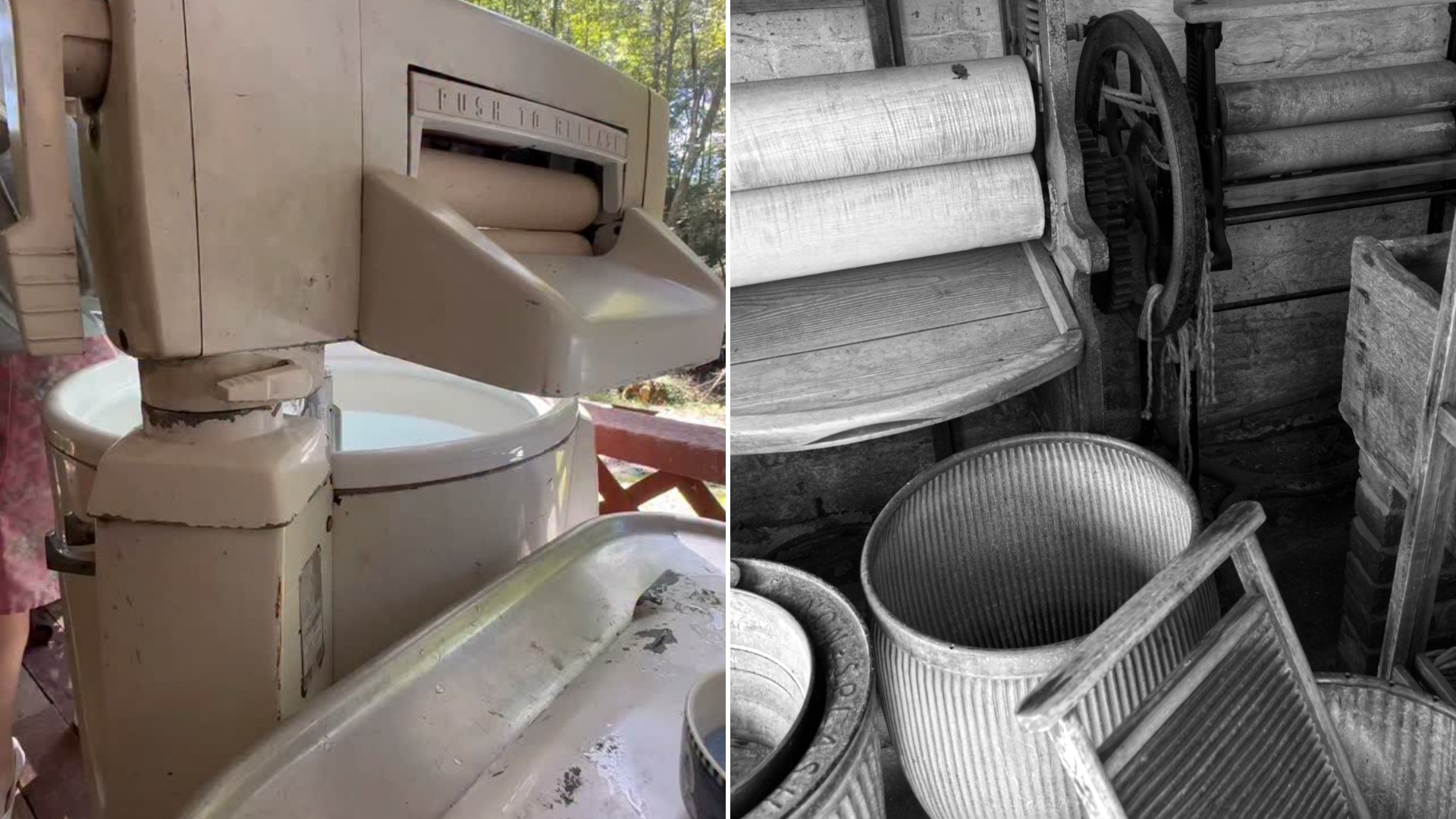
Few pieces of vintage home technology are as instantly recognizable, or as mechanically fascinating, as the wringer washing machine, and creator @mudcreekmemories gives one a proper demonstration in a recent Instagram reel. The video shows the old machine running, its rollers squeezing water from freshly washed laundry exactly as they would have for a homemaker decades ago, framed as a cheerful bit of proof that old technology can still hold its own against modern convenience.
Wringer washing machines dominated American households from roughly the 1910s through the 1960s, representing a massive leap forward from hand-scrubbing laundry on a washboard. The design is elegantly simple: an agitating tub does the washing, and a set of spring-loaded rubber rollers mounted above it squeezes excess water out of each item as it’s fed through by hand, replacing the backbreaking labor of manually wringing out heavy, waterlogged fabric. For anyone who grew up using one, or whose parents or grandparents did, the specific sound and motion of those rollers is instantly, viscerally familiar.
What makes this kind of demonstration so compelling to a modern audience is the stark contrast with today’s fully automated washing machines, which require nothing more than loading clothes, adding detergent, and pressing a button. The wringer machine, by comparison, demanded active, continuous participation — someone had to physically feed each item through the rollers, watch for buttons or zippers that might jam the mechanism, and stay present throughout the entire cycle rather than walking away. That hands-on involvement, often framed today as inconvenient, carries its own kind of appeal for viewers drawn to tangible, process-oriented tasks.
There’s also a genuine durability story embedded in content like this that resonates strongly with audiences skeptical of modern planned obsolescence. A wringer washer built in the 1940s or 1950s that still runs today, decades after its original owner likely passed it down or it was rescued from a barn or basement, stands as a quiet rebuke to appliances engineered to fail just past their warranty period. Vintage appliance enthusiasts frequently point to this exact kind of longevity as evidence that “they don’t make them like they used to” isn’t just a cliché but a demonstrable, mechanical fact.
This fascination with vintage home appliances fits into a broader pattern across nostalgia and vintage collecting communities, where functional old technology is prized not just for its aesthetic charm but for its continued usefulness. Unlike a purely decorative antique, a working wringer washer demonstrates something actively impressive: that mechanical engineering from nearly a century ago can still perform its original function competently, often with fewer components and failure points than its modern electronic counterparts.
It’s also worth considering the generational knowledge transfer happening in a video like this one. Operating a wringer washer safely requires specific technique — knowing how to feed fabric through evenly, understanding the real danger the rollers pose to fingers and loose clothing, and managing the whole multi-step process of washing, wringing, rinsing, and wringing again. That knowledge, once universal among homemakers, has largely disappeared from common use, making demonstrations like this a small but genuine act of preservation for a domestic skill set that modern convenience has rendered nearly obsolete.
The appliance also carries significant social history weight, having played a central role in the daily domestic labor that defined women’s work for much of the twentieth century. Laundry day was once a genuinely laborious, often all-day affair built entirely around machines like this one, and watching it function serves as a quiet reminder of how dramatically household labor, and the time it demanded, has shifted over the past several generations.
For collectors of vintage home goods, wringer washers occupy an interesting niche: they’re large, heavy, and impractical to display purely decoratively, which means the ones that survive tend to be kept specifically because someone wanted to preserve a functioning piece of history rather than simply an attractive object. That distinction — function over form — sets appliance collecting apart somewhat from more purely aesthetic vintage collecting categories.
Ultimately, videos like this one succeed because they offer something increasingly rare: genuine, demonstrable proof rather than just nostalgic assertion. It’s one thing to say that older appliances were built to last; it’s another to watch one still doing exactly what it was designed to do, decades after it rolled off an assembly line. That tangible evidence, more than any amount of sentimental narration, is what makes @mudcreekmemories’s wringer washer demonstration so quietly persuasive.

Leave a Reply