

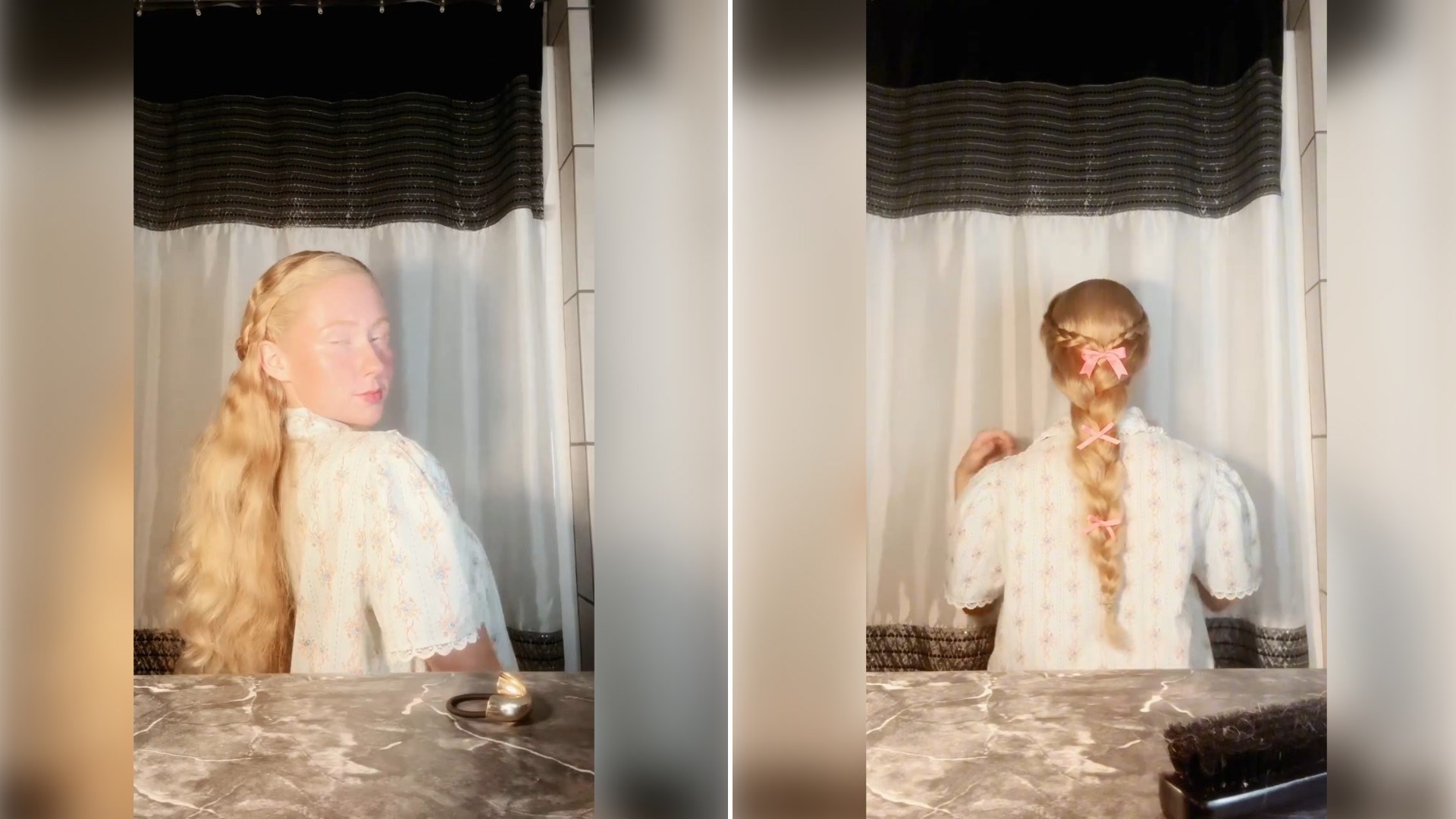
Toy-inspired beauty challenges tend to look easy right up until someone actually attempts them, and @iautumngrace takes on exactly that challenge after coming across a viral post highlighting a specific vintage Barbie doll’s hairstyle. Rather than simply admiring the look, she sets out to recreate it strand by strand on her own hair, walking through the intricate braiding and styling process required to match the reference as closely as possible.
The result is as much a demonstration of patience as it is a styling showcase, since matching a doll’s sculpted hairstyle on real human hair requires working through details a mass-produced toy never had to account for. Beyond the technical challenge, the creator makes a point of framing the finished look as genuinely inclusive, insisting the style works on any hair texture rather than being limited to the specific hair type most associated with vintage Barbie dolls historically.
Vintage Barbie hairstyles have become a recurring source of inspiration within nostalgic beauty and styling content, offering a specific, recognizable aesthetic tied directly to a toy line most viewers grew up with in some form. Recreating a doll’s hairstyle on real hair bridges toy nostalgia and beauty content in a way that appeals to both communities at once, giving each a reason to engage with a video that technically belongs to neither category exclusively.
The inclusivity angle adds a meaningful layer on top of the styling challenge itself, pushing back against the narrower assumptions often baked into vintage toy design and gently updating a nostalgic reference for a broader, more diverse audience of stylists and fans.
There is a specific kind of technical translation happening in a recreation like this one that deserves real credit. A doll’s hairstyle is sculpted or styled directly into synthetic fiber that holds a shape permanently, with none of the movement, weight distribution, or natural variation that real hair brings to the same style. Successfully translating that fixed, idealized reference onto living, moving hair, section by section, is a genuinely demanding styling skill, closer to freehand sculpture than to following a simple tutorial.
Vintage Barbie dolls specifically have accumulated a devoted following among both toy collectors and beauty creators precisely because so many individual releases had distinct, carefully designed hairstyles meant to be part of that specific doll’s identity. A viral post spotlighting one particular style out of decades of releases speaks to just how much design variety exists within the line, more than enough source material to keep this kind of recreation challenge going indefinitely.
The strand-by-strand approach taken here also reflects a broader trend in beauty content generally, toward process transparency rather than simply showcasing a finished result. Viewers increasingly want to see the actual labor behind a styling achievement, not just the polished end product, and a slow, deliberate build like this one rewards exactly that kind of patience from both the creator and the audience watching along.
It is also worth noting how toy-to-human beauty recreations fit into a much longer tradition of doll culture inspiring real-world fashion and styling choices, one that long predates social media. What has changed is mainly the visibility of that process, since a styling challenge like this one used to happen privately in a bedroom mirror and now gets documented, shared, and appreciated by an audience far larger than any one doll’s original fans.
There is also something worth appreciating about how this kind of recreation invites viewers to look at a familiar toy with genuinely fresh eyes. Most people who grew up around Barbie dolls never studied a specific hairstyle closely enough to imagine replicating it themselves, and a video like this one effectively re-introduces the toy as a legitimate source of styling inspiration rather than simply a nostalgic object to be glanced at and set aside.
The braiding and sectioning techniques demonstrated along the way also carry real, transferable value beyond this one specific style, since the underlying skills, precise parting, tension control, working in small controlled sections, apply just as well to countless other intricate hairstyles a viewer might want to attempt afterward. In that sense, a challenge built around nostalgia doubles as a genuine styling tutorial for anyone paying close attention to the technique rather than just the finished look.
There is also a quieter point worth making about how toy design itself has evolved in response to exactly this kind of feedback over the years, with manufacturers gradually expanding the range of hair textures and styles represented across a doll line in ways earlier generations of the same toy never attempted. A recreation like this one, explicitly framed as working for any hair texture, sits comfortably alongside that broader industry shift, updating a nostalgic reference without abandoning what made it appealing in the first place.
It is also worth noting the specific appeal of watching a challenge like this one unfold in close to real time rather than through a heavily compressed highlight reel. Seeing the actual sectioning, redoing, and adjusting that a genuinely intricate style requires gives viewers an honest sense of the time investment involved, which makes the finished result land as a real accomplishment rather than an effortless transformation conjured purely through editing tricks.
For anyone inspired to try a similar recreation, the takeaway from a video like this one is encouraging: a well-loved vintage look does not have to stay locked to its original, narrow presentation, and the most interesting versions are often the ones that prove a classic style can genuinely work for anyone willing to put in the time.

Leave a Reply